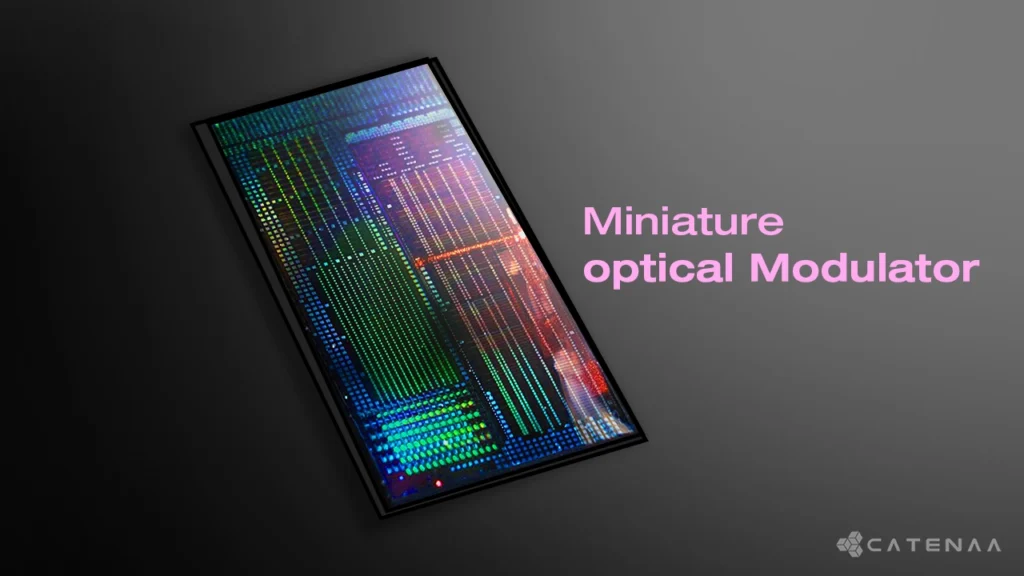


Catenaa, Saturday, December 20, 2025- Researchers at the University of Colorado Boulder have developed an optical phase modulator nearly 100 times thinner than a human hair, offering a pathway to larger, more practical quantum computers.
The device, reported in Nature Communications, allows precise control of laser frequencies needed to operate thousands or millions of qubits.
It achieves this using microwave-frequency vibrations that oscillate billions of times per second, generating stable and efficient laser signals for quantum computing, sensing, and networking.
Unlike conventional bulky tabletop modulators, the new device is fabricated using scalable CMOS manufacturing methods, the same technology behind computer and smartphone processors.
This enables mass production, reduces power consumption, and shrinks heat output, allowing dense integration of thousands of optical channels on a single chip.
The research team, led by Jake Freedman and Professor Matt Eichenfield, in collaboration with Sandia National Laboratories, said the modulator uses roughly 80 times less microwave power than commercial alternatives.
The device is designed to replace hand-assembled, space-consuming equipment that cannot scale to the tens or hundreds of thousands of channels needed for future quantum systems.
The team is now developing fully integrated photonic circuits combining frequency generation, filtering, and pulse shaping on the same chip.
Upcoming trials with quantum computing companies will test the technology in trapped-atom and trapped-neutral-atom systems.
Researchers say the development brings them closer to a scalable photonic platform capable of managing very large numbers of qubits, a critical step toward practical, large-scale quantum computing.