
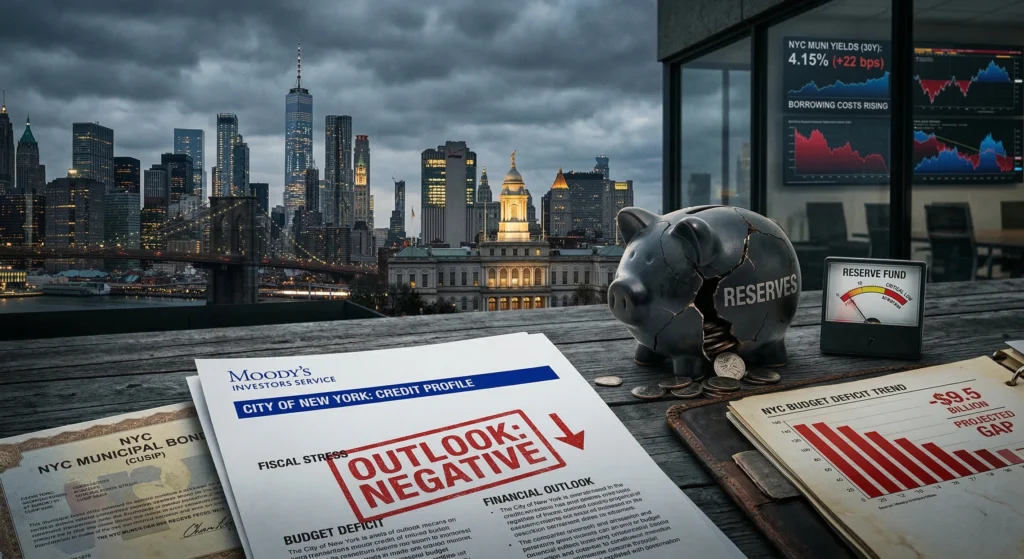
March 13, 2026 – The rating agency cited persistent structural deficits and declining fiscal flexibility as the city faces a projected $5.8 billion shortfall.
Moody’s Ratings revised New York City’s credit outlook to negative on March 11, 2026. The agency maintained the city’s Aa2 issuer rating. That grade ranks third-highest among investment grades. However, the shift in outlook signals mounting concern. Analysts pointed to widening budget gaps that exceed prior forecasts.
What Triggered the Outlook Change?
Moody’s analysts highlighted what they called structural budget imbalances. Updated city spending projections revealed larger multi-year deficits than expected. Mayor Zohran Mamdani’s administration has warned of a $5.8 billion deficit. Operating expenses are projected to surpass revenue by $4.53 billion in fiscal 2026. The Comptroller’s office confirmed this gap in its preliminary budget analysis.
The city’s proposed $127 billion fiscal year 2027 budget relies heavily on one-time measures. It draws roughly $980 million from the Rainy Day Fund. Another $229 million comes from the Retiree Health Benefits Trust. These drawdowns could reduce the city’s ability to weather future downturns. Moody’s warned that reserves have declined nearly 50% under the current plan.
Budget Strategies Under Debate
Mayor Mamdani has proposed two paths to close the deficit. The first option raises income taxes on residents earning above $1 million. The second increases the city’s property tax rate to 9.5%. Mamdani has described the property tax hike as a last resort. Governor Kathy Hochul has repeatedly rejected new tax increases on the wealthy.
State lawmakers have shown partial support for the mayor’s tax proposals. Both the Senate and Assembly budgets include corporate and income tax hikes. Meanwhile, the City Council identified $1.7 billion in potential savings for fiscal 2026. A final budget must be passed by July 1, when the new fiscal year begins.
Market and Credit Implications
A negative outlook often precedes a potential credit rating downgrade. Such a downgrade would increase the city’s borrowing costs. Higher costs would strain funding for infrastructure and essential services. This is the first negative outlook since the COVID-19 pandemic.
City Comptroller Mark Levine called the decision a “sobering wake-up call.” He stressed the need for realistic revenue projections and sustainable spending. City Hall spokesperson Dora Pekec called the outlook revision premature. She cited state legislative proposals that could deliver $5 billion in additional city funding.
Moody’s noted it could downgrade the rating further. That risk grows if budget gaps approach 10% of city fund revenue. Conversely, maintaining balanced budgets could stabilise the outlook. Rebuilding reserves would also support a return to a stable rating.
Sources
1. Moody’s Ratings – New York City Outlook Report, March 11, 2026
2. NYC Comptroller’s Office – Statement on Moody’s Outlook Revision (comptroller.nyc.gov)
3. NYC Comptroller – Comments on Preliminary Budget FY 2027 (comptroller.nyc.gov)
4. The Bond Buyer – “Moody’s Lowers New York City’s Rating Outlook to Negative,” March 11, 2026
5. New York Focus – “State Legislature Backs Tax Hikes on Wealthy,” March 10, 2026
6. NYC City Council – Press Release on $1.7B Potential Savings, March 10, 2026