
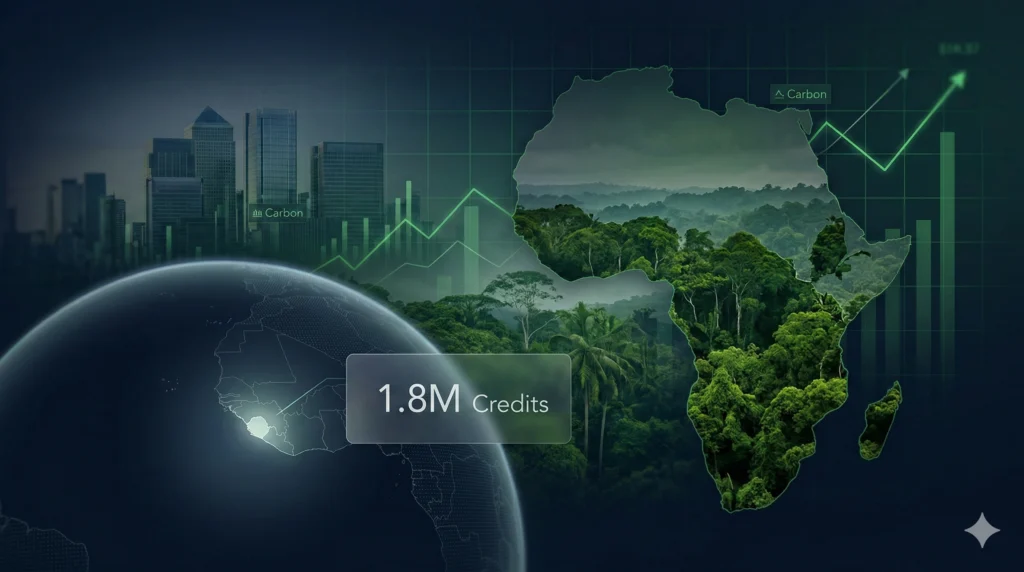
March 04, 2026 – Microsoft Corp. has signed a 15-year carbon credit agreement with Rainforest Builder, a tropical reforestation firm in West Africa. As a result, the deal will deliver up to 1.8 million carbon removal credits. Furthermore, it ranks among the largest single-project carbon removal contracts ever announced on the continent.
A Long-Term Bet on Reforestation
Under the agreement, Rainforest Builder’s Project Buffalo will restore 15,000 hectares of degraded land in Sierra Leone. Specifically, the initiative targets the Upper Guinean Forest, a biodiversity hotspot that has lost over 90% of its original cover.
Importantly, this is not a short-term offset arrangement. Instead, the 15-year structure gives Rainforest Builder long-term revenue certainty. Consequently, that stability supports workforce growth, monitoring, and community development. So far, the project directly employs 1,200 people.
Microsoft’s Carbon Negative Strategy Gains Momentum
Above all, the agreement aligns with Microsoft’s goal of becoming carbon negative by 2030. Since 2020, the company has shifted toward verified carbon dioxide removal. Moreover, in fiscal year 2024, Microsoft signed removal deals covering 22 million metric tons. As a result, that volume exceeded the combined volume of all prior years.
Why Africa’s Carbon Market Matters
Although Africa accounts for just 3.9% of global emissions, it holds enormous carbon removal potential. For instance, industry projections suggest the continent’s credit market could reach $6 billion annually by 2030. Meanwhile, the Africa Carbon Markets Initiative has already secured over $1 billion in buyer commitments.
The Bigger Picture for Corporate Carbon Buyers
Overall, this deal signals a broader shift among corporate climate buyers. In particular, companies now favour long-term removal contracts over short-duration offsets. Therefore, Microsoft’s approach prioritises scientific oversight, biodiversity co-benefits, and community impact. As compliance frameworks like Article 6 of the Paris Agreement mature, analysts expect demand for high-integrity African credits to grow sharply.