

March 19, 2026 – Blockchain-based trade finance could slash settlement times and close India’s massive MSME credit gap. Analysts see 2026 as the tipping point.
Trade finance tokenisation is moving from the pilot stage to production in 2026. The global asset tokenisation market hit $2.08 trillion in 2025. Analysts project it will reach $18.74 trillion by 2031. That represents a compound annual growth rate (CAGR) of 44.25%.
India stands to benefit the most from this shift. The country’s trade finance market is valued at $2.72 billion in 2025. It is expected to grow to $4.09 billion by 2031. Tokenised invoices and letters of credit could accelerate this growth.
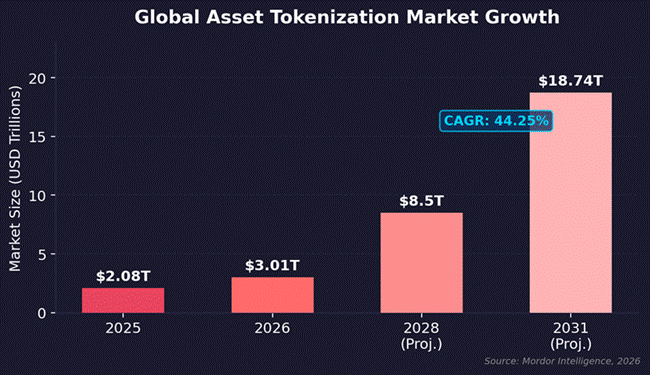
Figure 1: Global Asset Tokenisation Market Growth Trajectory
India’s MSME Credit Gap Demands Blockchain Solutions
India’s MSMEs contribute nearly 30% of GDP. They account for 46% of total exports. Yet only 20% of these enterprises access formal credit. The Reserve Bank of India estimates a credit gap of INR 20–25 trillion ($240–300 billion).
Delayed payments remain the core problem. Buyers often take 45–90 days to settle invoices. This locks billions in unpaid receivables. Tokenised invoices could cut settlement time to near real-time. Smart contracts would automate validation and payment triggers.
Figure 2: India Trade Finance Market & MSME Credit Access Gap
How Tokenised Trade Rails Work
An invoice token stores face value, due date, and payer identity. Letters of credit become programmable commitments. They execute automatically when shipment milestones are confirmed. These digital assets live on permissioned ledgers with cryptographic proofs.
Permissioned blockchains dominate institutional adoption. They held 50.6% of the market in 2025. Banks favour these networks for KYC compliance and audit control. Once tokenised, invoices can be sold to multiple financiers. Smart contracts prevent double-pledging and automate risk pricing.
Institutional Momentum Builds in 2026
Major financial institutions are accelerating tokenisation efforts. BlackRock’s tokenised fund attracted over $550 million within months. Standard Chartered forecasts $2 trillion in tokenised assets by 2028. Securitise plans to list on Nasdaq at a $1.25 billion valuation.
The tokenisation market is projected to reach $4.07 billion in 2026. BFSI dominates with a 26.13% end-user share. Asia-Pacific is the fastest-growing region, with a 53.75% CAGR. India’s regulatory stance on permissioned networks aligns with this trend.
What Investors Should Watch
Investors should track tokenised invoice volumes and DSO improvements. Bank-backed pilots and trade body endorsements signal credibility. Integration with India’s e-invoicing and TReDS platforms is critical. Platforms publishing uptime and finality metrics deserve closer attention.
The SEC’s innovation exemption launched in January 2026. The CFTC’s tokenised collateral framework is now operational. India’s data localisation and audit requirements favour permissioned models. Practical execution, not hype, will determine returns this year.
Key Market Metrics at a Glance
| Metric | Value |
| Global Asset Tokenization (2025) | $2.08 Trillion |
| Projected Market Size (2031) | $18.74 Trillion |
| CAGR (2026–2031) | 44.25% |
| India Trade Finance Market (2025) | $2.72 Billion |
| India MSME Credit Gap | INR 20–25 Trillion |
| MSME GDP Contribution | ~30% |
| Permissioned Chain Market Share | 50.6% |
| Asia-Pacific Growth (CAGR) | 53.75% |