

March 27, 2026 – The U.S. stablecoin market has entered a new regulatory era. With a landmark federal framework now in place, institutional adoption is accelerating fast.
In Summary
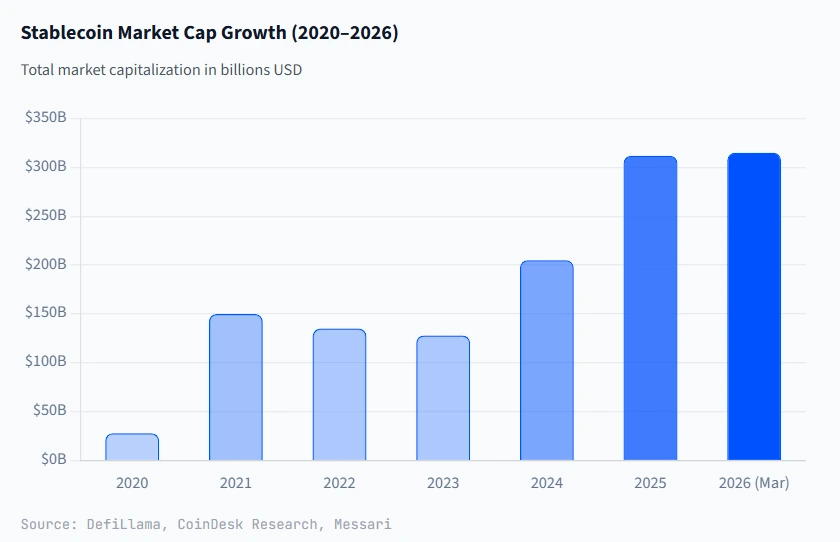
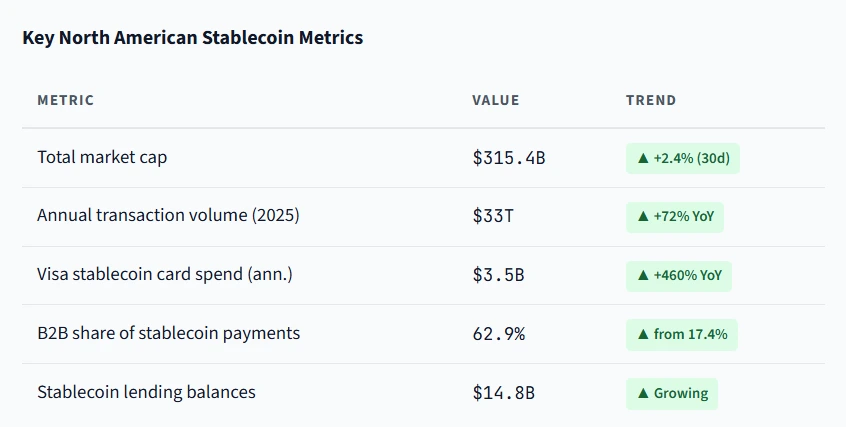
The global stablecoin market cap surpassed $315 billion in March 2026.
The GENIUS Act, signed in July 2025, created the first U.S. federal stablecoin framework.
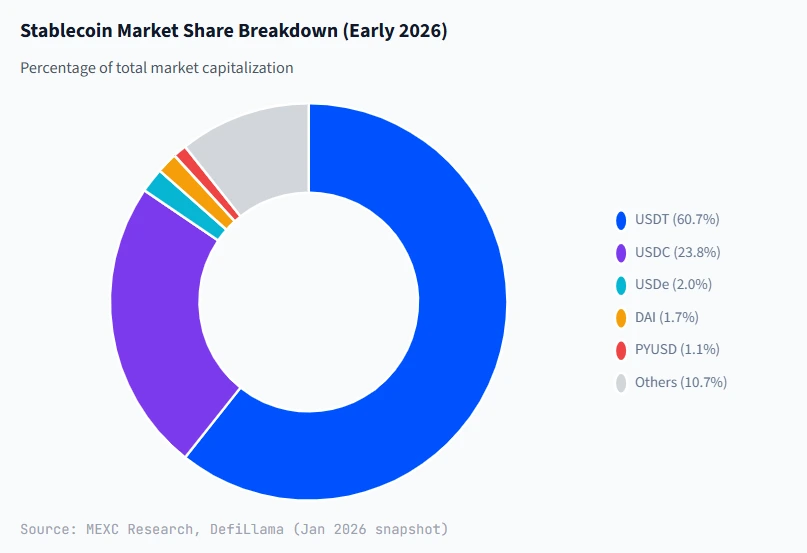
USDT controls over 60% of the market. USDC holds roughly 24%.
Citi projects the market could reach $1.9 trillion to $4 trillion by 2030.
Major U.S. banks are now exploring issuing their own stablecoins.
North America’s stablecoin market is booming. The total global market cap now exceeds $315 billion, according to DefiLlama data. That figure has grown by more than $100 billion in just 18 months.
The catalyst? Regulatory clarity. On July 18, 2025, President Trump signed the GENIUS Act into law. It became the first comprehensive federal stablecoin framework in U.S. history. The Senate passed it 68–30 with bipartisan support.
The law mandates 1:1 reserve backing for all payment stablecoins. Only regulated entities may issue them. Issuers must hold U.S. Treasuries or equivalent low-risk assets.
USDT and USDC Dominate the Field
Tether’s USDT remains the undisputed leader. It holds over 60% of the stablecoin market. Its supply surged to $182 billion by October 2025, growing by a third since January that year.
Circle’s USDC ranks second at roughly $75.7 billion. It grew about 78% year-over-year through 2025. USDC remains the preferred choice for institutional users seeking compliance.
Newer challengers are gaining traction too. Ethena’s synthetic dollar USDe reached $6.3 billion. PayPal’s PYUSD climbed to $3.6 billion. These numbers signal a broadening competitive landscape.
Institutional Adoption Is Accelerating
Wall Street is moving fast. Bank of America released a report calling this shift “multi-year.” It expects the OCC, FDIC, and Federal Reserve to issue stablecoin-specific rules under the GENIUS Act.
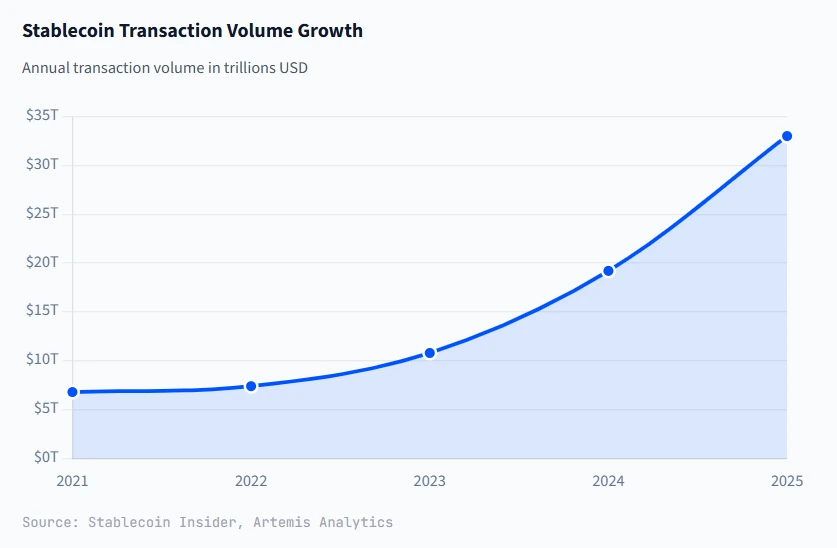
The numbers are striking. Stablecoin transaction volume hit $33 trillion in 2025. That represents a 72% increase from the prior year. Monthly B2B payments via stablecoins grew from 17.4% to 62.9% of total stablecoin payments.
Citi projects stablecoins to become a $1.9 trillion to $4 trillion market by 2030, with increasing use for payments and cross-border transfers.
Mastercard’s $1.8 billion acquisition of BVNK underscored the trend. Analysts called it a signal that stablecoins are moving from niche tools to core payment rails.
Visa’s stablecoin-linked card spending hit a $3.5 billion annualised rate. That marked 460% year-over-year growth by Q4 2025.
The GENIUS Act Changes Everything
The legislation brought clarity to a murky regulatory landscape. It explicitly excludes compliant stablecoins from the definitions of securities and commodities. The SEC and CFTC do not oversee them.
Instead, the OCC, FDIC, and Federal Reserve share jurisdiction. State-regulated issuers with outstanding supply below $10 billion can opt for state-level oversight. That dual framework was a key compromise.
The law also subjects issuers to the Bank Secrecy Act. Anti-money laundering and sanctions compliance are mandatory. Issuers must publish monthly reserve compositions audited by registered accounting firms.
The World Economic Forum noted that stablecoin transaction volumes already surpass Visa and Mastercard combined. Fewer than 10 major economies have adopted specific stablecoin legislation. That gives the U.S. a first-mover advantage.
What Comes Next
The FDIC is finalising rules for bank subsidiaries to issue stablecoins. Those rules must be ready by July 2026. They take effect January 2027. Major banks, including JPMorgan and Bank of America, are already exploring issuance.
Tether plans to launch USAT, a U.S.-compliant stablecoin, targeting 100 million Americans. It intends to compete directly with USDC on domestic soil.
The regulatory framework is set. Capital is flowing. North America’s stablecoin market is no longer an experiment. It is rapidly becoming core financial infrastructure.