
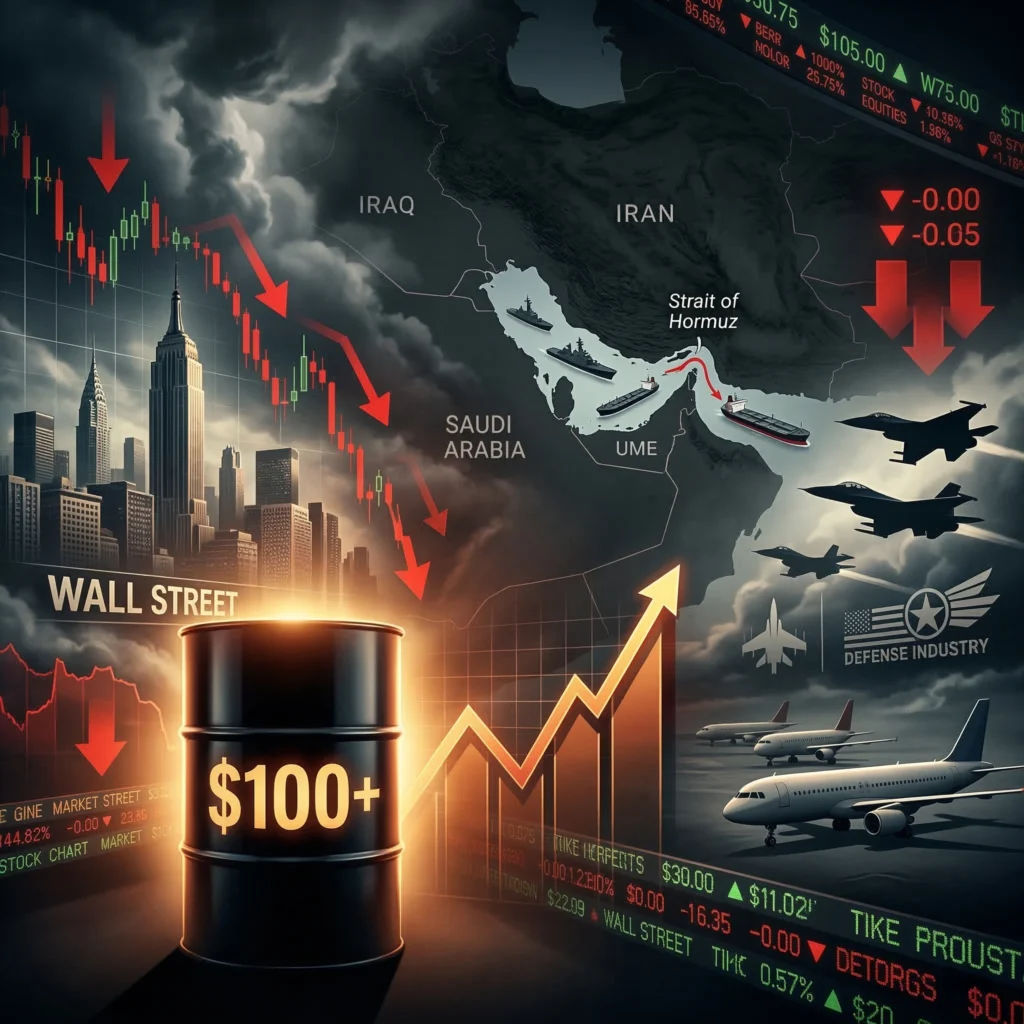
March 10, 2026 – The Dow lost 350 points on Monday. WTI crude posted its biggest weekly gain since futures trading began. Defense stocks rose while airlines and financials tumbled.
U.S. stocks fell sharply on Monday as crude oil surpassed $100 a barrel1. The move marked the first triple-digit price for crude oil since mid-2022. It intensified fears that rising energy costs could trigger stagflation. The Dow Jones Industrial Average dropped 350 points, or 0.7%. The S&P 500 declined 0.4%, while the Nasdaq Composite dipped 0.1%2.
Losses were far steeper earlier in the session. The Dow plunged nearly 900 points at its low. Both the S&P 500 and the Nasdaq fell as much as 1.5%. Semiconductor stocks helped the market recover from its worst levels. Broadcom rose over 3%. Micron Technology and AMD each gained about 2%.
Oil Prices Shatter the $100 Barrier
West Texas Intermediate crude climbed above $100 on Sunday. This was its first time above that level since Russia invaded Ukraine. WTI ended the prior week at $90.14, posting a 35% weekly gain. That marks the largest weekly surge since oil futures began trading in 19833. Brent crude hit a session high of $119.50 before settling lower.
The Strait of Hormuz remains closed. This critical waterway handles roughly 20% of global oil demand. Iraq, Kuwait, and the UAE have cut oil output. Saudi Arabia also reduced production as storage hit full capacity.
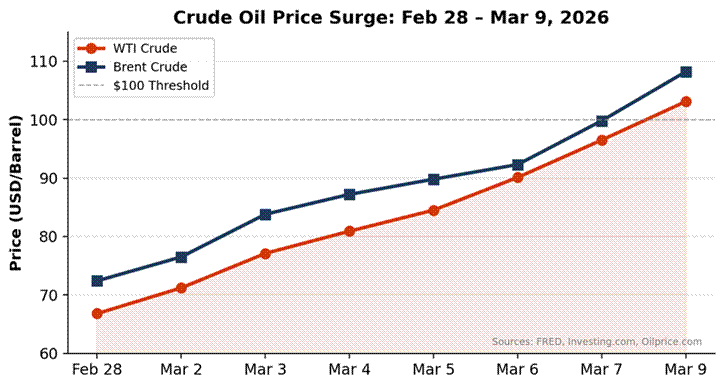
Figure 1: Crude oil prices surged past $100 as the Strait of Hormuz remained closed.
Table 1: Oil Price Weekly Performance
| Benchmark | Feb 28 Close | Mar 7 Close | Weekly Chg % |
| WTI Crude | $66.80/bbl | $90.14/bbl | +35.0% |
| Brent Crude | $72.40/bbl | $92.32/bbl | +27.5% |
| WTI (Mar 9) | — | $103.07/bbl | Topped $100 |
| Brent (Mar 9) | — | $108.20/bbl | Session high: $119.50 |
Sources: FRED, Investing.com, Oilprice.com, Barchart.com
White House Dismisses Oil Price Concerns
President Trump responded to the oil surge on Truth Social. He called the rising prices a “very small price to pay” for U.S. and global safety. He predicted prices would fall after Iranian threats were neutralized. Energy Secretary Chris Wright echoed that sentiment. He said prices would retreat once Iran lost its ability to threaten tankers.
Equity Markets Under Severe Pressure
The week ending March 7 was Wall Street’s worst in nearly a year. The Dow tumbled 2.5% over five sessions. The S&P 500 lost 1.9%. The Nasdaq slid 1.8%, while the Russell 2000 fell 4.7%4. The VIX volatility index surged 24% to 29.49%. That level reflects growing market anxiety.
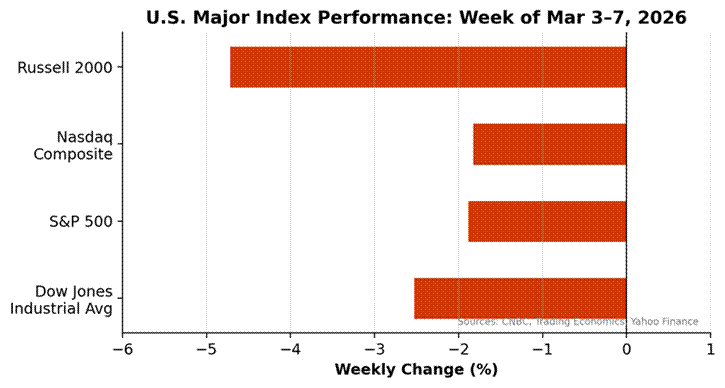
Figure 2: All major U.S. indices posted weekly losses, with small caps hit hardest.
Table 2: U.S. Major Index Performance (Week Ending March 7, 2026)
| Index | Close (Mar 7) | Weekly Chg | Weekly Chg % | YTD Chg % |
| Dow Jones | 47,501.55 | -1,237.86 | -2.54% | -3.6% |
| S&P 500 | 6,740.02 | -129.48 | -1.89% | -3.2% |
| Nasdaq | 22,387.68 | -419.80 | -1.84% | -4.8% |
| Russell 2000 | 2,620.00 | -130.00 | -4.73% | -0.3% |
Sources: CNBC, Trading Economics, Investing.com, Yahoo Finance
Sector Divergence: Defense Up, Airlines Down
Defense contractors gained ground as the Iran war entered its 10th day. RTX, Northrop Grumman, and Lockheed Martin each rose about 1% in premarket trading. Their month-to-date gains ranged from 2% to 4%.
Airlines suffered the opposite fate. Delta, Alaska Air, and American Airlines each dropped about 3%. United and Southwest fell by over 2%. Surging jet fuel costs threatened to crush profit margins.
The S&P financials sector declined roughly 2% on Monday. It extended its 2026 loss to approximately 10%. Private credit firms were the worst performers. Ares Management, Blackstone, KKR, and Apollo fell between 26% and 33% year to date. Recent corporate bankruptcies deepened concerns about credit risk.
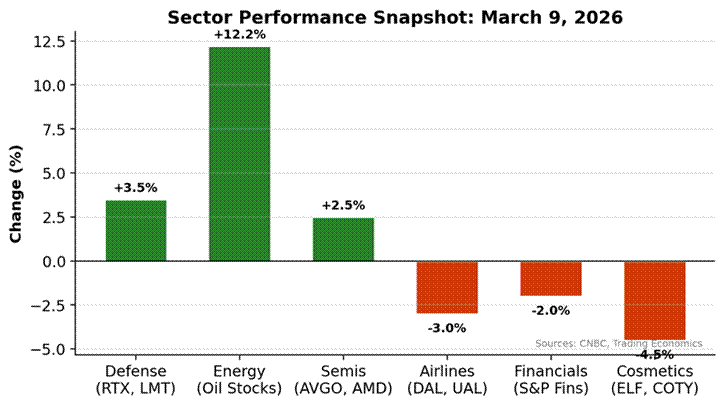
Figure 3: Defense and energy stocks gained while airlines, financials, and cosmetics fell.
Table 3: Key Stock Movers (March 9, 2026)
| Stock | Sector | MTD Chg % | Mar 9 Premarket | Catalyst |
| RTX Corp | Defense | +3.0% | +1.0% | War spending |
| Northrop Grumman | Defense | +4.0% | +1.0% | War spending |
| Lockheed Martin | Defense | +2.0% | +1.0% | War spending |
| Delta Air Lines | Airlines | -8.0% | -3.0% | Fuel costs surge |
| United Airlines | Airlines | -11.0% | -2.0% | Fuel + intl exposure |
Sources: CNBC Markets, Trading Economics
Growth Outlook Darkens as Stagflation Risk Grows
Bond markets signaled rising inflation expectations. A bear steepening of the yield curve compressed bank margins. The widening spread between 2-year and 10-year Treasuries hurt financial stocks. Gold surged to near $5,400 an ounce, reinforcing the inflation-hedge trade.
What Comes Next for Investors
Analysts remain deeply divided on the path forward. J.P. Morgan warned that sustained disruption of Hormuz could push Brent to $120 to $130. Qatar’s energy minister told the Financial Times that all Gulf exporters could shut down within weeks. He suggested prices could hit $150 per barrel.
Not everyone shares that bearish outlook for equities. Steve Eisman, known for his role in “The Big Short,” told CNBC he would not change a single trade. He called the long-term impact of the conflict “very, very positive” for markets. Still, Citi strategist Scott Chronert warned that shorter-term risk is elevated. He urged investors to prepare for unintended consequences.
This week, investors will closely monitor diplomatic developments. The G7 meeting on Iran could signal whether a resolution is possible. Key economic data releases, including GDP and the PCE price index, will also shape sentiment. Until the Strait of Hormuz reopens, volatility is likely here to stay.