March 19, 2026 – The credit-rating giant becomes the first agency to operate a blockchain node, marking a pivotal shift in tokenised finance.
| KEY TAKEAWAYS • Moody’s launched the Token Integration Engine (TIE) on the Canton Network. • First credit rating agency to operate a blockchain node. • The tokenised asset market could reach $400 billion by the end of 2026. • Canton Network hosts 50+ institutional members, including Goldman Sachs and DTCC. |
Moody’s Corporation (NYSE: MCO) has launched its Token Integration Engine™ (TIE). The system delivers credit insights directly into blockchain-based workflows. This makes Moody’s the first credit rating agency to share analytical data on-chain.
The initial deployment runs on the Canton Network, a permissioned blockchain for institutional finance. Moody’s now operates its own node on the network. The move signals growing institutional confidence in blockchain infrastructure.
What is TIE, and why does it matter?
TIE functions as a network-agnostic integration layer. It ingests financial data and distributes credit ratings within on-chain workflows. Issuers control participation while Moody’s retains oversight of its methodology.
“As financial markets digitize, the need for independent risk analysis does not change,” said Fabian Astic, Managing Director and Global Head of Digital Economy at Moody’s Ratings. The agency plans to extend TIE to additional blockchains and asset types.
This isn’t Moody’s first blockchain experiment. The agency ran a pilot with fintech firm Alphaledger in June 2025. That effort explored on-chain credit data delivery. TIE represents the production-grade evolution of that concept.
Canton Network: The Institutional Blockchain
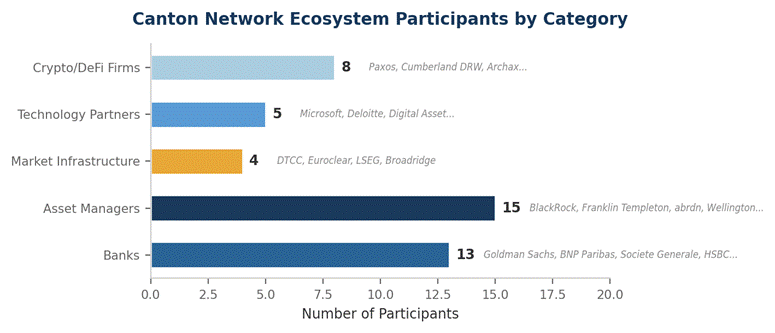
Canton was launched in 2023 by a consortium of over 30 financial institutions. Key participants include Goldman Sachs, BNP Paribas, DTCC, Euroclear, and HSBC. The network now has nearly 400 ecosystem participants and over 600 active validator nodes.
Digital Asset, the firm behind Canton, raised $135 million in June 2025. The round was led by DRW Venture Capital and Tradeweb Markets. Goldman Sachs, Citadel Securities, and DTCC also invested.
Bridge’s distributed-ledger repo platform on Canton already handles over $350 billion in daily transactions. DTCC partnered with Digital Asset in late 2025 to tokenise U.S. Treasury securities on the network.
Figure 1: Canton Network Ecosystem Participants
A Market Poised for Explosive Growth
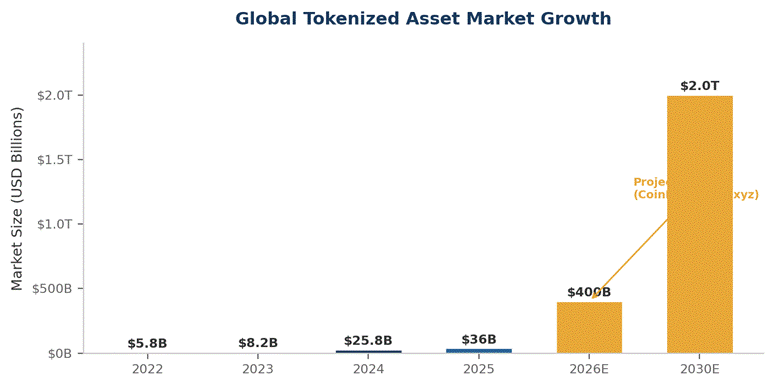
The tokenised asset market almost quadrupled in 2025. It reached nearly $20 billion by year-end, according to data from RWA.xyz. Industry projections suggest it could top $400 billion by the end of 2026.
Private credit makes up 61% of tokenised real-world assets. U.S. Treasuries account for 30%. Tokenised treasury and money-market fund assets hit $7.4 billion in 2025, an 80% year-to-date increase.
A BCG–Ripple report projects the broader market to reach $18.9 trillion by 2033. That represents a compound annual growth rate of 53%. BlackRock’s tokenised fund (BUIDL) crossed multi-billion AUM during 2025.
Figure 2: Global Tokenized Asset Market Trajectory
Regulatory Tailwinds and Competitive Pressure
Europe’s MiCA framework became fully effective in late 2024. Singapore’s MAS Project Guardian expanded into tokenised bank liabilities and FX. The UAE introduced progressive virtual asset rules through VARA and ADGM.
Moody’s move creates competitive pressure for S&P Global and Fitch Ratings. Neither rival has announced on-chain credit infrastructure. As tokenised bonds and loans grow, on-chain ratings could become essential market infrastructure.
The Bottom Line
Moody’s TIE deployment represents more than a technology upgrade. It signals that legacy financial gatekeepers are embedding themselves into blockchain rails. The tokenised asset market’s growth makes on-chain credit analysis a strategic necessity, not an experiment.
Canton’s privacy-first design and institutional backing make it the natural launchpad. With Goldman Sachs, DTCC, and now Moody’s on the network, the infrastructure for on-chain capital markets is rapidly taking shape.