
March 18, 2026 – Payments giant bridges fiat and crypto with record stablecoin infrastructure acquisition, eclipsing Stripe’s Bridge deal.
What You Need to Know:
- Mastercard agreed to acquire London-based BVNK for up to $1.8 billion.
- The deal includes $300 million in performance-contingent payments.
- This surpasses Stripe’s $1.1 billion Bridge acquisition as the largest stablecoin deal.
- The stablecoin market cap has surged to $320 billion in March 2026.
Mastercard announced on Tuesday a binding agreement to acquire BVNK. The London-based stablecoin infrastructure startup will cost up to $1.8 billion. This marks Mastercard’s biggest crypto bet to date.
The deal includes $300 million tied to performance milestones. It is expected to close before the end of 2026. Regulatory approvals remain a standard condition, according to the companies.
BVNK, founded in 2021, bridges fiat currency and stablecoin payments. Its platform operates across 130 countries on all major blockchains. Clients include Worldpay, Deel, and Flywire. The company processes billions in annual transaction volume.
Record-Breaking Deal Signals Industry Shift
This acquisition eclipses Stripe’s $1.1 billion purchase of Bridge in February 2025. It also dwarfs Ripple’s $200 million Rail acquisition. Consequently, this is now the largest stablecoin deal in history.
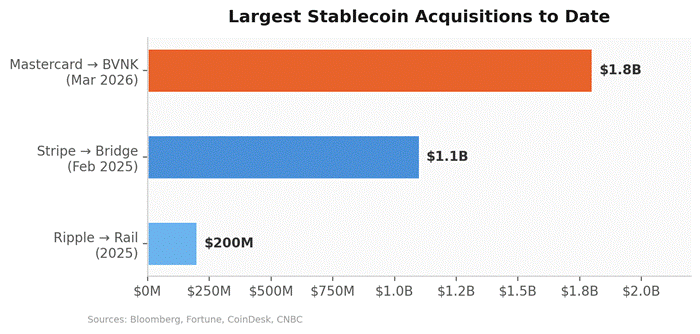
Fig. 1: Comparison of major stablecoin acquisitions.
Coinbase previously explored acquiring BVNK for roughly $2 billion. However, those negotiations collapsed in November 2025. Mastercard had also considered buying crypto firm Zerohash. That deal similarly fell through earlier this year.
“We expect that most financial institutions and fintechs will, in time, provide digital currency services,” said Jorn Lambert, Mastercard’s Chief Product Officer.
Stablecoin Market Reaches $320 Billion
The global stablecoin market cap has surged to $320 billion in March 2026. This represents a tenfold increase from $28 billion in 2020. Stablecoin payment volumes reached at least $350 billion in 2025. Monthly transaction volumes are projected to near $1 trillion by late 2026.
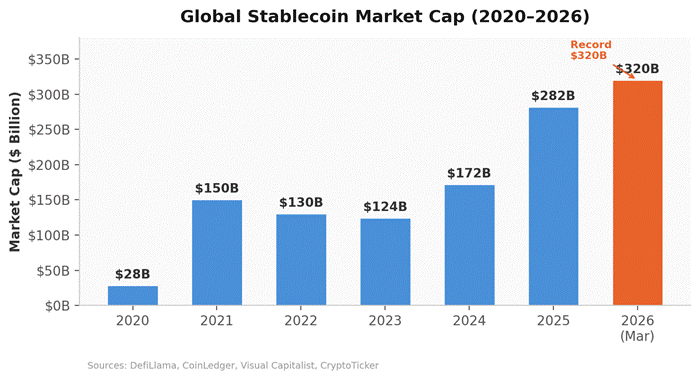
Fig. 2: Global stablecoin market cap growth (2020–2026).
Citi projects the stablecoin market could reach $1.9 trillion by 2030 in its base case. A bull scenario envisions up to $4 trillion. The GENIUS Act, signed into U.S. law in mid-2025, has accelerated institutional adoption.
Strategic Rationale: Bridging Traditional and Digital Rails
Mastercard processes approximately $9.5 trillion in annual payment volume across 210 countries. By integrating BVNK, it gains on-chain payment capabilities. Key use cases include cross-border transfers, remittances, and B2B payments.
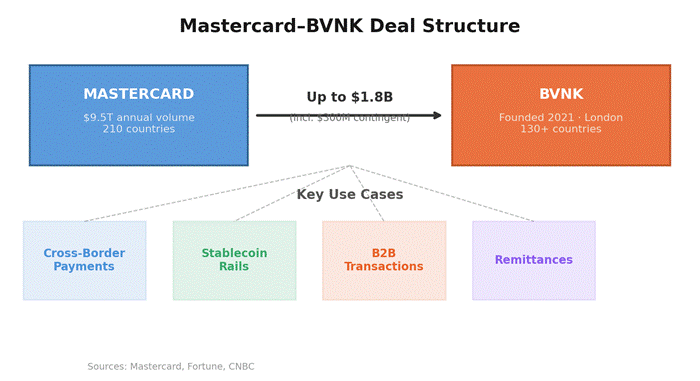
Fig. 3: Deal structure and key use cases.
Just last week, Mastercard launched its Crypto Partner Program. The initiative unites more than 85 companies, including Circle, Ripple, and Fireblocks. This signals a broader strategic push into digital assets.
BVNK was previously valued at $750 million during a 2024 Series B round. The acquisition price represents more than a 2x valuation jump. Investors included Visa Ventures, Tiger Global, Coinbase Ventures, and Haun Ventures.
What This Means for the Industry
Traditional payment networks no longer view stablecoins as a threat. Instead, they see them as complementary infrastructure. Mastercard and Visa are both competing to establish early leads in this space.
William Blair analysts described the acquisition as further validation of stablecoins for cross-border commerce. Meanwhile, Circle’s USDC has grown to $78 billion in market cap. PayPal also expanded its PYUSD stablecoin to 70 countries this week.
The deal is expected to close by year-end 2026, pending regulatory approvals.