

March 20, 2026 – Decentralised exchange captures commodity traders seeking round-the-clock access amid Middle East tensions. Analysts say the trend signals a structural shift in derivatives markets.
| KEY TAKEAWAYS – Hyperliquid’s oil perpetual contract hit $1.7B in daily volume, a 250x surge from pre-conflict levels. – JPMorgan analysts say non-crypto traders now use DeFi platforms to gain 24/7 exposure to commodities. – Open interest in WTI crude contracts reached $300M; total platform OI topped $1.43B. – Only 7 of 30 top Hyperliquid markets are crypto pairs; most trade commodities and equities. – Legacy exchanges (Nasdaq, NYSE, Cboe) are racing to extend hours but can’t yet match DeFi’s always-on model. |
Hyperliquid, a decentralised perpetual futures exchange, is rewriting how traders access commodity markets. Its oil-linked perpetual contract recently hit $1.7 billion in daily trading volume, according to Fortune. That figure represents a roughly 250-fold increase from pre-conflict levels.
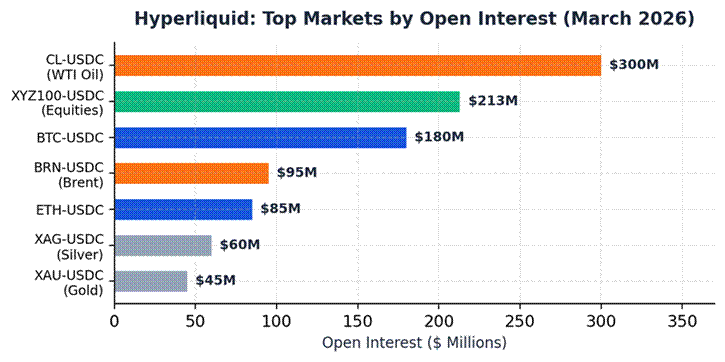
JPMorgan analysts, led by managing director Nikolaos Panigirtzoglou, flagged the platform’s rapid growth in a research note published Thursday. The bank noted that non-crypto traders are increasingly using Hyperliquid for oil exposure. Open interest in the WTI crude contract (CL-USDC) surged to approximately $300 million.
Weekend Gaps Fuel DeFi Demand
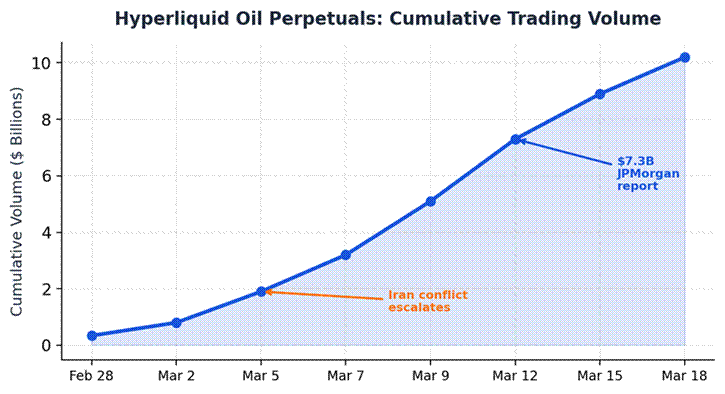
The catalyst was geopolitical. When U.S.–Israel strikes on Iran escalated over a weekend in late February, traditional venues like CME were shut. Hyperliquid’s perpetual contracts kept trading. WTI perpetuals on the platform jumped to around $96 per barrel, compared to CME’s Friday close of $90.90. Cumulative trading volume for oil contracts exploded from $339 million on February 28 to $7.3 billion by mid-March.
The platform offers up to 20x leverage, USDC-margined contracts, and sub-second transaction finality. Unlike most decentralised exchanges, Hyperliquid uses on-chain limit order books instead of automated market makers. This design attracts algorithmic and high-frequency traders who demand tighter spreads.
Source: Tekedia, DeFiLlama
Beyond Crypto: A Structural Market Shift
What makes this surge significant is its composition. According to CoinDesk reporting, only 7 of the top 30 markets on Hyperliquid are crypto pairs. The rest trade commodities and equities. Oil contracts alone accounted for 18% of the platform’s total volume at peak activity.
Hyperliquid processed $1.59 trillion in derivatives volume over six months. That figure places it among the top 10 derivatives venues globally, according to CoinGecko data. The platform generated nearly $700 million in annual revenue, according to DeFiLlama.
Source: ASXN, Hyperliquid Exchange Data
Traditional Exchanges Race to Respond
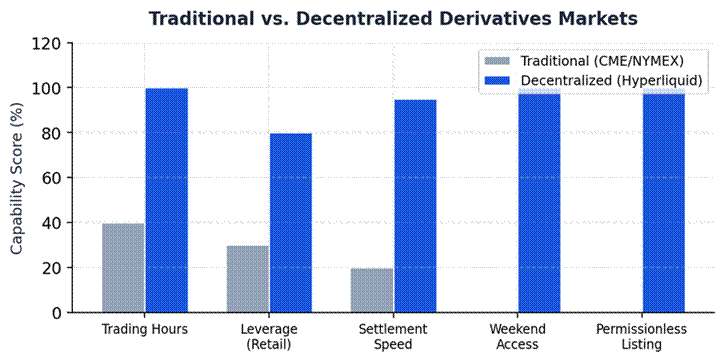
Legacy venues are taking notice. Nasdaq is targeting 23-hour weekday equities trading by late 2026. The NYSE is developing a tokenised assets platform. Cboe has proposed near-24/5 equities trading. However, none currently match the perpetual futures structure or leverage ratios available on decentralised platforms.
JPMorgan’s analysts projected continued growth for decentralised commodity trading. They expect DeFi platforms to expand into additional asset classes beyond oil and gold. The key advantage remains clear: global events don’t pause for market hours. Decentralised exchanges fill that gap.
Source: JPMorgan Research
What’s Next
The HYPE token has rallied 35% year-to-date, making it the top performer among billion-dollar-cap cryptocurrencies. Ripple Prime recently integrated Hyperliquid for institutional clients. Analysts like Arthur Hayes have set $150 price targets for HYPE.
The platform is not without risks. U.S. residents cannot access it directly. Commodity contracts face higher slippage than legacy venues. Oracle pricing on weekends varies by individual contract deployer. Still, JPMorgan’s endorsement marks a milestone. Traditional finance is watching DeFi’s real-world utility, and it’s hard to look away.