

In Summary
The US dollar controls over 99 per cent of the global stablecoin market today.
Euro usage on public blockchains remains at a critically low 0.2 per cent.
The Qivalis consortium plans to launch a heavily regulated euro stablecoin.
This private initiative aims to prevent complete digital dollarisation in Europe.
The EU’s MiCA regulation offers a safe, legally clear framework for these assets.
Introduction
Europe is facing a severe financial threat known as digital dollarisation. The region urgently needs a native euro stablecoin. Without it, European markets risk losing their financial sovereignty entirely. Jan-Oliver Sell, CEO of Qivalis, recently warned about this growing issue. He noted that the US dollar currently dominates blockchain finance. Therefore, twelve major European banks have launched the Qivalis consortium. Their primary goal is to build a regulated euro stablecoin. This strategic move aims to keep the euro relevant globally.
The Staggering Gap in Market Share
The global stablecoin market has expanded rapidly in recent years. Today, this massive sector is worth roughly $314 billion. Surprisingly, over 99 per cent of these digital assets are dollar-pegged. In traditional finance, the euro commands 20 per cent of activity. However, on public blockchains, the euro accounts for just 0.2 per cent. This massive discrepancy highlights a critical vulnerability for the European economy.
According to research from the Digital Euro Association, this trend creates dangerous dependencies. European users are forced to rely on dollar-denominated tokens. Popular examples include Tether (USDT) and Circle (USDC). Consequently, European businesses face unnecessary foreign exchange risks daily. They also lose direct control over their digital financial ecosystem. This reliance undermines the broader economic stability of the Eurozone.
The Push for a Native Solution
To counter this dominance, the newly formed Qivalis consortium aims to act quickly. Backed by major banking institutions, it seeks to issue native tokens. This initiative complements the European Central Bank’s digital euro plans. Experts predict the public digital currency will arrive after 2029. This long timeline leaves a dangerous gap in the market. Therefore, aggressive private sector action is absolutely essential right now.
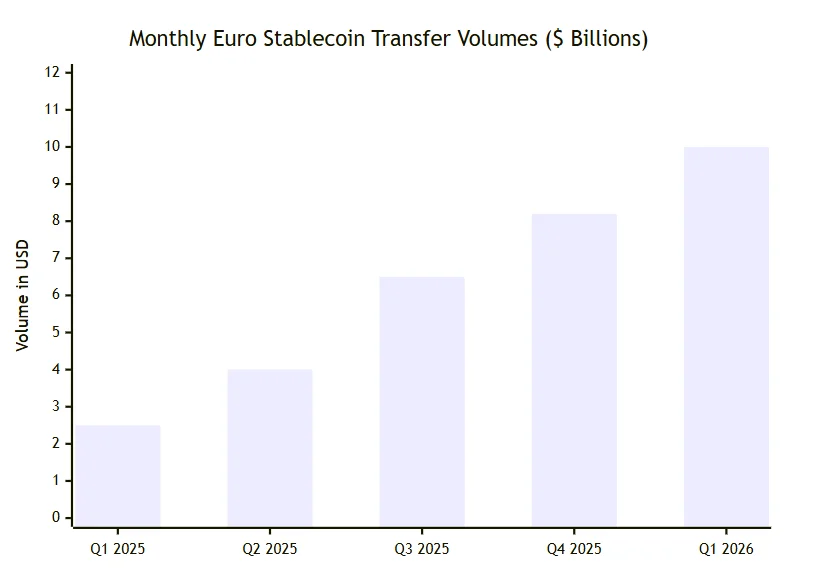
Furthermore, a recent Visa-backed report highlights early signs of progress. Euro-denominated stablecoins make up 80 per cent of the non-dollar market. The total supply of these euro tokens reached $1.2 billion. Transfer volumes are climbing steadily, reaching about $10 billion per month. However, this still represents a tiny fraction of the crypto sector.
Regulatory Clarity Through MiCA
Regulation plays a massive role in this ongoing financial transition. The European Union successfully established the Markets in Crypto-Assets framework. This comprehensive law provides much-needed legal clarity for crypto providers. It establishes strict rules for transparency, custody, and risk management.
Thanks to MiCA, European stablecoin issuers possess a distinct competitive advantage. They can safely operate within a highly regulated and trusted environment. Many non-compliant tokens have already faced significant delistings across Europe. As noted by legal experts tracking MiCA compliance, market impacts are undeniable. The new rules protect investors while strongly encouraging local blockchain innovation.
The Path Forward for Europe
Market fragmentation has historically severely hurt previous euro stablecoin projects. A unified, bank-backed approach is highly necessary to build deep liquidity. Qivalis believes broad distribution across multiple exchanges will drive rapid adoption.
If Europe fails, digital dollarisation will become a permanent structural issue. The window of opportunity to prevent this negative outcome is closing. The ultimate success of Qivalis depends on swift regulatory approvals. It also requires rapid ecosystem integration from users and digital merchants. Europe must act decisively today to secure its future financial independence.