
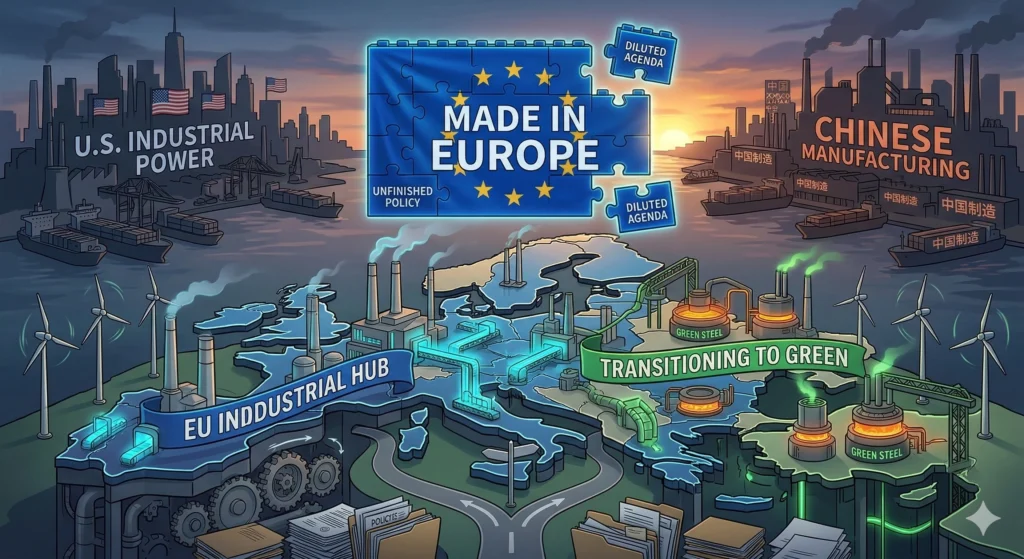
March 07, 2026 – The European Commission unveiled its Industrial Accelerator Act on Wednesday. At the heart of the legislation sits the “Made in Europe” provision. It aims to redirect public procurement spending toward EU-based manufacturers. However, after three delays and significant rewrites, the policy looks far less ambitious than originally planned.
EU industry chief Stéphane Séjourné presented the package as a boost for European competitiveness. Critics see it differently. The act lacks a clear definition of what qualifies as “Made in Europe.” One diplomat compared the rollout to “building a LEGO set without all the pieces.” That ambiguity could undermine enforcement from the start.
Trade Tensions Cloud the Outlook
Early drafts mirrored China’s aggressive industrial subsidies. Later versions softened those measures considerably. A key sticking point remains the definition of “trusted partner” nations. Recent free trade agreements with India and Mercosur complicate matters further. Those partners now fear the act could disrupt newly forged economic ties.
Germany and nine other member states have pushed back. They want Brussels to simplify regulations rather than layer on new ones. This resistance signals that internal EU divisions may further slow implementation.
A Green Lining Amid the Doubt
Still, the act could accelerate the green transition. It includes provisions to stimulate demand for low-carbon steel and aluminium. Domien Vangenechten of environmental think tank E3G argued that Europe’s competitiveness depends on making industrial decarbonization investable. Without bold action, the bloc risks losing its manufacturing base entirely.
The stakes are high. Europe faces mounting pressure from both U.S. protectionism and Chinese overcapacity. Whether a diluted “Made in Europe” act can deliver meaningful results remains the central question for investors and policymakers alike.