
March 26, 2026 – The ECB wants technical rules locked by summer 2026. Banks face billions in costs. Here is what the timeline, the data, and the politics reveal.
In Summary
ECB targets summer 2026 for digital euro technical standards.
Estimated cost for EU banks: €4–6 billion over four years.
A 12-month pilot will begin in the second half of 2027.
Full issuance could happen in 2029 if legislation passes.
134 countries globally are now exploring CBDC projects.
The European Central Bank has drawn a line in the sand. Specifically, ECB Executive Board member Piero Cipollone told EU lawmakers on March 24 that the bank expects to announce European technical standards for a digital euro by this summer.
Importantly, this is not a vague aspiration. Instead, it is a firm deadline. As a result, banks, payment providers, and merchants must embed those standards into terminals and apps immediately.
Indeed, the move marks the most concrete step yet in Europe’s CBDC push. Meanwhile, cash usage in the eurozone fell from 79% in 2016 to just 52% in 2024, according to ECB payment data.
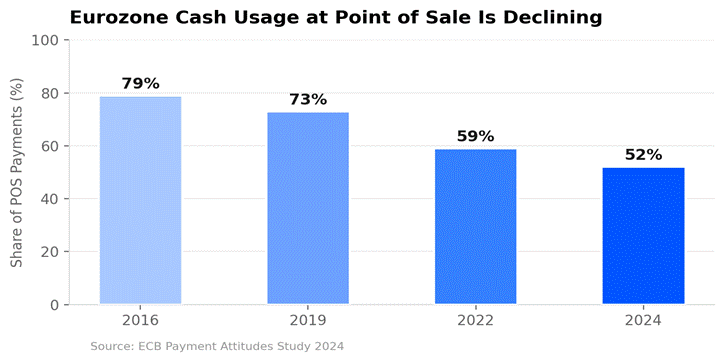
Fig 1: Eurozone cash usage at point of sale — Source: ECB Payment Attitudes Study 2024
The Cost Question: €4–6 Billion
However, a digital euro will not come cheap. According to earlier ECB analysis, reported by Reuters, implementation could cost EU banks €4–6 billion over four years.
Notably, the ECB framed this as roughly 3% of banks’ annual IT maintenance budgets. Furthermore, Cipollone argued that long-term savings from keeping merchant fees inside Europe should outweigh these costs.
In addition, a separate ECB estimate pegged the total build cost at around €1.3 billion. After that, the ECB expects annual running costs of €320 million.
| Cost Category | Estimated Amount |
| Bank implementation (4 years) | €4–6 billion |
| ECB build cost | €1.3 billion |
| Annual running cost | €320 million/year |
| Share of bank IT budgets | ~3% |
Table: Digital euro cost estimates, Sources: Reuters, HRF CBDC Tracker
“The digital euro is conceived as public infrastructure that private intermediaries would use, not a direct-to-consumer ECB product.”
— PIERO CIPOLLONE, ECB EXECUTIVE BOARD MEMBER
Timeline: From Standards to Launch
The ECB’s roadmap now follows a sharply defined sequence. First, the ECB expects legislation to pass in 2026. Then, a 12-month pilot follows in the second half of 2027. Finally, full issuance could begin in 2029.
More specifically, on May 5, 2026, the European Parliament’s ECON committee will vote on the ECB’s proposals. Before that, the European Council already approved them in December 2025.
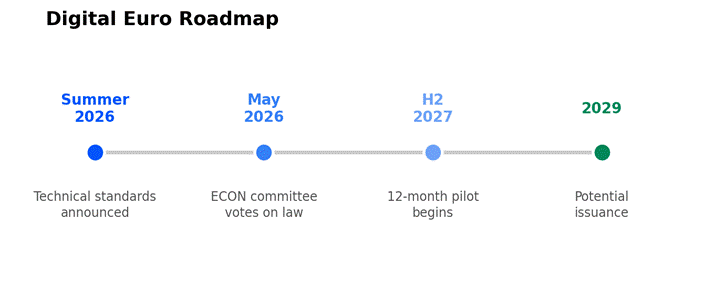
Fig 2: Digital euro roadmap, Source: ECB
Why Now? The Geopolitical Pressure
Above all, Europe’s payments system faces a sovereignty gap. Currently, non-European companies process nearly two-thirds of eurozone card transactions. Moreover, thirteen member states depend entirely on international card schemes.
Under the proposal, the digital euro wallet would carry a holding limit of €3,000–4,000 per person. Also, it would support both online and offline transactions. In addition, merchants would have to accept it by law.
Meanwhile, on the global stage, 134 countries representing 98% of world GDP are exploring CBDCs. For example, China’s digital yuan has already processed billions of yuan. In contrast, the U.S. has stalled, while Europe sits in between.
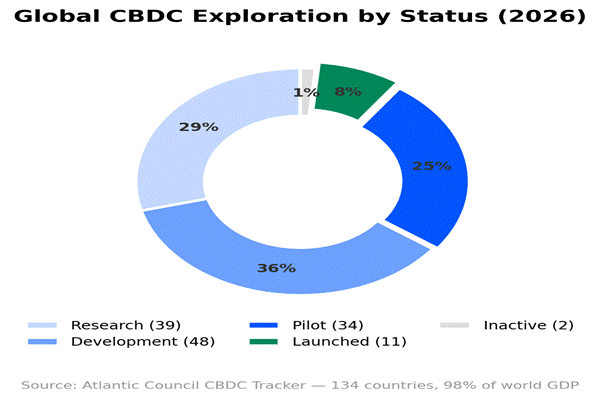
Fig 3: Global CBDC exploration by status, Source: Atlantic Council CBDC Tracker
The Bottom Line
Ultimately, the ECB’s summer deadline transforms the digital euro from a concept into an engineering project. Clearly, the costs are real, and the political timeline remains tight.
Yet the strategic stakes are even larger. In particular, payment sovereignty, reduced foreign dependence, and pan-European interoperability all hang in the balance.
Consequently, if the ECON vote passes in May, Europe enters the final stretch. On the other hand, if it stalls, the continent risks falling further behind China and private stablecoin networks.