March 16, 2026 – The ambitious programme has connected 44 million people so far. Analysts say it must reach 50 million annually to stay on track.
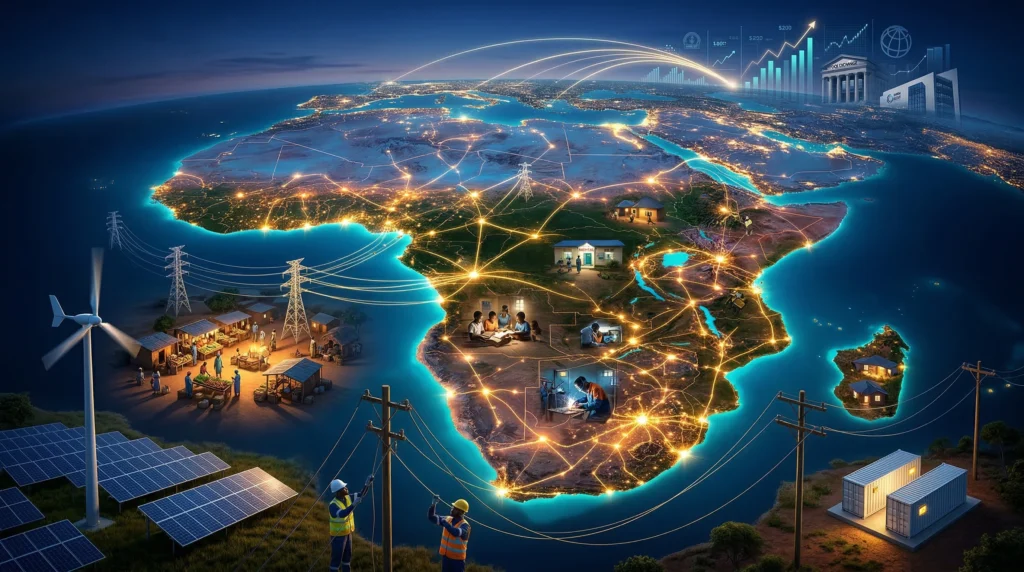
The World Bank confirmed that over $50 billion has been pledged to Mission 300. The programme aims to connect 300 million Africans to electricity by 2030. Since its official launch in Dar es Salaam in January 2025, it has delivered power to 44 million people.
The stakes are enormous. Nearly 570 million people in sub-Saharan Africa lack access to electricity. That figure represents roughly half the region’s population. It also accounts for over 80% of the world’s unelectrified population, according to the United Nations.
A Funding Coalition Takes Shape
The $50 billion commitment draws from multiple sources. The World Bank and the African Development Bank provide concessional loans. Private-sector investors and other development finance institutions contribute the rest. The World Bank Group targets 250 million connections. The AfDB will deliver the remaining 50 million.
The Rockefeller Foundation recently pledged an additional $10 million to strengthen delivery. This funding supports Compact Delivery and Monitoring Units in 15 African countries. The French Development Agency has separately committed €1 billion to electrification projects across the continent.
Progress Versus the 2030 Deadline
Forty-four million connections represent meaningful progress. However, the maths remain daunting. Roughly 50 million people must gain access each year to meet the 2030 target. That pace far exceeds current delivery rates.
Cassady Walters, Vice President for Power at the Rockefeller Foundation, acknowledged the challenge. She noted that 2025 focused on building foundations. “As we move into 2026, we’re fully focused on acceleration,” she told African Business. Nearly 200 million people are covered by pipeline projects.
Thirty African nations have now launched National Energy Compacts. These compacts outline policy reforms, investment targets, and timelines. Countries such as Ghana, Kenya, and Rwanda are already on track to achieve full access by 2030, according to the IEA.
The Economic Case for Urgency
Unreliable power costs sub-Saharan African economies between 1% and 4% of GDP annually. Nigerian enterprises alone lose up to 7% of potential output to outages. About 70% of the region’s population is under 30. Electrification is critical to unlocking employment and industrial growth for this demographic.
Africa holds 19% of the world’s population but generates just 3.1% of global electricity demand, according to Ember. Clean energy sources already supply 25% of the continent’s power. Solar panel imports have surged over the past 12 months. These trends suggest a renewable-led pathway is viable.
Risks and Headwinds
Financing remains the primary obstacle. The dissolution of USAID has reduced traditional aid flows. European aid budgets are also shrinking. However, most Mission 300 funding is already committed through multilateral channels. This offers some insulation against volatility in bilateral aid.
The IEA estimates that Africa needs $15 billion annually in electricity-access investment. Recent annual commitments have totalled less than $2.5 billion. Closing this gap will require sustained private-sector participation and national-level regulatory reform.
Mission 300 represents the largest coordinated electrification effort in African history. Its success hinges on converting ambitious pledges into functioning grid and off-grid connections. The next four years will determine whether Africa can fundamentally reshape its energy landscape.
Sources:
World Bank Mission 300 Overview (worldbank.org/en/programs/energizing-africa)
Bloomberg, “World Bank Says $50 Billion Committed to African Electrification,” March 5, 2026
Ember – Africa Energy Data (ember-energy.org/countries-and-regions/africa)
IEA Africa Energy Outlook 2022 (iea.org)
African Business, “50 Million a Year Need Electricity Access,” March 2026
Rockefeller Foundation Mission 300 Announcement, March 5, 2026
United Nations SDG Portal (unsdg.un.org)
African Sustainability Matters – African Energy Week 2026 Analysis