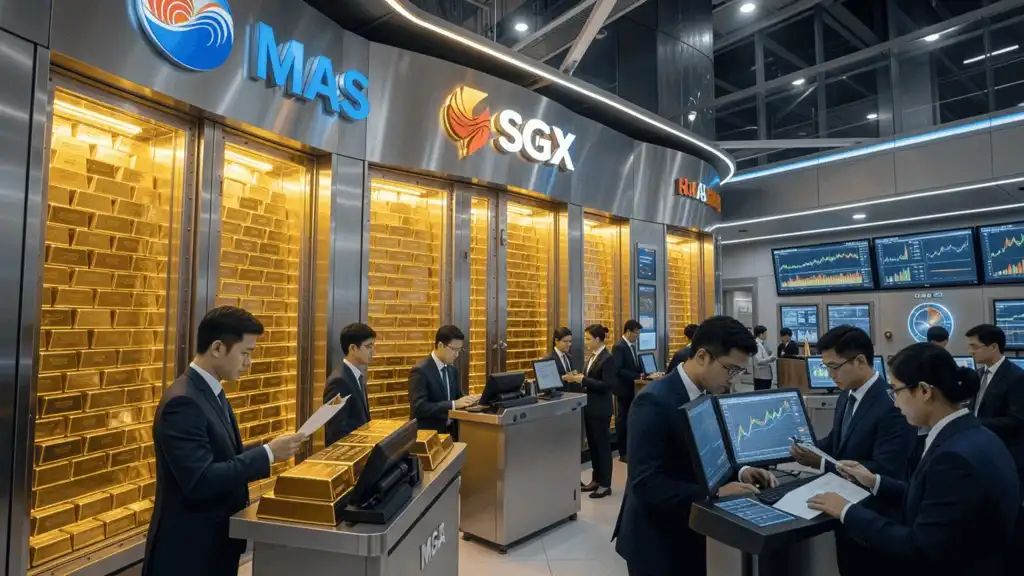
Catenaa, Wednesday, April 01, 2026- The Monetary Authority of Singapore announced plans to create a regional gold trading ecosystem including physical vaulting, ETFs and derivatives, over-the-counter clearing, and sovereign storage to compete with Dubai, Shanghai, and Hong Kong while targeting institutional and central bank demand.
The initiative responds to Asia’s fragmented gold infrastructure. Central banks purchased 1,037 tonnes in 2025, the highest annual total since 1971, while ETF inflows reached $8.2 billion in Q1 2026. Existing hubs vary in capacity and accessibility: Dubai stores 1,200 tonnes, Shanghai 2,200 tonnes with domestic focus, and Hong Kong 800 tonnes dominated by retail investors. Singapore’s projected vaulting will reach 500 tonnes, offering sovereign and institutional clients neutral storage with MAS oversight.
The launch follows LionGlobal Physical Gold ETF debuting March 26 on SGX, providing fractional allocations in SGD and USD. Storage partners Brink’s, Loomis, and Malca-Amit will handle transport and vaulting. Clearing standards for 12.4kg London bars and 1kg Asian kilobars are set to launch by Q3 2026. Singapore’s approach contrasts with Dubai’s VAT costs and Shanghai’s capital controls, giving the city-state a competitive edge in political stability and tax neutrality.
Physical vaulting, capital markets, standardized clearing, and sovereign access are expected to attract long-term institutional flows. Analysts project Singapore could capture 5–7% of Asian gold trade, roughly $15 billion annually, with ETF assets under management reaching $2 billion by 2028. SGX gold futures volumes tripled immediately after the ETF launch, and spot gold rose 1.4% post-announcement.
The MAS vaults will provide structural demand floors, reducing retail-driven volatility. Tokenized kilobars and pilot gold-backed stablecoins under Project Guardian will enable digital settlements. Central banks in Indonesia and the Philippines are exploring MAS vault usage, reflecting confidence in Singapore’s neutral geopolitical position.
Workforce development is integral. The hub is projected to create 1,200 jobs, including 400 in vaulting and logistics, 500 in trading and compliance, and 300 in research and analysis. DBS, JPMorgan, and UBS plan specialized gold training programs for staff throughout 2026.
Industry observers note that Asia’s gold market has grown rapidly due to de-dollarization and BRICS nations’ reserve accumulation, which doubled to 6,000 tonnes. Analysts highlight Singapore’s low political risk, 0% GST, and SGX/OTC liquidity as incentives for institutional adoption.
Tokenization is expected to accelerate settlement efficiency. LiquidChain L3 infrastructure integrates Chainlink oracles for gold price feeds and aims to facilitate programmable, 24/7 settlement by 2028. The MAS sandbox is testing gold-backed stablecoins in Q3 2026, potentially enabling Asia to lead in digital gold infrastructure.
Singapore has processed $15 billion in gold annually, about 3% of the global market. Between 2022 and 2025, storage capacity doubled to 200 tonnes. MAS formed a working group in January 2026 to align with global trends following sanctions impacting India and Russia. Previous ETF initiatives include the LionGlobal Physical Gold ETF and Phillip SINGDOLLAR Gold ETF ($120 million AUM).
The hub seeks to narrow regional premiums, which fell from 2.8% in 2024 to 1.2% above London gold prices. Standardized kilobars and tokenized clearing aim to eliminate arbitrage opportunities. Projected long-term growth could produce a $50 billion ecosystem by 2030 if Singapore maintains neutrality and efficiency, while failure risks ceding Asian flows to Hong Kong.