

March 20, 2026 – The Wall Street giant’s amended S-1 positions it to shift from crypto distributor to direct ETF issuer, a structural milestone for regulated digital asset markets.
| KEY TAKEAWAYS • Morgan Stanley’s second S-1 amendment confirms ticker MSBT on NYSE Arca. • Coinbase Custody and BNY Mellon named as custodians for the fund. • The SEC is reviewing over 126 pending crypto ETF applications. • This is the first Bitcoin ETF filed by a major U.S. bank. |
Morgan Stanley submitted its second S-1 amendment to the SEC on March 18, 2026. The filing confirms that the Morgan Stanley Bitcoin Trust will trade under the ticker MSBT. It will be listed on NYSE Arca, the exchange that hosts most U.S. spot crypto ETFs. If approved, it would become the first Bitcoin ETF issued directly by a major American bank.
What the Filing Reveals
The amended registration provides significantly more operational detail. Shares will be priced daily using the CoinDesk Bitcoin Benchmark, based on the 4:00 PM New York settlement rate. The trust will issue 50,000 seed shares, expected to raise roughly $1 million. Morgan Stanley selected Coinbase Custody to hold Bitcoin in offline cold storage. BNY Mellon will serve as cash custodian, administrator, and transfer agent.
The fund will support both cash and in-kind creation and redemption. This structure targets institutional authorized participants specifically. However, the filing still omits key details about the management fee. Industry analysts estimate the expense ratio at between 0.20% and 0.30%.
Why This Filing Matters
The strategic logic is clear. By issuing its own ETF, Morgan Stanley captures management fees directly. Currently, it earns only distribution commissions from third-party products like BlackRock’s IBIT. With $1.8 trillion in wealth management assets, the shift could be significant. The firm’s 15,000+ financial advisors were authorized in early 2026 to proactively recommend Bitcoin ETFs.
The filing also coincided with the Morgan Stanley European Financials Conference. Co-President Dan Simkowitz spoke at the London event on the same day. This timing suggests deliberate signaling to institutional investors worldwide.
Market Landscape: Spot Bitcoin ETF AUM Distribution
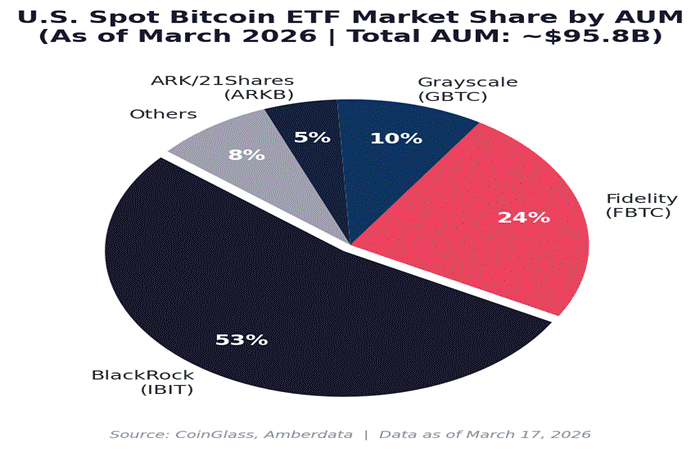
Figure 1: BlackRock’s IBIT dominates with 53% market share. Morgan Stanley’s entry intensifies competition.
The U.S. spot Bitcoin ETF market has reached approximately $95.8 billion in total AUM as of mid-March 2026. BlackRock’s IBIT controls roughly 53% of the market at around $72 billion. Fidelity’s FBTC follows with about $33 billion, or 24%. Grayscale’s converted GBTC holds approximately 10%. Morgan Stanley’s late entry into this crowded field requires differentiation.
The Wall Street Crypto Arms Race
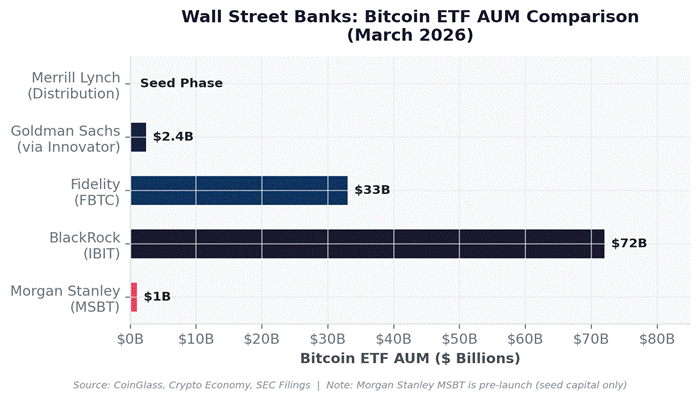
Figure 2: Wall Street banks are rapidly scaling Bitcoin ETF exposure via issuance and acquisitions.
Morgan Stanley is not entering this space alone. Goldman Sachs acquired ETF issuer Innovator for $2 billion in late 2025. It now holds $2.4 billion in crypto exchange-traded products. Merrill Lynch authorized its advisors to recommend spot Bitcoin ETFs in January 2026. JPMorgan projects that pension funds could drive $130 billion in annual crypto ETF inflows.
Beyond Bitcoin: A Multi-Asset Strategy
Morgan Stanley’s ambitions extend well beyond Bitcoin. In January 2026, the firm filed for both a spot Ethereum ETF and a Solana Trust. Both filings include staking components, a key differentiator from earlier products. The Solana Trust plans to delegate holdings to third-party staking providers. Quarterly staking rewards would be distributed to shareholders.
The broader regulatory pipeline is also expanding rapidly. The SEC currently has over 126 crypto ETF applications under review. Eight XRP ETF proposals alone could mobilize $5–$7 billion upon approval. Bitwise’s staking-enabled Solana ETF (BSOL) debuted with $56 million in first-day volume.
The Bottom Line
Morgan Stanley’s MSBT filing marks a structural inflection point. A top-tier bank transitioning from distributor to issuer reshapes competitive dynamics. The move validates crypto ETFs as a permanent institutional product category. For investors, the key watchpoints are fee disclosure and the SEC’s approval timeline. The crypto ETF market’s next chapter will likely be written by Wall Street’s biggest names.