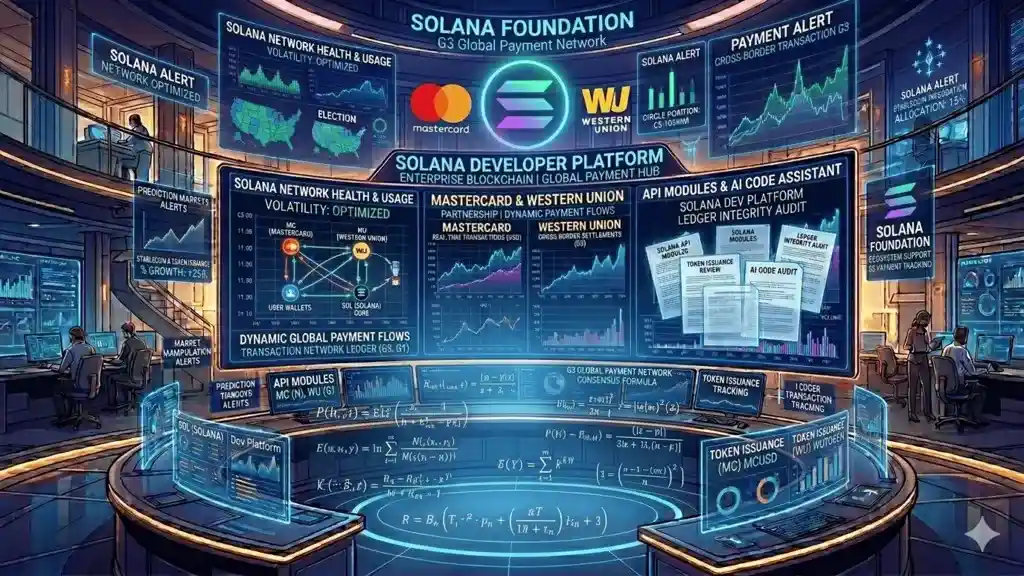
Catenaa, Sunday, March 29, 2026-Major payments and financial services firms including Mastercard, Western Union and Worldpay said Tuesday they are early adopters of the Solana Foundation’s new enterprise developer toolbox, an AI‑powered platform designed to help institutions build tokenized and payment products on the Solana ecosystem.
The Solana Developer Platform (SDP) unifies key infrastructure across the Solana ecosystem in a single interface, offering modules that support the issuance of tokenized deposits such as compliant stablecoins, orchestration of payments flows, and trading functions like atomic swaps and vault services.
Mastercard is tapping SDP to support expanded stablecoin settlement capabilities that integrate with its existing payment systems, the company said. In a statement, Mastercard Executive Vice President for Blockchain & Digital Assets Raj Dhamodharan said the initiative aims to marry blockchain speed and programmability with Mastercard’s global reach and reliability.
Western Union said it plans to use SDP to extend its cross‑border payment capabilities with an API‑driven on‑chain layer that supports both fiat and stablecoin transfers. Malcolm Clarke, vice president of digital assets at Western Union, said the partnership will modernize the company’s operations without replacing its core network.
The platform is expected to integrate with popular AI coding environments including Claude Code by Anthropic and Codex by OpenAI, enabling developers to build onchain apps more efficiently.
Enterprise adoption of blockchain infrastructure has grown in recent years as financial institutions seek tokenization and real‑world asset solutions. Tokenized deposits, programmable money flows and onchain products such as stablecoins have shifted from experimental use cases toward operational deployments in payments and liquidity markets.
Solana’s high throughput and low latency have made it an attractive option for developers looking to scale tokenized products, though it still represents a small share of the wider onchain real‑world assets market. Data from industry trackers show consistent month‑over‑month growth in tokenization volumes across chains, with Solana frequently cited for performance and cost efficiency in enterprise settings.
The SDP launch comes as an increasing number of established firms explore blockchain integration for payments, settlement, and asset issuance. Other offerings, such as tokenized equities and derivatives, have also emerged on Solana, often preceding launches on other chains.
The participation of globally recognized payments firms could drive broader institutional interest in blockchain rails. By bridging legacy systems with onchain infrastructure, SDP aims to facilitate compliance, liquidity and programmability within regulated markets.
For Mastercard, integrating SDP into stablecoin settlement workflows could accelerate the adoption of digital currencies in cross‑border payment corridors, potentially reducing costs and settlement times compared with traditional systems.
Western Union’s engagement signals a shift in how established money transfer networks view blockchain layers: not as replacements but as complementary technologies that enhance existing services.
The integration with AI developer tools may also shorten the time to market for institutional blockchain applications, particularly as financial services firms expand teams building on decentralized networks.
SDP is supported at launch by more than 20 infrastructure partners focused on node services, wallet setup, on‑ and off‑ramping, and compliance. Custodial and wallet service providers such as Anchorage Digital, BitGo and Coinbase are included, along with non‑custodial wallet infrastructure like Fireblocks.
Major analytics and compliance firms including Chainalysis, Elliptic, Range and TRM Labs will provide tools to meet know‑your‑customer and travel‑rule requirements across use cases.
SDP’s payments module will be powered by fiat‑to‑crypto rails offered by partners like Bridge, BVNK, Lightspark, Modern Treasury and MoonPay.
The development arrives as some key players in the sector expand their own footprint: Mastercard recently agreed to acquire BVNK in a deal valued at up to $1.8 billion, while payments provider Stripe acquired Bridge in 2024.
Industry analysts said the move may hasten adoption of hybrid payments systems that combine blockchain and legacy infrastructure. As major firms invest in tooling that supports stablecoin flows and tokenized assets, they help build a bridge between onchain innovation and regulated financial services.
Critics caution integration will require careful compliance planning, particularly around AML, KYC and cross‑border regulation, but proponents argue that unified platforms with strong compliance partners can ease that transition.
Developers also welcomed the inclusion of AI coding environments, saying it reduces friction in building, iterating and deploying secure onchain applications.
Tokenization and real‑world assets have become central themes in the financial technology landscape over the past several years. Real‑world asset (RWA) tokenization refers to the representation of physical assets — such as debt instruments, equities, mortgages or commodities — as digital tokens on a blockchain. The technology promises faster settlement, improved liquidity and transparent audit trails.
The concept gained traction as institutional investors and financial services firms sought alternatives to traditional systems. Stablecoins like USD Coin and USDT have become a backbone of onchain liquidity, bridging fiat currencies and digital markets. Blockchain platforms with high throughput and low latency have been favored for tokenization applications, with Solana often highlighted for its performance characteristics in enterprise settings.
Institutional players have gradually integrated blockchain primitives into payments and settlement workflows, exploring use cases for stablecoin rails, cross‑border transfers and tokenized instruments. As real‑world asset markets grow, tools that unify infrastructure and compliance — such as SDP — aim to reduce barriers for enterprises entering the space.