

April 02, 2026 – Gate’s institutional arm bets on cross-exchange infrastructure, sub-2ms execution, and bankruptcy-remote custody. Can it capture the next wave of institutional capital?
In Summary
Gate Institutional offers 4,500+ trading pairs with ~2ms execution latency.
A January 2026 Coinbase & EY survey found 73% of institutional investors plan to increase crypto allocations this year.
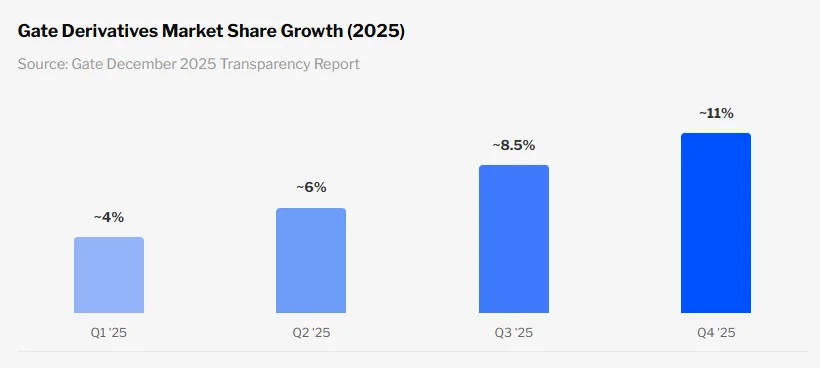
Gate’s derivatives market share reached 11% by year-end 2025, making it the fastest-growing exchange in that category.
Institutional crypto adoption is no longer experimental. It is structural. A Coinbase and EY-Parthenon survey of 351 decision-makers confirmed this shift. Some 73% plan to boost digital asset allocations in 2026. Meanwhile, 74% expect prices to rise within twelve months.
Gate Institutional is positioning itself at the center of this trend. The platform provides trading and financial services for hedge funds, market makers, and proprietary firms. It ranked first in BeInCrypto’s 2026 institutional trading platform rankings.
What Gate Institutional Offers
The platform covers spot, futures, options, and TradFi instruments. It supports over 4,500 trading pairs. Execution latency sits at approximately 2 milliseconds. Account activation typically completes within 48 hours.
Gate’s SuperLink protocol acts as its infrastructure backbone. It connects compliant custodians like BitGo, Copper, and Fireblocks. Client assets remain legally bankruptcy-remote from the exchange’s balance sheet. This design directly addresses post-FTX trust concerns.
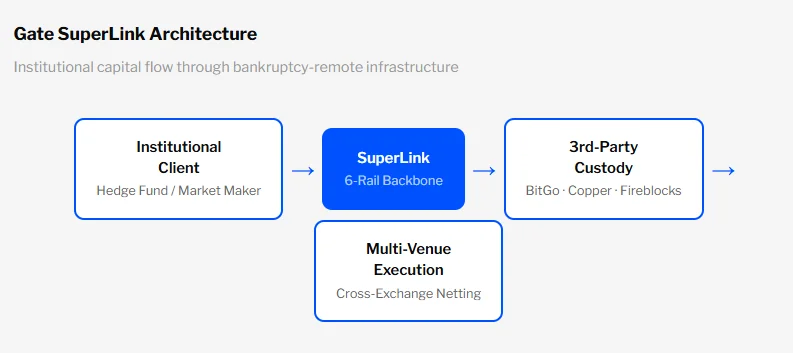
CrossEx, Gate’s cross-exchange trading platform, deepens this model. It lets institutions trade across Gate, Binance, and OKX through a single account. The unified API covers roughly 400 mainstream trading pairs.
Market Growth and Competitive Position
Gate’s derivatives market share reached approximately 11% by December 2025. That made it the fastest-growing exchange in the category for the year. Its registered user base surpassed 50 million users with 3,600+ listed digital assets.
The broader institutional landscape supports this trajectory. JPMorgan analysts noted in February 2026 that institutional flows would likely drive a recovery in the crypto market. Goldman Sachs data shows 35% of institutions cite regulatory uncertainty as the biggest hurdle. Another 32% view regulatory clarity as the top growth catalyst.
Institutional Sentiment in 2026
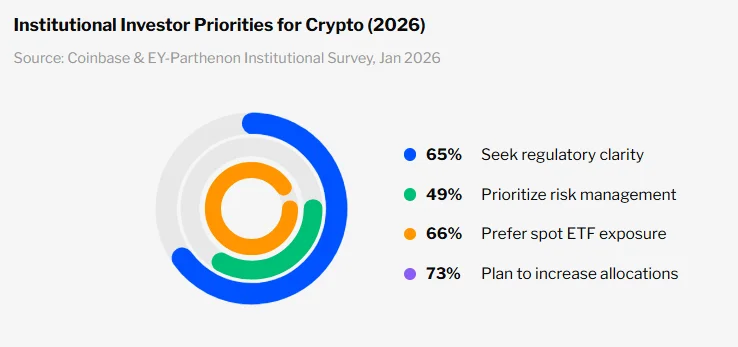
This sentiment shift goes beyond speculation. Coinbase’s head of institutional research called it a move toward “permanent operating models.” Institutions now demand governance, compliance, and custody before cost. Gate’s segregated custody and off-exchange settlement address exactly these concerns.
What Comes Next
Gate recently partnered with Bank Frick to launch institutional fiat deposit channels. Its GUSD stablecoin hit $120 million in minting within two weeks of launch. Total AUM peaked at $300 million. Simple Earn TVL reached a record $3.14 billion.
The exchange also obtained a MiCA license via Malta. It holds AUSTRAC registration in Australia. These regulatory milestones strengthen its cross-border institutional appeal.
However, challenges remain. Gate’s 50-million-user figure counts registrations, not active users. MiCA passporting faces political scrutiny across the EU. And competition is fierce. Citi plans institutional Bitcoin custody this year. Franklin Templeton just launched a dedicated crypto division.
Gate’s institutional bet rests on infrastructure neutrality. If SuperLink delivers on its promise of open, bankruptcy-remote, multi-venue access, the exchange may carve out a durable niche. In a market where 73% of institutions are increasing allocations, the race is not for attention. It is for trust.