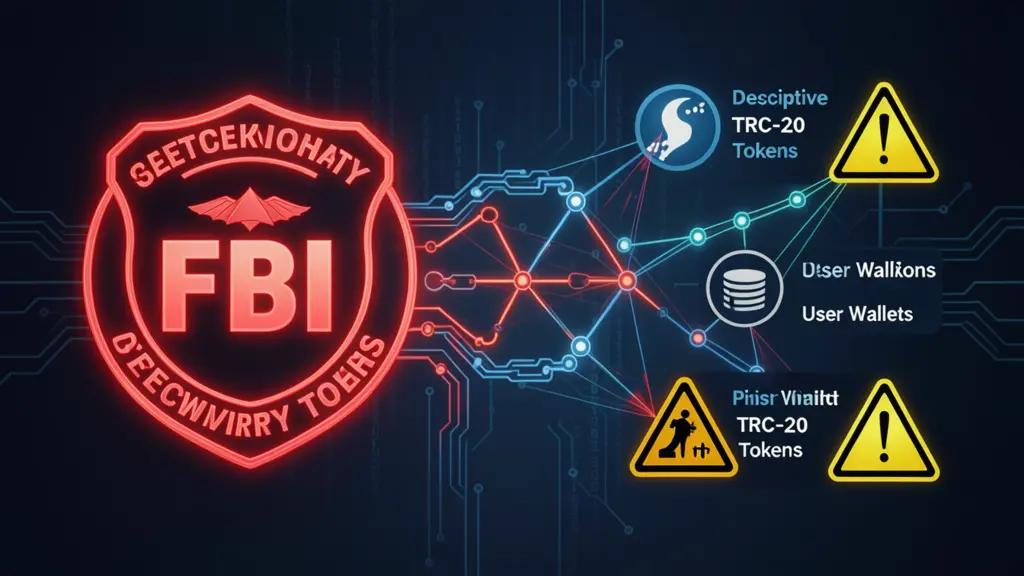
Catenaa, Monday, March 23, 2026- The Federal Bureau of Investigation on Thursday issued a public warning urging cryptocurrency users to be wary of fraudulent tokens on the Tron network that impersonate the agency in an elaborate phishing scam designed to steal personal information.
In a post on X from its New York field office, the FBI said the tokens are being sent unsolicited to users’ wallets and include messages claiming the recipient’s account is under investigation for alleged anti‑money‑laundering violations. The messages attempt to pressure users into providing personal identifying information or visiting external websites to “resolve” the purported issue — a common tactic in crypto phishing scams.
“If you receive a token from an account with the details below, do not provide any identifying information to any website associated with such token,” the FBI said, urging users on Tron to exercise caution when encountering assets purporting to be affiliated with the bureau.
According to the FBI’s shared screenshots and public alert, the phishing token is structured using the TRC‑20 token standard, a common format on the Tron network. Once a wallet receives such a token, scammers trigger on‑chain messages claiming an official investigation and threatening asset freezes or penalties unless the user complies with bogus requests for personal data.
Security experts say these schemes combine fear, urgency and the appearance of official language to manipulate victims into sharing sensitive details. This type of social engineering is increasingly common across crypto ecosystems, where malicious actors exploit trust in legitimate brands to deceive users.
The FBI did not disclose how many users might have been affected by the scam, but analysts warn that even a small number of successful interactions can lead to identity theft, wallet compromise or unauthorized access to digital assets. Victims who believe they have already been targeted are encouraged to report incidents to the bureau’s Internet Crime Complaint Center (IC3).
The FBI’s warning underscores a broader and growing trend of cryptocurrency‑related scams. According to the bureau’s annual Internet Crime Report, losses attributed to cryptocurrency fraud have surged over recent years, reflecting the rapid expansion of digital asset markets and the sophistication of criminal tactics. In 2023, the FBI’s Internet Crime Complaint Center received tens of thousands of complaints tied to cryptocurrency fraud, with reported losses running into the billions of dollars.
Fraud schemes vary widely, from phishing and impersonation to complex investment cons and “pig butchering,” in which criminals cultivate trust over time before extracting funds from victims. The FBI has noted that investment fraud — where victims are persuaded to send cryptocurrency under false pretenses — accounts for a significant portion of the financial losses reported annually.
Public service announcements from the FBI and IC3 highlight not only phishing scams but also fraudulent recovery services and impersonators of legitimate institutions, including exchanges and law enforcement agencies, all aiming to coax unwary users into divulging sensitive information or sending funds to malicious addresses.
The IC3, a division of the FBI focused on internet‑facilitated criminal activity, provides a centralized platform where victims can report suspected crypto fraud and scams. Established in 2000 to tackle online crime, the IC3 analyzes complaints and disseminates leads to law enforcement partners at federal, state, local and international levels.
Users who encounter suspicious tokens or messages, especially those claiming official affiliation with agencies such as the FBI, are advised not to click on external links, share personal details or respond with sensitive credentials. Cybersecurity guidelines recommend verifying any unsolicited communication through official channels and avoiding engagement with tokens or messages that create a false sense of urgency.
Filing a complaint through IC3.gov can also help authorities identify trending scams and develop mitigation strategies. Law enforcement officials stress that legitimate agencies never request personal information or credentials in unsolicited communications, and official communications from the FBI will always come from secure “.gov” domains.
The proliferation of fake tokens and phishing scams highlights the vulnerabilities inherent in decentralized finance, where users control private keys and must exercise heightened vigilance. Scammers increasingly impersonate trusted entities — from exchange support teams to regulatory agencies — to leverage blockchain transparency and fear tactics in pursuit of personal data or asset access.
As the crypto market continues to grow, security experts emphasize the importance of education, cautious interaction with unknown digital assets and the use of robust wallet security practices such as hardware wallets, strong authentication and verification of legitimate project credentials.