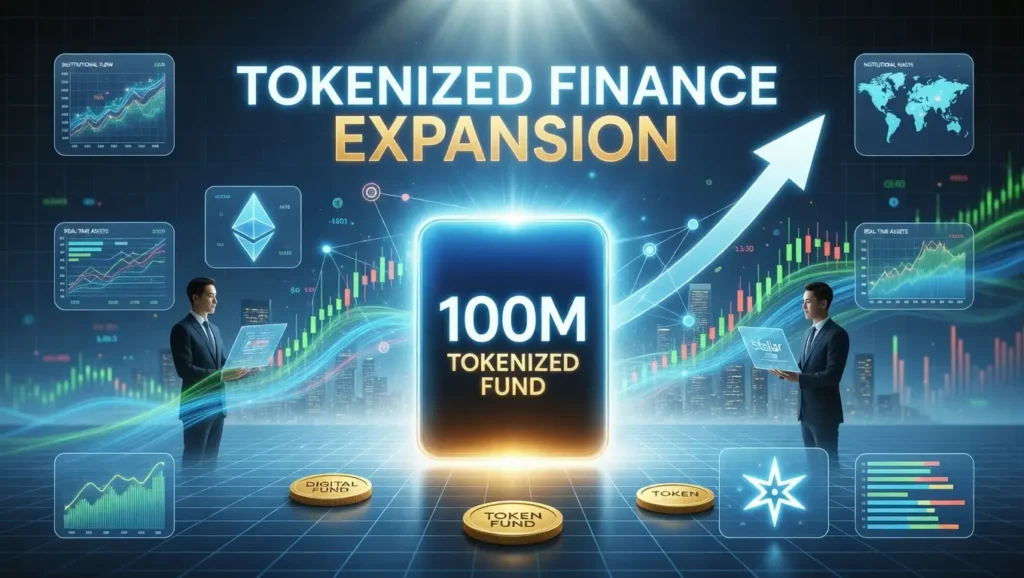
Catenaa, Thursday, March 19, 2026- Europe’s largest asset manager Amundi has launched a $100 million tokenized fund on blockchain networks, marking an expansion of institutional adoption of digital asset infrastructure in traditional finance.
The Paris-based firm introduced the Spiko Amundi Overnight Swap Fund, built on Ethereum and Stellar, with committed assets of $100 million. The fund is structured as a tokenized sub-fund under a French-regulated investment vehicle and targets corporate treasury and institutional liquidity management needs.
The product offers near-instant settlement, continuous transferability and real-time transparency through blockchain-based records. Investors can subscribe and redeem in multiple currencies, including the euro, U.S. dollar, British pound and Swiss franc.
The fund operates with CACEIS as depositary and administrator, while Spiko serves as transfer agent and tokenization platform. Chainlink supports onchain reporting by publishing the fund’s net asset value across supported networks.
Amundi acts as delegated investment manager, overseeing allocation and liquidity management through fully collateralized swap agreements with major financial institutions. The structure is designed to maintain overnight liquidity while enabling blockchain-based settlement.
This marks the firm’s second blockchain-based fund initiative in recent months, following an earlier tokenized share class launched on Ethereum in late 2025.
The launch reflects growing demand from institutional investors seeking faster settlement and improved transparency in cash management tools. Tokenization enables traditional financial assets to be represented digitally on blockchain networks, allowing automated processes and broader accessibility.
Industry data shows the tokenized real-world asset market has expanded rapidly, rising from about $15 billion at the start of 2025 to nearly $52 billion by March 2026. Growth has been driven by increasing interest from asset managers, banks and fintech firms exploring blockchain-based infrastructure.
Ethereum leads the segment in total value, followed by other specialized networks supporting financial applications. The expansion highlights competition among blockchain platforms to host institutional-grade products.
Tokenized funds aim to reduce settlement times from days to near-instant execution, while also lowering operational costs tied to reconciliation and record-keeping. Blockchain-based registers allow investors and administrators to access updated ownership data in real time.
The ability to transfer fund shares continuously across borders without relying on traditional intermediaries is seen as a major advantage for global treasury operations. Programmatic access through APIs and smart contracts also enables automated investment strategies and integrations with financial systems.
Amundi’s move signals that large asset managers are increasingly exploring blockchain infrastructure as part of their core operations rather than experimental projects. The initiative places pressure on competitors to develop similar offerings or risk falling behind in efficiency and client demand.
Other financial institutions have also begun testing tokenized funds, stablecoins and digital settlement systems as part of a broader shift toward digital finance. The trend reflects efforts to modernize legacy systems that often involve delays and higher transaction costs.
At the same time, challenges remain around regulatory alignment, interoperability and investor access, particularly across jurisdictions with different rules governing digital assets.
Analysts expect continued growth in tokenized financial products as infrastructure matures and regulatory frameworks become clearer. Expansion into additional blockchain networks and asset classes is likely as firms test scalability and investor demand.
Amundi indicated that access to the fund will initially be limited to professional investors, with plans to broaden distribution through digital channels over time.
The launch underscores a broader transition in global finance, where blockchain-based systems are increasingly integrated into traditional investment products to enhance efficiency, transparency and cross-border functionality.