Catenaa, Monday, March 23, 2026- Staff at the Commodity Futures Trading Commission published a frequently asked questions document Friday that explains how futures commission merchants and clearinghouses should handle crypto assets used as collateral in U.S. derivatives markets.
The FAQ, issued jointly by the CFTC’s Market Participants Division and Division of Clearing and Risk, builds on two staff letters from December 2025 that formed the basis of a digital assets pilot program allowing bitcoin, ether and USDC to be posted as collateral. The guidance aims to clarify operational practices for firms engaging in these arrangements under existing regulatory frameworks.
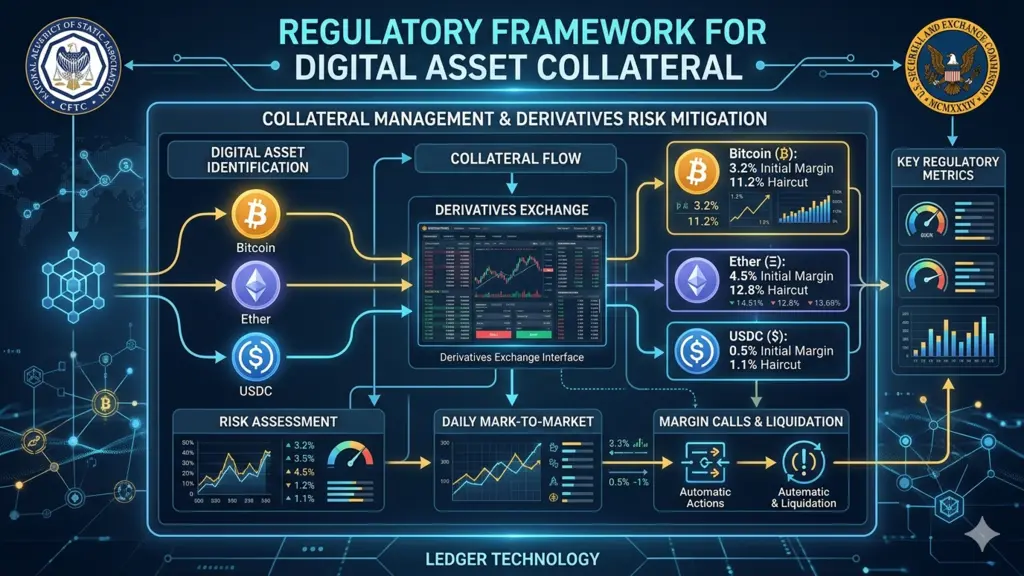
Among key points, the CFTC said it is aligning its capital charge, or “haircut,” framework with that of the Securities and Exchange Commission. Futures Commission Merchants holding proprietary positions in bitcoin or ether should apply a minimum 20 % capital charge, while payment stablecoins receive a 2 % charge. The FAQ cites the SEC’s February FAQ on matching haircut rates for broker‑dealers as a reference for this approach.
Context
The FAQ also sets boundaries on permissible uses of crypto in segregated customer accounts. FCMs may deposit their own payment stablecoins as residual interest, with the 2 % charge, but may not use bitcoin or ether for that purpose. Customer funds may not be invested in payment stablecoins, and the permitted investment list under CFTC rules remains in place.
For uncleared swaps, swap dealers generally may not use crypto assets, including stablecoins, as margin collateral. One exception applies to tokenized versions of assets already eligible, provided they carry the same legal and economic rights as traditional forms.
Derivatives clearing organizations, however, may accept crypto as initial margin for cleared transactions if the assets meet existing risk requirements. DCOs must set haircuts and conduct monthly reviews and stress testing.
Firms that want to rely on the CFTC’s no‑action letter must file a notice through the agency’s WinJammer system. They face an initial three‑month period in which they may only accept payment stablecoins, bitcoin and ether from customers, must report operational or cybersecurity issues, and must file weekly reports on crypto holdings. After three months, restrictions on the types of crypto assets they can accept may expand.
Implications
The FAQ also establishes a two‑phase definition of “payment stablecoin.” Before the GENIUS Act takes effect, a qualifying payment stablecoin must be USD‑denominated, issued by a state‑regulated money transmitter, trust company or national trust bank, maintain reserves in cash or U.S. Treasuries, and publish monthly reserve attestations. Once the GENIUS Act becomes law, issuers must meet that statute’s framework.
The underlying no‑action position traced back to a December request involving Coinbase Financial Markets and clearinghouse Nodal Clear, which sought to make USDC acceptable as collateral for U.S. futures trading. The FAQ notes it does not represent the views of the full Commission or create enforceable rights, but for firms that have awaited clarity on how crypto fits into derivatives infrastructure, it offers guidance on day‑to‑day operational expectations.