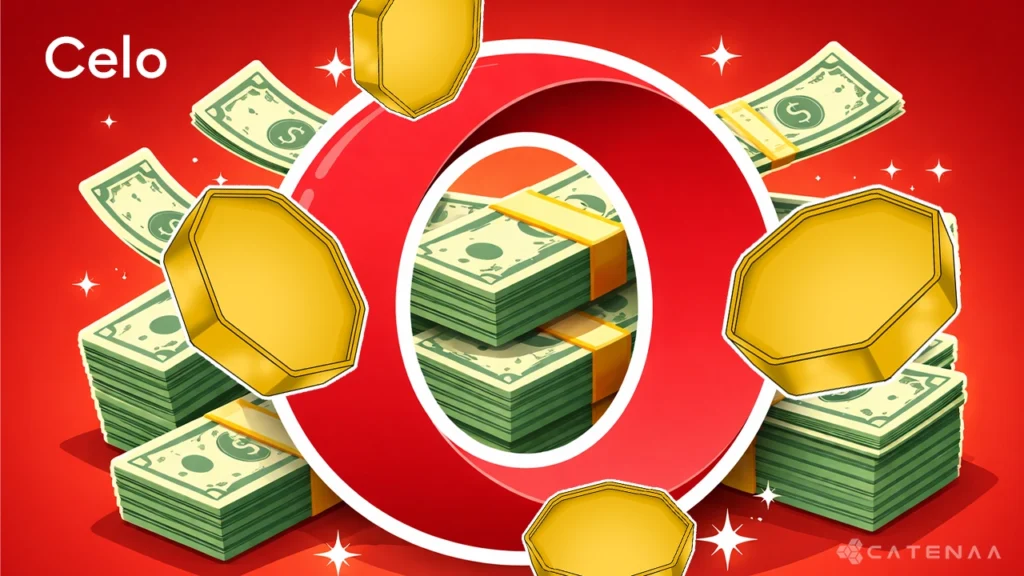
Catenaa, Monday, March 23, 2026-Celo, a mobile-focused blockchain, is seeking community approval to grant 160 million CELO tokens to web browser company Opera, aiming to deepen a long-term partnership and expand MiniPay adoption.
The grant, representing 16% of CELO’s maximum supply and valued at roughly $12 million, would make Opera one of the largest holders of CELO. Under the proposal, Opera would receive a one-time allocation from Celo’s treasury and commit not to sell the tokens for three years.
The proposal also limits the voting power from these tokens to 10% of staked CELO, maintaining governance balance on the network. CELO trading rose 4.58% to $0.081 following the announcement.
The grant would follow Celo’s existing U.S. dollar-denominated quarterly token support to Opera, designed to expand the MiniPay ecosystem within the browser’s Mini App framework. In 2023, the community approved a quarterly distribution totaling $568,182 in CELO to fund co-marketing, user rewards, and ecosystem development. Since MiniPay’s launch, Opera and Celo have expanded self-custodial wallets to 66 countries, facilitating more than 400 million transactions and supporting over 14 million users, including 4.23 million weekly active USD₮ users.
Celo completed its transition to an Ethereum Layer 2 network using the OP Stack last year after approximately two years of development. The move allows broader interoperability while maintaining low-cost global payments. The proposed grant would be drawn from Celo’s unreleased treasury, increasing circulating CELO tokens, which currently stand at 597.6 million.
The one-time grant could strengthen Opera’s alignment with Celo as a strategic stakeholder, potentially enhancing user engagement and driving MiniPay adoption in Latin America and Southeast Asia. By locking tokens for three years and capping voting influence, the proposal aims to balance incentives and governance control while promoting long-term collaboration. Analysts said granting a significant portion of CELO’s supply to a single partner carries both opportunities and risks. It may drive ecosystem activity but could also concentrate token ownership and influence in one corporate entity.
The expansion of MiniPay and Mini App rewards could accelerate stablecoin adoption and self-custodial wallet usage. Broader user access may increase transaction volumes and create more opportunities for third-party developers. Market observers noted that governance mechanisms such as voting caps and structured vesting periods are critical to prevent centralized control while leveraging strategic partnerships.
The proposal also signals a shift in how Layer 2 networks manage treasury allocations to incentivize commercial collaborations. By offering substantial token grants, blockchain projects can foster network growth and real-world adoption, particularly when partners control large user bases. For Celo, Opera’s 60 million users represent a gateway for scaling the ecosystem and increasing transaction throughput.
Blockchain analysts said the grant could transform Opera from a distribution partner into a committed long-term stakeholder, creating aligned incentives for platform development. They emphasized the importance of vesting and governance limits to maintain decentralization while leveraging strategic users.
Industry observers noted that partnerships between blockchain networks and major web platforms can accelerate adoption of self-custodial wallets and stablecoins. They said the proposal demonstrates how Layer 2 networks may employ treasury assets to strengthen commercial alliances, increase active users, and expand transaction volume. Experts also highlighted the potential for enhanced engagement in underserved markets like Southeast Asia and Latin America, where mobile-first blockchain adoption remains high.
Governance and community approval will ultimately determine whether the grant moves forward. Analysts say careful monitoring of token distribution, usage and voting influence will be critical to maintaining network balance and avoiding centralization risks.