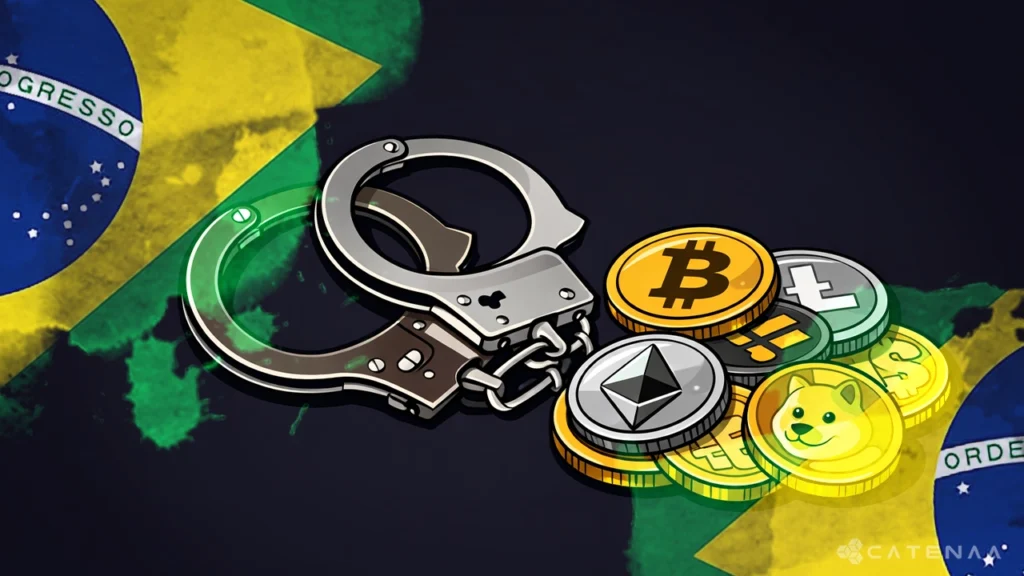
Catenaa, Monday, March 30, 2026- Brazil has enacted a new law allowing authorities to seize cryptocurrencies such as Bitcoin from criminal networks and redirect proceeds toward public security, marking a shift in how digital assets are treated in law enforcement strategy.
President Luiz Inácio Lula da Silva signed the legislation this week, expanding the state’s ability to target financial structures tied to organized crime. The law permits courts to freeze, seize and, in some cases, liquidate digital assets linked to serious offenses, with funds allocated to security programs.
The measure forms part of a broader crackdown on organized crime, giving authorities new tools to disrupt illicit financial flows. Judges can now order precautionary actions against both traditional and digital assets, including cryptocurrencies held in private wallets or on exchanges. In certain cases, early liquidation of seized assets is allowed, accelerating the transfer of funds into public security budgets.
Officials say the move aims to weaken criminal groups by cutting off financial resources. Authorities have long struggled to track and manage crypto-linked assets, which can be transferred quickly across borders. By integrating digital assets into existing asset seizure frameworks, Brazil is attempting to close that gap.
The law also addresses custody challenges. Public authorities will generally be responsible for holding seized crypto assets, unless technical constraints require alternative arrangements. This follows incidents in other jurisdictions where improper handling led to losses, highlighting risks tied to digital asset management.
Brazil introduced the bill in November amid wider efforts to tighten oversight of crypto-related activity. The push followed enforcement actions against illegal mining operations and concerns about the use of digital assets in organized crime and money laundering.
Globally, regulators are moving to adapt legal frameworks as cryptocurrencies gain wider adoption. While some countries focus on fostering innovation, others are prioritizing enforcement and financial monitoring.
Brazil’s approach reflects a dual objective: enabling law enforcement to act more effectively while recognizing the growing role of digital assets in the financial system. The law signals that cryptocurrencies are increasingly being treated not only as investment tools but also as assets subject to the same legal scrutiny as traditional forms of wealth.
The policy may influence other jurisdictions exploring similar measures, particularly as cross-border crime and digital finance continue to intersect. Analysts say enforcement capability will depend on how effectively authorities implement custody, tracing, and liquidation processes in practice.