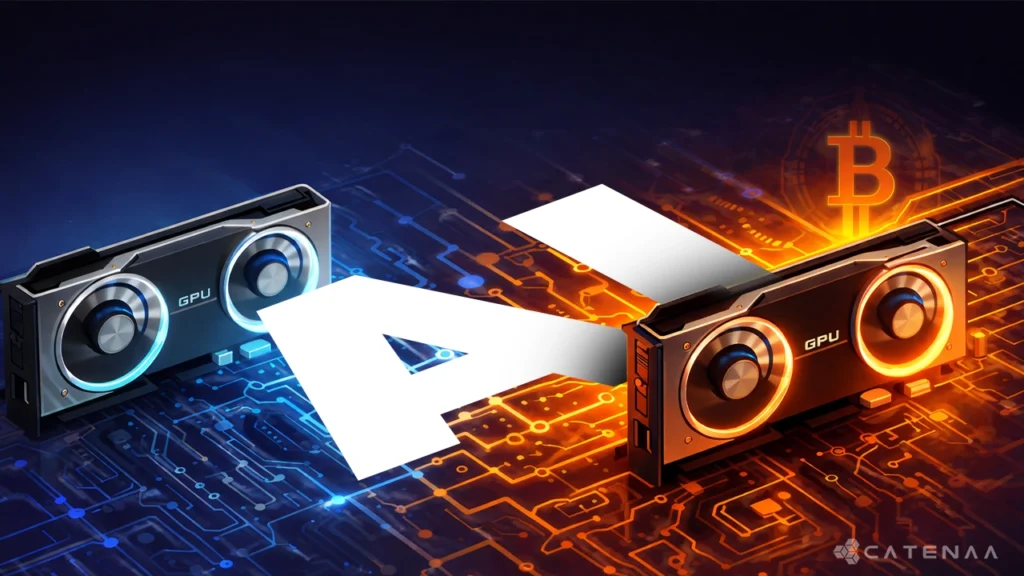
Catenaa, Friday, March 13, 2026- Publicly traded bitcoin mining companies are shifting infrastructure toward artificial intelligence computing as demand for data center power accelerates, according to analysis from VanEck.
Matthew Sigel, head of digital asset research at VanEck, said miners operate facilities already designed for energy-intensive computing and could repurpose that capacity for high-performance AI workloads.
The report argues that large mining companies trade at discounts compared with traditional data center operators despite controlling substantial energy infrastructure suited for AI training systems.
Companies such as Core Scientific and Riot Platforms have begun shifting part of their operations toward AI hosting and high-performance computing services.
Core Scientific has outlined plans to sell a portion of its bitcoin holdings to finance expansion into AI data centers, while Riot Platforms is exploring leasing energy capacity and infrastructure to technology companies seeking computing power.
Industry analysts say the transition is driven partly by growing electricity demand from AI training clusters. Research from Goldman Sachs estimates that data centers could account for about 8 percent of total US electricity consumption by 2030 as artificial intelligence systems scale.
Bitcoin mining sites already operate large power connections and cooling systems required for energy-dense hardware. That infrastructure allows facilities to host AI graphics processors with relatively limited retrofitting.
Modern AI clusters often use GPUs such as the NVIDIA H100, which consume large amounts of electricity and require dense server installations similar to cryptocurrency mining equipment.
Several miners also operate in regions with flexible power agreements or access to excess energy capacity. Facilities in Texas and other US states can reduce consumption during peak grid demand and resell electricity back to utilities.
These arrangements can generate additional revenue streams while preserving the ability to run mining operations during periods of lower energy prices.
The shift also reflects changing economics for bitcoin mining after the network’s most recent block reward halving, which reduced the amount of new bitcoin miners receive for processing transactions on the Bitcoin network.
Lower rewards have pushed companies to search for alternative income sources that use existing infrastructure more efficiently.
Industry executives say combining bitcoin mining with AI hosting can stabilize revenue by balancing cryptocurrency price volatility with long-term computing contracts.
Some companies have already secured multiyear agreements to host AI clusters for external customers, while others are developing hybrid facilities that allocate computing capacity dynamically between mining operations and artificial intelligence workloads.
Investors have responded with renewed interest in mining stocks tied to AI expansion. Some publicly traded miners have reported large share gains over the past year, reflecting expectations that their energy infrastructure could become valuable as computing demand grows.
Analysts say the emerging model positions large bitcoin mining operators as potential suppliers of power and computing capacity for the expanding artificial intelligence economy.