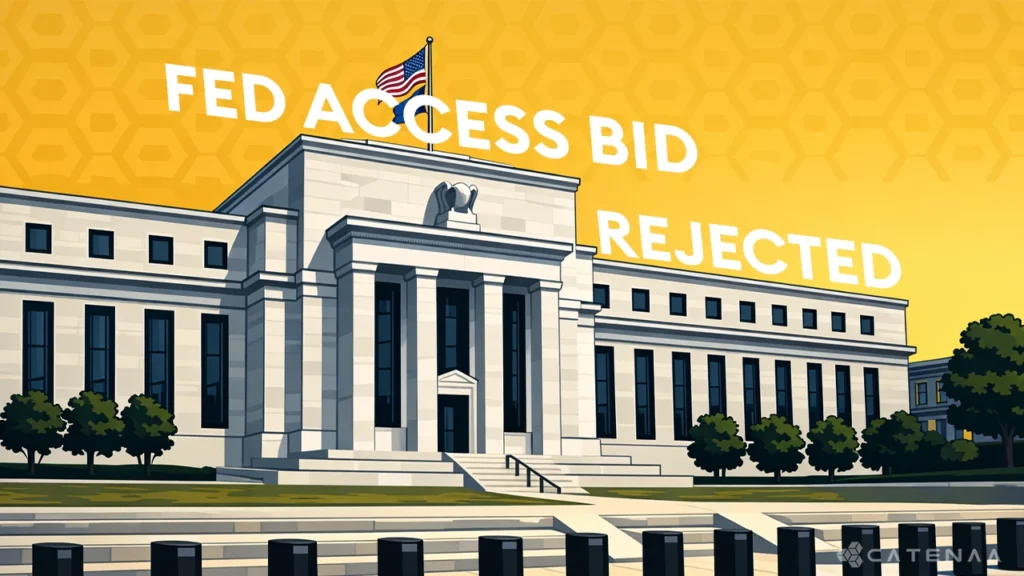
Catenaa, Monday, March 15, 2026- A US federal appeals court rejected Custodia Bank’s final attempt to gain direct access to the Federal Reserve payment system, ending a five-year legal dispute over whether crypto-focused banks can hold master accounts with the central bank.
The ruling came Friday from the US Court of Appeals for the Tenth Circuit in Denver, which voted 7-3 to deny the bank’s petition and uphold the authority of the Federal Reserve to decide which institutions receive master accounts.
The decision concludes litigation launched after regulators rejected Custodia’s 2020 application for a master account. Such accounts allow financial institutions to hold reserve balances directly at the Federal Reserve and access payment systems including Fedwire.
Custodia argued that the Monetary Control Act of 1980 entitles qualified state and federally chartered institutions to obtain those accounts. Federal judges ruled that the law does not remove the central bank’s discretion to evaluate risk before granting access.
Custodia was founded by Caitlin Long and operates under a special purpose depository institution charter issued by Wyoming. The charter requires the bank to maintain full liquid reserves rather than lending customer deposits.
Supporters of the bank argued that the model eliminates many traditional banking risks because deposits remain fully backed by liquid assets. Critics said the institution’s focus on digital assets and the absence of federal deposit insurance raised supervisory concerns.
The Federal Reserve’s Kansas City branch originally reviewed the application before denying it in October 2021. Custodia then filed suit, claiming the central bank improperly delayed and rejected the request despite meeting regulatory requirements.
A federal district court supported the Fed’s position in 2023, and the Tenth Circuit affirmed that ruling in early 2025. The appeals court declined to reconsider the case again in its latest vote.
In a dissenting opinion, Judge Timothy Tymkovich argued that denying master account access could severely limit the ability of state-chartered banks to compete if no explicit legal exclusion exists.
Master accounts allow banks to settle payments directly through the Federal Reserve rather than relying on correspondent banks. Financial institutions without direct access must route transactions through partner banks, which can add costs and operational complexity.
The ruling arrives as regulators evaluate new ways for crypto firms to connect with traditional financial infrastructure. Earlier this month, the Kraken exchange secured a restricted master account through the Federal Reserve Bank of Kansas City.
That arrangement allows limited settlement functions but excludes some services such as check clearing or automated clearinghouse payments. Regulators view such restricted accounts as a possible compromise between access and risk management.
Other digital asset companies are pursuing different regulatory paths to gain banking privileges. Firms including Ripple Labs, Circle Internet Financial and Paxos have explored national trust or banking charters that could allow closer integration with the financial system.
Some fintech companies are also seeking industrial loan company charters or national bank licenses from the Office of the Comptroller of the Currency.
Analysts say the Custodia ruling highlights continuing debate about how digital asset firms should interact with the US banking system. While policymakers have encouraged innovation in payment technologies, regulators remain cautious about integrating crypto-native institutions into core central bank infrastructure.
The Federal Reserve has developed tiered policies for evaluating master account requests, particularly from nontraditional financial institutions. Those policies emphasize safety, financial stability and operational risk when reviewing applications.
Industry groups say the court decision may push more crypto firms toward partnerships with traditional banks or toward limited access arrangements similar to Kraken’s model.
For Custodia, the ruling ends its legal effort to obtain direct access to the Federal Reserve’s payment rails. The bank may continue operating under its Wyoming charter but must rely on correspondent banking relationships to connect with the broader US financial system.
The decision also signals that federal courts are likely to defer to the central bank’s discretion in determining which institutions qualify for direct participation in the Federal Reserve payment network.