April 01, 2026 – Shielded transactions hit 59.3% as encryption-first design outpaces obfuscation. Quantum-resistant upgrades and $90M in institutional capital signal a structural shift.
In Summary
Zcash shielded transactions reached 59.3% in February 2026.
Cypherpunk Technologies acquired over $90M in ZEC.
Project Tachyon targets post-quantum resistance via lattice-based cryptography.
Machine-learning attacks now link wallet IPs with 95%+ accuracy on transparent chains.
NIST finalised three post-quantum standards in August 2024.
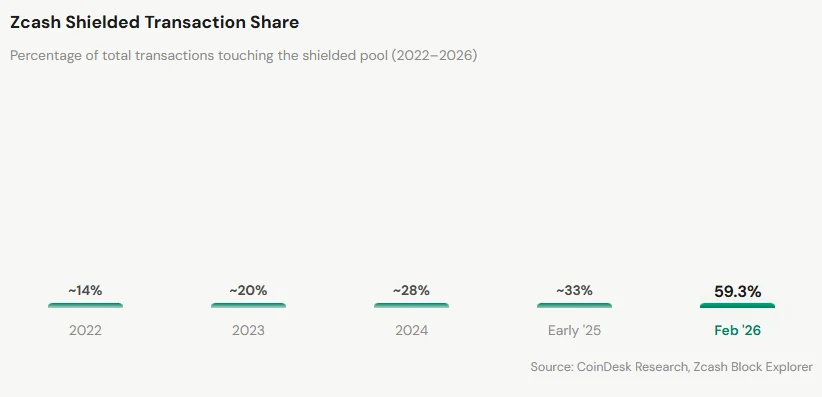
Crypto privacy is no longer a niche ideology. It is becoming a structural necessity. Zcash’s share of shielded transactions reached 59.3% in February 2026, nearly double its early 2025 rate. The driver was simple: wallet defaults changed.
The Zodl wallet now automatically routes users into encrypted pools. It uses Unified Addresses to shield activity by default. This design choice alone doubled adoption. Privacy works best when users do not have to ask for it.
Obfuscation Is Failing at Scale
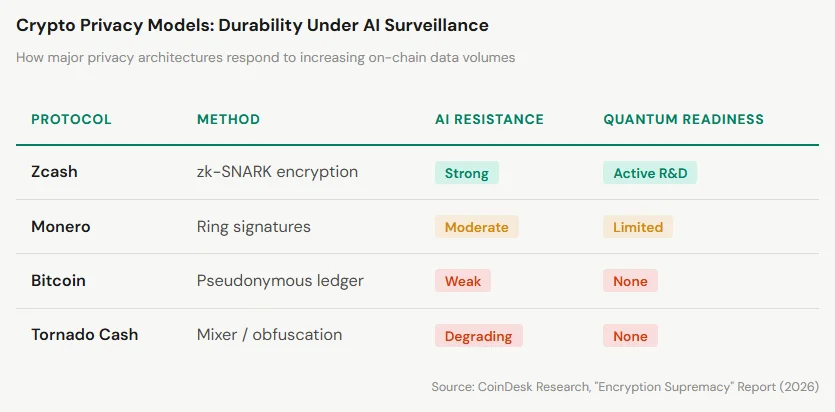
Machine learning can now classify Bitcoin transaction patterns from on-chain metadata alone. The TRAP attack links IP addresses to wallet pseudonyms across Bitcoin, Ethereum, and Solana. It achieves 95% or higher accuracy without legal process.
The core problem is structural. Obfuscation degrades as training data grows. More blockchain activity means better models. Encryption-based approaches, like Zcash’s, strengthen under scale. Each shielded transaction expands the anonymity set.
The Quantum Clock Is Ticking
A recent Caltech and Oratomic paper sharply compressed quantum threat timelines. Researchers found that as few as 10,000 physical qubits could break ECC-256 encryption. That standard secures Bitcoin and Ethereum wallets today.
Zcash’s response is Project Tachyon. It introduces Oblivious Synchronisation. This removes encrypted note data from the blockchain entirely. Only proofs and commitments remain on-chain. There is no ciphertext for a future quantum computer to harvest.
Zcash researchers are also testing NIST-finalised lattice-based algorithms. NIST published three post-quantum standards in August 2024. Two algorithms are under active evaluation: ML-KEM for key encapsulation and ML-DSA for digital signatures.
Institutional Money Flows In
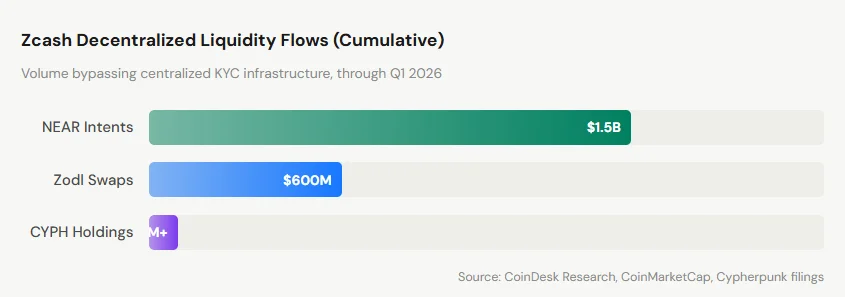
Capital is following the technology shift. Cypherpunk Technologies (Nasdaq: CYPH), backed by the Winklevoss twins, has accumulated over $90 million in ZEC. It also led the Zodl wallet’s seed funding round.
Grayscale framed Zcash as a repricing opportunity. The asset manager argued that AI surveillance will make privacy a core monetary feature. ZEC accounts for roughly 0.3% of the $1.6 trillion cryptocurrency segment. Even a minor shift in privacy demand could produce outsized returns.
Governance Fragments by Design
In Q1 2026, Zcash split its centralised development model. The original ECC team resigned in January. Three independent entities now manage the ecosystem. The Zcash Foundation handles governance. Shielded Labs focuses on network sustainability. Zodl pursues commercial wallet development.
This fragmentation is deliberate. Specialised teams move faster. Commercial fundraising options opened up. The Zodl team previously raised private capital that was blocked under a nonprofit structure. The approach mirrors the protocol’s own decentralisation thesis.
What Comes Next
ZEC trades near $248, with a market cap of around $4.1 billion. It ranks 22nd by market capitalisation. The token surged by over 700% since late September 2025. Yet it remains a fraction of the total crypto market.
The thesis is straightforward. Obfuscation-based privacy weakens as data grows. Encryption-based privacy strengthens. Zcash is betting that mathematics will outperform heuristics. If AI surveillance accelerates, that bet becomes harder to ignore.