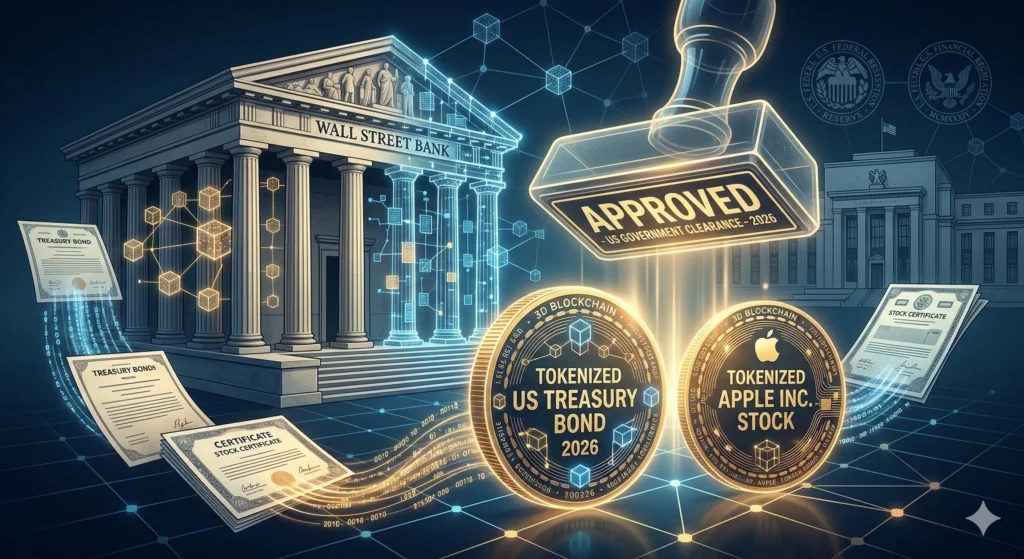
March 09, 2026 – The three primary U.S. banking regulators issued a landmark joint guidance on March 5, 2026. The Federal Reserve, Office of the Comptroller of the Currency (OCC), and Federal Deposit Insurance Corporation (FDIC) confirmed that tokenised securities will receive identical capital treatment to traditional assets. The move eliminates a key barrier for banks exploring blockchain-based finance.
The agencies declared that their capital framework is “technology neutral.”[1] In practice, this means a tokenised Treasury bond receives the same risk weighting as its paper equivalent. Banks will not face additional capital charges simply because an asset resides on a blockchain.
A $26 Billion Market Gets Regulatory Clarity
The guidance arrives as tokenised real-world assets (RWAs) have surged to approximately $26 billion on public blockchains.[2] Tokenised U.S. Treasuries alone have attracted nearly $2 billion in fresh institutional inflows since January 2026.[3] The tokenised stock market has grown more than 50-fold in 2025, rising from under $30 million to over $1 billion.[4]
Major asset managers have moved aggressively into this space. BlackRock’s USD Institutional Digital Liquidity Fund attracted over $550 million within months of its launch. Franklin Templeton and Securitise are also building on-chain fund products. JPMorgan’s Kinexys network processed $1.5 trillion in tokenised transactions by the end of 2024.
Table 1: Tokenised Real-World Asset Market Breakdown (2025)
| Asset Class | Market Share (%) | Estimated Value (USD) |
| Private Credit | 58% | $15.1 billion |
| U.S. Treasuries | 34% | $8.8 billion |
| Tokenized Equities | 4% | $1.1 billion |
| Other (Real Estate, Commodities) | 4% | $1.0 billion |
Source: RWA.xyz, CoinLaw Asset Tokenisation Statistics 2026
Going Beyond Basel: A Technology-Neutral Approach
This guidance goes further than the international Basel standards require. The original 2023 Basel III Endgame proposal would have increased capital requirements by roughly 16% for the largest banks.[5] Under the Trump administration, regulators have pivoted toward a capital-neutral approach instead.[6]
Crucially, the new rules apply equally to permissioned and permissionless blockchains. Previous Biden-era guidance treated public chains like Ethereum as inherently riskier. The current framework rejects that distinction entirely. It focuses on the economic substance of the asset, not its technical infrastructure.
Vice Chair for Supervision Michelle Bowman has signalled that a revised Basel III Endgame proposal will arrive in early 2026. The final rule could be implemented as soon as 2027.[7] The tokenised securities guidance fits within this broader deregulatory agenda.
Table 2: U.S. Tokenised Securities Regulatory Timeline
| Date | Regulatory Action | Issuing Agency |
| Jan 2025 | Executive Order on digital assets growth | White House |
| Nov 2025 | Joint FAQ: tokenised securities capital treatment | Fed, OCC, FDIC |
| Dec 2025 | FDIC stablecoin rulemaking proposal (GENIUS Act) | FDIC |
| Mar 2026 | Joint FAQ: tokenized securities capital treatment | Fed, OCC, FDIC |
| H1 2026 | Capital-neutral Basel III Endgame proposal (expected) | Fed |
| Jul 2026 | GENIUS Act stablecoin framework deadline | Interagency |
Sources: OCC, FDIC, Freshfields, Bloomberg Professional Services, Capstone DC
Institutional Adoption Accelerates
The broader asset tokenisation market was valued at $2.08 trillion in 2025. It is projected to reach $18.74 trillion by 2031, growing at a 44.25% CAGR.[8] Citigroup estimates that tokenised securities alone could reach $4–$5 trillion by 2030.[9]
Approximately 86% of institutional investors already have exposure to, or plan to invest in, digital assets. High-net-worth individuals aim to allocate 8.6% of their portfolios to tokenised assets by 2026. Over 200 institutional RWA projects are currently active, backed by more than 40 major financial institutions.
Table 3: Tokenised Asset Market Growth Projections
| Year | Estimated Market Value | Source |
| 2024 | $25.8 billion | Market.us |
| 2025 | $2.08 trillion | Mordor Intelligence |
| 2026 (est.) | $3.01 trillion | Mordor Intelligence |
| 2030 (est.) | $4–5 trillion | Citigroup |
| 2031 (est.) | $18.74 trillion | Mordor Intelligence |
| 2034 (est.) | $30 trillion | Standard Chartered |
Sources: Mordor Intelligence, Market.us, Citigroup, Standard Chartered, CoinLaw
Strategic Implications for Banks
Banks can now integrate tokenised securities into balance sheet management without penalty. Near-instant settlement, 24/7 trading, and reduced counterparty risk become accessible. The collateral treatment is equally significant. Tokenised assets that meet legal ownership requirements can serve as credit risk mitigants under existing repo and lending frameworks.
The Depository Trust Company (DTC) will begin creating blockchain-based digital twins of securities it already holds in 2026. This includes U.S. equities, ETFs, and Treasury securities on approved distributed ledger networks. The move embeds compliant tokenisation directly within core market infrastructure.
Platforms such as Robinhood, Kraken, Securitise, and Coinbase are competing to provide access. Superstate’s Opening Bell platform has already surpassed $1 billion in assets under management. It allows public companies to issue shares directly onto networks like Solana and Ethereum.
The Bottom Line
The March 5 guidance marks a decisive inflexion point. U.S. regulators are no longer treating blockchain finance as experimental. Instead, they are integrating it into the existing banking rulebook. For institutional investors, this removes the last major capital-related barrier to adoption.
The question is no longer whether tokenised securities belong in mainstream banking. It is how quickly banks will move to capture the operational efficiencies and liquidity advantages that blockchain infrastructure offers. With regulators now firmly aligned, the race to tokenise has entered a new phase.
[1]OCC News Release NR-IA-2026-14, March 5, 2026. https://www.occ.gov/news-issuances/news-releases/2026/nr-ia-2026-14.html
[2]RWA.xyz Tokenized Assets Dashboard, accessed March 2026.
[3]Blockchain Magazine, March 6, 2026.
[4]Cornell University, Tokenized Equities Research Brief, February 2026.
[5]Bloomberg Professional Services, Basel III Endgame Analysis, September 2025.
[6]Capstone DC, Banking 2026 Preview, December 2025.
[7]Freshfields 2025 Bank Regulatory Roundup, February 2026. https://blog.freshfields.us
[8]Mordor Intelligence, Asset Tokenization Market Report, January 2026.
[9]CoinDesk, March 5, 2026. https://www.coindesk.com/policy/2026/03/05/u-s-banking-agencies-say-capital-should-be-same-for-standard-or-tokenized-securities