
March 27, 2026 – Q4 robotaxi revenue surges 160% as the trio targets Zagreb for Europe’s first driverless ride-hailing service, with 20+ cities planned by year-end.
In Summary
Pony.ai, Uber and Verne will launch Europe’s first commercial robotaxi in Zagreb, Croatia.
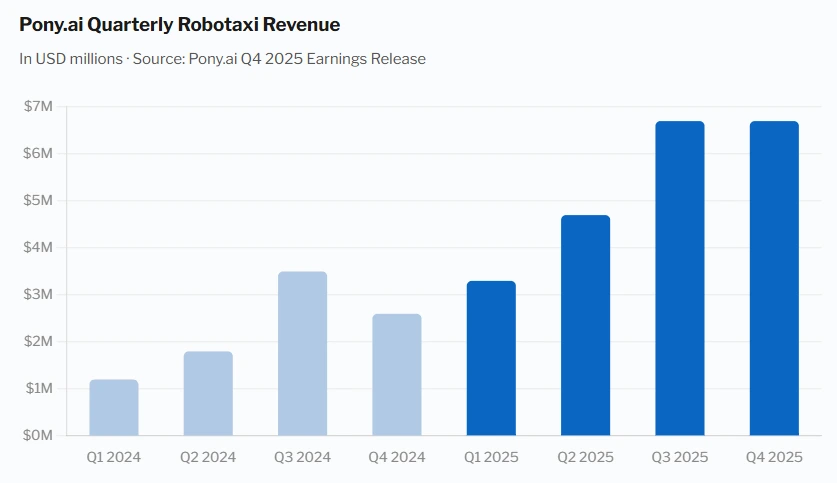
Q4 2025 robotaxi revenue hit $6.7 million, a 160% year-over-year increase.
Fare-charging revenue jumped over 500% in the same quarter.
Fleet size now exceeds 1,400 vehicles. The 2026 target is 3,000+.
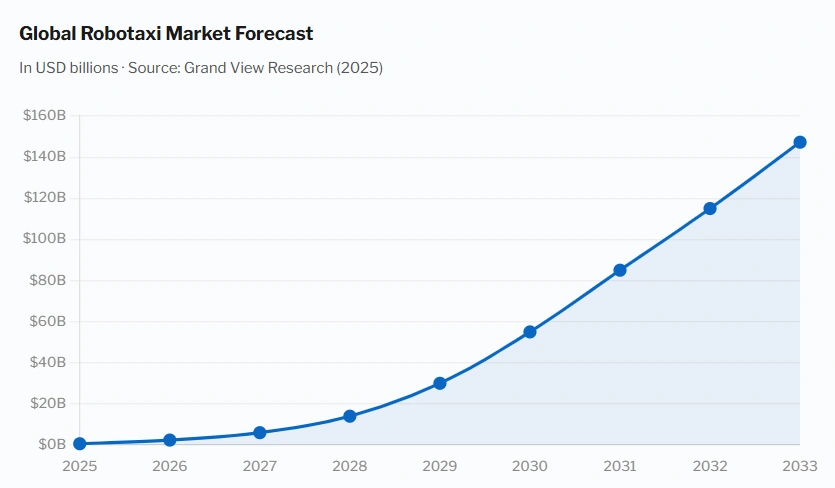
The global robotaxi market could surpass $147 billion by 2033.
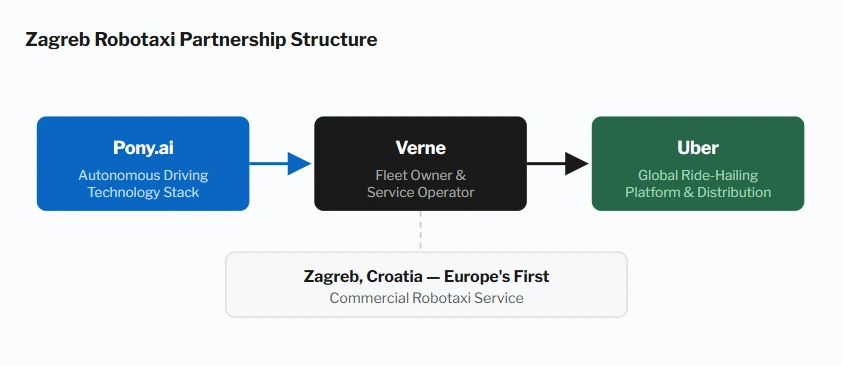
Pony.ai has entered a three-way partnership with Uber and Verne. The trio plans to deploy Europe’s first commercial robotaxi service. Zagreb, Croatia’s capital, will host the launch.
Under the deal, each partner fills a distinct role. Pony.ai supplies its autonomous driving stack. Verne owns and operates the fleet. Uber plugs the service into its global ride-hailing network.
Revenue Growth Accelerates Sharply
The partnership announcement coincided with strong Q4 2025 results. Robotaxi revenue reached $6.7 million in Q4. That marks a 160% gain from the year-ago quarter. Fare-charging revenue alone soared over 500%.
For the full year, robotaxi revenue totaled $16.6 million. This represents a 129% annual increase. The acceleration stems from its Gen-7 fleet rollout.
The company achieved unit economics breakeven in Guangzhou and Shenzhen. On its peak day, each Gen-7 vehicle earned RMB 394 in net revenue. That came with roughly 25 daily orders per vehicle.
Fleet Expansion Targets Are Ambitious
Pony.ai’s fleet now exceeds 1,400 robotaxis. As of March 25, it had produced 1,446 vehicles. The company targets 3,000+ vehicles by year-end 2026.
A strategic partnership with Toyota supports mass production. Toyota is funding a significant share of the fleet expansion. The asset-light “joint deployment” model reduces Pony.ai’s capital burden.
Geographic reach is expanding rapidly too. The company plans to operate in 20+ cities globally. Nearly half of those will sit outside China.
Market Context: A $147 Billion Opportunity
The deal arrives as the global robotaxi market enters hypergrowth. Grand View Research estimates the market at $0.61 billion in 2025. It projects growth to $147.25 billion by 2033. That implies a 99.1% compound annual growth rate.
North America held 90% of the market in 2025. However, Europe is catching up. The EU’s Green Deal and Smart Mobility Strategy both favour autonomous transport.
Waymo currently leads with over 2,500 vehicles. Baidu’s Apollo Go is expanding into the Middle East. Pony.ai’s entry into Europe via Croatia marks a new frontier.
Why This Deal Matters
Europe lacks a commercial robotaxi service today. Zagreb offers a controlled entry point. Croatia’s smaller market allows testing before scaling to larger cities.
For Uber, the deal extends its autonomous vehicle strategy. The company already partners with Lucid and Nuro for a Bay Area robotaxi launch planned later this year. Adding Pony.ai diversifies its AV supplier base.
Pony.ai’s CTO described robotaxis as the first true application of “physical AI.” This refers to AI systems operating in real environments. NVIDIA’s Jensen Huang recently called 2026 the inflection point for this technology category.
Risks and Open Questions
Pony.ai still operates at a loss. Analysts estimate a Q4 loss of $0.20 per share. Scaling from breakeven in two cities to profitability across 20+ remains unproven.
Regulatory fragmentation across Europe poses another challenge. Each country has its own autonomous vehicle rules. Croatia’s framework may not transfer easily to Germany or France.
Still, the numbers tell a compelling story. Revenue is accelerating. The fleet is growing. And Europe just opened its door to driverless rides.