March 15, 2026 – The automaker’s plan to manufacture 200 billion AI chips annually would rival TSMC’s scale, but semiconductor fabs are among the hardest industrial projects on Earth.
Elon Musk confirmed that Tesla’s Terafab Project will launch on March 21. As a result, the announcement puts a firm date on the most ambitious semiconductor venture ever attempted by an automaker. However, enormous execution risks remain.
The Numbers Behind the Bet
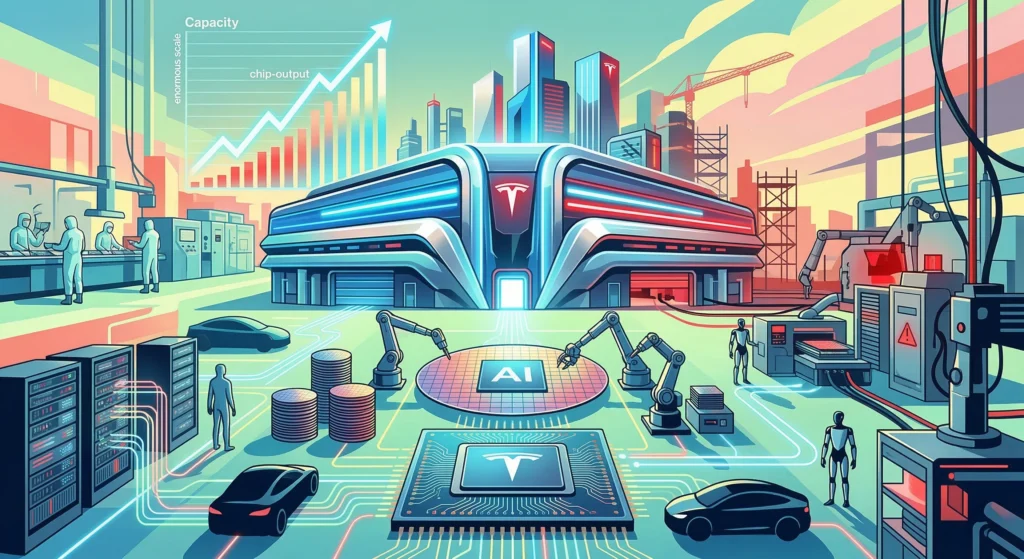
Terafab is a vertically integrated chip fabrication facility. Specifically, the plant will combine logic processing, memory storage, and advanced packaging under one roof. Consequently, no private company outside Taiwan and South Korea currently operates at this scale.
Tesla’s Terafab carries an estimated price tag of approximately $25 billion. Furthermore, this figure sits atop Tesla’s record 2026 capital expenditure plan, which exceeds $20 billion. In addition, CFO Vaibhav Taneja acknowledged that the full Terafab cost has not yet been factored into the budget.
Moreover, production targets are staggeringly large. The facility aims to produce between 100 and 200 billion custom AI chips per year. Initially, output targets 100,000 wafer starts per month. Eventually, the ambition is to scale to one million wafer starts per month. In other words, that would represent roughly 70% of TSMC’s current total output.
Additionally, Tesla is targeting 2-nanometre process technology for the plant. This is the most advanced node currently in commercial production. As a result, Tesla’s fifth-generation AI chip, the AI5, is among the first products Terafab will produce. Consequently, small-batch production is expected in 2026, with volume production projected for 2027.
A Multi-Pronged Chip Strategy
Importantly, Terafab does not exist in isolation. In fact, Tesla is also pursuing a parallel manufacturing strategy. For instance, Samsung Electronics signed an eight-year, $16.5 billion deal in July 2025. Under that agreement, Samsung will produce Tesla’s AI6 chip at its facility in Taylor, Texas.
Currently, Samsung manufactures Tesla’s AI4 chip. Meanwhile, TSMC is slated to produce the AI5—first in Taiwan, then at its Arizona facility. Therefore, this dual-sourcing approach reflects Tesla’s effort to reduce geopolitical supply chain risk. For context, Samsung holds just 8% of the global foundry market, while TSMC dominates with 67%.
Who Terafab Really Serves
First and foremost, the immediate beneficiary is Tesla itself. AI chips power three core programmes: Full Self-Driving, Cybercab robotaxi, and the Optimus robot line. Notably, Musk has stated that Optimus alone requires chip volumes no external supplier can guarantee.
In addition, the less obvious beneficiary is xAI, Musk’s artificial intelligence company. Specifically, Musk has described Terafab’s scope as including chips for Dojo, Tesla’s supercomputer. It will also supply Grok model training infrastructure. As a result, Terafab would make xAI’s next-generation compute fully independent of third-party silicon.
Furthermore, recent hiring moves reinforce this trajectory. For example, xAI hired Devendra Chaplot, co-founder of Mistral AI, to train the Grok model. Similarly, Andrew Milich and Jason Ginsberg, who scaled Cursor to $2 billion in revenue, also joined. Consequently, the pattern shows a company rebuilding its model and product layers simultaneously.
The Execution Risk Is Enormous
However, building a semiconductor fab from scratch is arguably the hardest industrial challenge in the world. Even established manufacturers struggle with yields at smaller process nodes. In fact, Nvidia CEO Jensen Huang has argued that chip fabrication demands decades of accumulated expertise.
Moreover, a March 21 “launch” almost certainly does not mean a fully operational facility. Typically, semiconductor fabs of this scale take years to construct and commission. In contrast to Musk’s ambitious timelines, Tesla’s track record is mixed. For instance, the Cybertruck, originally promised for 2021, did not ship until late 2023.
Additionally, the financial burden is significant. Tesla shares closed at $391.20 on March 13, 2026, near their 200-day moving average. The stock has a market capitalisation of $1.47 trillion. Therefore, committing $25 billion to a single facility represents substantial capital risk.
What It Means for the AI Chip Market
The global AI chip market was valued at $52.92 billion in 2024. Furthermore, it is projected to reach $295.56 billion by 2030, at a 33.2% compound annual growth rate. As a result, Tesla’s entry as a vertically integrated chip manufacturer would reshape competitive dynamics.
If Terafab succeeds, Tesla becomes one of a handful of entities producing frontier AI silicon in-house. Consequently, this would fundamentally change its cost structure for autonomous vehicles and robotics. In conclusion, March 21 is the next marker on that path. Ultimately, whether Tesla can execute remains the $25 billion question.
SOURCES
1. Musk, E. (2026, March 14). “Terafab Project launches in 7 days.” X. https://x.com/elonmusk/status/2032814398033768737
2. Tesla Q4 2025 Earnings Call (2026, January 28). Bloomberg. https://www.bloomberg.com/news/articles/2026-01-28/musk-says-tesla-needs-to-build-terafab-to-manufacture-chips
3. Tesla Q4 2025 Earnings Call Highlights. Investing.com. https://ca.investing.com/news/company-news/tesla-inc-tsla-q4-2025-earnings-call-highlights-navigating-growth-amidst-challenges-4424965
4. Samsung-Tesla $16.5B Chip Deal (2025, July 28). CNN Business. https://www.cnn.com/2025/07/28/business/tesla-samsung-chip-deal
5. Samsung-Tesla AI6 Contract (2025, July 28). TechCrunch. https://techcrunch.com/2025/07/28/tesla-signs-16-5b-deal-with-samsung-to-make-ai-chips/
6. Samsung Foundry Market Share. TrendForce (via Carbon Credits, July 2025). https://carboncredits.com/teslas-game-changing-16-5bn-samsung-deal-for-ai-chips/
7. AI Chip Market Size – $52.92B in 2024, projected $295.56B by 2030 (CAGR 33.2%). Carbon Credits analysis.
8. Tesla Stock Data (March 13–14, 2026). MacroTrends / Robinhood / Investing.com.
9. Reuters (2026, March 14). “Musk Says Tesla’s Mega AI Chip Fab Project to Launch in Seven Days.”
10. FinTech Weekly (2026, March 14). “Tesla Terafab Project: Elon Musk Confirms Launch in Seven Days.”