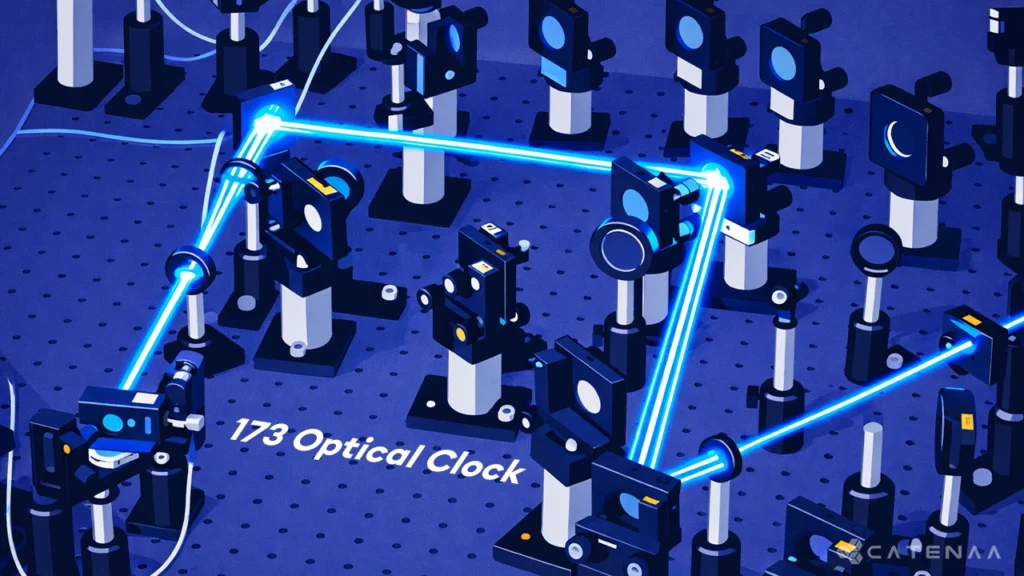
Catenaa, Thursday, March 19, 2026- German researchers have demonstrated a new optical atomic clock based on ytterbium-173 ions that combines single-ion precision with multi-ion stability, advancing efforts to redefine the international second.
Scientists at the Physikalisch-Technische Bundesanstalt, working with Thailand’s National Institute of Metrology (Thailand), reported results in *Physical Review Letters* describing a multi-ion clock architecture that addresses long-standing challenges in optical frequency measurement. The system leverages unique nuclear properties of ytterbium-173 to enable stable laser excitation of a previously difficult quantum transition.
Researchers said the design could position ytterbium-173 among leading candidates for replacing the cesium-based definition of the second within the coming decade.
Traditional atomic clocks rely on cesium atoms, which define the second through microwave frequencies. The current standard is based on the cesium hyperfine transition established in 1967.
Optical clocks operate at much higher frequencies, enabling far greater precision. However, many optical transitions are difficult to excite because they are quantum mechanically “forbidden,” requiring intense lasers that can disturb atomic motion and introduce measurement errors.
Ytterbium-173 features a nuclear spin of I=5/2 and a deformed nuclear structure that interacts strongly with surrounding electrons. This interaction partially relaxes selection rules, making the 2S1/2 to 2F7/2 transition accessible with laser light at approximately 688 terahertz.
The research team measured the excited state lifetime at about 52 seconds, confirming suitability for high-precision frequency standards.
Single-ion clocks, such as ytterbium-171 systems, provide exceptional accuracy but limited signal strength. Large ensembles, such as strontium lattice clocks, improve stability but can introduce additional systematic effects.
The new ytterbium-173 design confines multiple ions in a trap while maintaining quantum coherence. Researchers use sympathetic cooling with co-trapped barium ions to reduce thermal noise and suppress decoherence.
Scientists reported that averaging across several ions improves signal-to-noise performance while preserving precision comparable to single-ion systems.
The approach may allow fractional uncertainties approaching 10⁻¹⁹ in future refinements, strengthening its case for international standardization.
The cesium fountain clock remains the global reference for timekeeping. The National Institute of Standards and Technology operates one of the most accurate cesium systems in the world, contributing to Coordinated Universal Time.
However, optical clocks have demonstrated stability levels reaching 10⁻¹⁸, far exceeding microwave-based systems. Several laboratories worldwide are now comparing optical standards to prepare for potential redefinition.
International discussions coordinated by the International Bureau of Weights and Measures are expected to evaluate candidate systems over the next several years. A formal vote by the General Conference on Weights and Measures could follow if consensus emerges.
Researchers said the ytterbium-173 system may also support quantum computing research. The ion’s multiple hyperfine states allow advanced qubit encoding, while the octupole transition offers reduced magnetic sensitivity.
Trapped-ion platforms already demonstrate high gate fidelity in experimental systems. The same stability that benefits precision measurement may enhance scalable quantum processors.
The clock could also enable fundamental physics tests, including searches for variations in fundamental constants and improved measurements of nuclear structure effects.
Scientists noted that frequency comparisons between distant clocks can test relativistic time dilation with extreme sensitivity. Fiber-linked networks are already being developed to compare optical standards across continents.
Other research groups continue advancing alternative optical standards, including strontium lattice clocks and aluminum ion systems. Each approach offers distinct strengths in accuracy, stability, or scalability.
The ytterbium-173 design seeks to combine benefits from both single-particle and ensemble techniques. Researchers believe this hybrid approach could accelerate readiness for international adoption.
Experts caution that further validation and cross-laboratory comparisons are required before formal redefinition. Multiple national metrology institutes must demonstrate consistent results under standardized conditions.
Metrology organizations are conducting coordinated evaluation campaigns to compare leading optical systems. These comparisons help ensure agreement across laboratories and support a smooth transition from cesium-based definitions.
If adopted, the optical standard would represent one of the most significant updates to the International System of Units in decades. A transition period would likely allow dual operation of cesium and optical references before full implementation.
Researchers emphasized that continued collaboration will be essential to confirm reproducibility and long-term reliability.
Ytterbium optical clock research has evolved over more than a decade, with multi-ion spectroscopy techniques improving measurement robustness. The latest results build on earlier demonstrations of single-ion precision and ensemble stability.
The collaboration between German and Thai metrology institutes reflects broader international efforts to expand optical timekeeping capacity.
Scientists said the ytterbium-173 system now represents one of the strongest contenders in the global race to modernize the definition of the second.