Table of Contents
- Table of contents will be generated automatically when the page loads.
In the introductory article of the series, we explored interesting facts about why tokezisation is gaining global attention. Throughout our study, we identified inefficiencies in traditional finance and the transition toward programmable infrastructure.
Now we move to the foundation:
What exactly is tokenization?
This article builds fundamental concepts using a structured framework:
- A precise definition
- What a token really is
- Digitization vs. tokenization
- Real-World Assets (RWA) and blockchain
- The legal and economic architecture behind tokens
By the end, we anticipate clearly understanding on the central idea:
A token is not the asset. It is a legally and economically linked digital formation of that asset.
A Precise Definition of Tokenization
Tokenization involves creating a blockchain-based digital token that represents defined ownership rights, claims, or value linked to an underlying asset.
The World Economic Forum (2020) defined tokenization as a process of creating digital representations of assets on distributed ledger technology (DLT).
The Bank for International Settlements (BIS) further describes that tokenization allows assets to be represented in programmable form on shared ledgers, which enables trading and settlement to take place in a unified system.
Let’s simplify that.
Tokenization means:
- An asset exists.
- Legal rights are defined.
- A digital token is created on a blockchain to represent those rights.
The token mirrors value, which does not replace the asset.
What Is a Token? A Deeper Conceptual View
A token is a unit of data stored in a blockchain that comprises specific rights or economic value. However, to get a real picture of tokens, we must consider them from three perspectives:
Technical Dimension
A token is deployed on a blockchain network. It is based on predefined standards (for example, ERC-20 or ERC-721 on Ethereum). It can be transferred, divided, or programmed.
Legal Dimension
A token must be supported by legal agreements that define:
- Ownership rights
- Income rights
- Voting rights
- Redemption conditions
Without legal recognition, a token does not automatically confer enforceable ownership. A token does not automatically grant enforceable ownership without legal ownership. Therefore, the legal dimension is an integral part of a token, which adds legal identity & validity to the token
Economic Dimension
A token represents a value claim.
This value may be derived from:
- Rental income
- Dividends
- Interest payments
- Appreciation
The token is incomplete in the absence of any of the above dimensions. Dimensional understanding distinguishes tokenization from speculative digital assets.
Digitization vs Tokenization: Structural Difference
You may assume tokenization simply means converting something into digital form. That is not correct. Let’s compare it.
Digitization
Digitization means converting physical records into digital records.
Examples:
- Scanning paper share certificates
- Moving land records into government databases
- Online brokerage accounts
In this process, the system remains unchanged despite the format changes. Ownership still depends on centralized entities, and settlement still relies on middlemen or intermediaries. Records remain siloed. Though digitization improves efficiency, it does not transform financial architecture.
Tokenization
Tokenization transforms the traditional structures of how ownership and settlement happen.
Instead of involvement of:
- Separate ledgers
- Clearing houses
- Manual reconciliation
A blockchain ledger becomes the shared record. The BIS defines tokenization as a programmable asset that supports trading and settlement in a single infrastructure layer.
In simple terms:
- Digitization upgrades information.
- Tokenization upgrades infrastructure.
The difference is clear. Tokenization not only simplifies the process that transforms structural architecture but also adds legal validity.
Real-World Assets (RWA): Connecting Blockchain to Reality
A Real-World Asset (RWA) is any asset that exists outside a blockchain but can be represented on it.
Examples include:
- Real estate
- Government bonds
- Corporate debt
- Infrastructure
- Commodities such as gold
- Private equity stakes
When an RWA is tokenized:
- The asset remains in the physical or legal world.
- A digital token represents defined rights linked to it.
The Legal and Regulatory Foundation
This is the most important aspect of the tokenization. A token only has real value and validity if there is a legally enforceable link between the token and the underlying asset.
This requires:
- A legal holding of the asset
- Clear contractual agreements
- Defined investor rights
- Compliance with securities laws
- Custody and audit mechanisms
The International Organization of Securities Commissions (IOSCO) emphasized that tokenization remains subject to existing regulatory frameworks. Technology does not contradict regulation and must comply with the law. Blockchain supports record-keeping, and it does not eliminate legal responsibility.
A Conceptual Model: The Three-Layer Stack
The conceptual model of tokenization is a three-layer stack:
Layer 1: The Underlying Asset – e.g. A property, bond, equity stake, or commodity.
Layer 2: The Legal Dimension – A company, special purpose vehicle (SPV), trust, or contractual structure that holds the asset and defines rights.
Layer 3: The Blockchain Token – A digital representation of the legally defined rights.
The strength of the token relies on legal structure and asset quality.
Weak legal structure → weak enforceability.
Weak asset quality → weak economic value.
Why Precision in Definition Matters
A token is:
- Not automatically an investment
- Not guaranteed to appreciate
- Not free from regulatory oversight
- Not the asset itself
Tokenization is valid only if it meets legal requirements. This will safeguard investors and avoid market conflicts.
Practical Illustration: Tokenizing a Commercial Property
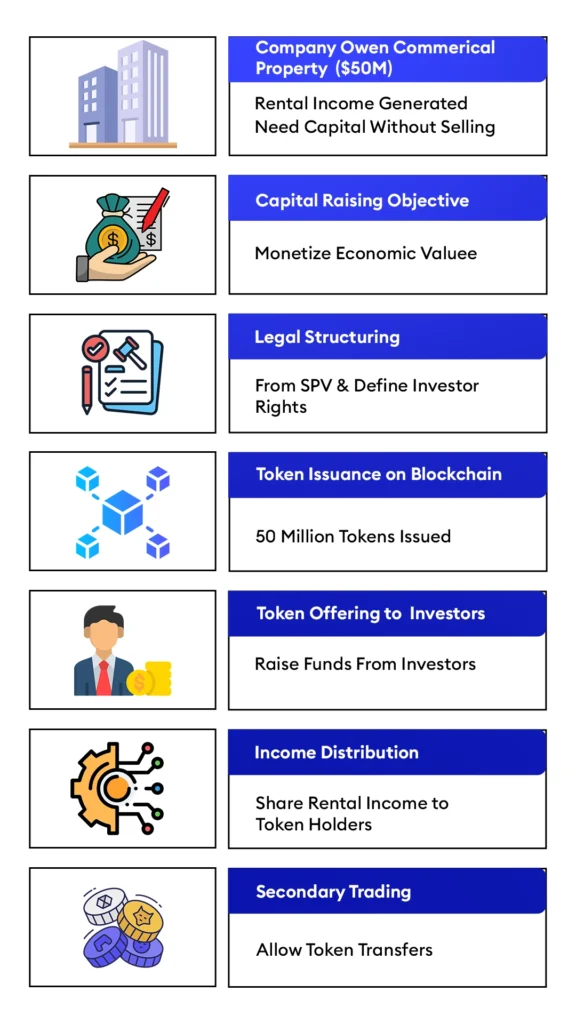
Let’s take a sample real-world scenario to explain the tokenization of a commercial property.
Let’s assume a company owns a commercial property worth $50 million, and it currently generates substantial rental income. Presently, the company wants to raise capital; they do not want to sell the property since it generates substantial rental income and is a strong long-term asset.
Traditionally, the company would have considered
- Obtain a bank loan
- If the company fails to obtain a bank loan, it may need to dispose of the property as a last resort.
Now consider a tokenization approach.
Step 1: Define the Objective – The objective is to raise capital and retain the property without selling
Step 2: Create a Legal Structure – The company can place the commercial property into a Special Purpose Vehicle (SPV). Then, the SPV legally owns the property, and this provides a legal assurance and secure legal rights for the investors who will invest in the SPV.
These rights could include:
- A share of rental income
- A proportional claim on future sale proceeds
- Defined voting rights
Step 3: Issue Digital Tokens – The SPV then issues 50 million blockchain-based tokens. Each token represents a fractional economic interest in the property.
- 1 token = 1/50,000,000 share of the defined rights
- Token owners are entitled to a portion of rental income
The total token supply indicates the valuation of the commercial property.
Step 4: Distribution to Investors
Investors purchase the tokens and provide capital to the company.
The company retains ownership of the property through the SPV structure.
Now, Token holders have:
- Digital proof of their ownership of the commercial property subject to their investment
- Defined economic rights
- Blockchain-based transferability (subject to legal rules). This means that an investor can sell their token to another party.
Step 5: Ongoing Income Distribution: The rental income of the commercial property belongs to the investors who hold tokens, and the rental income distribution flow as follows:
- Income flows to the SPV
- Smart contracts or administrative processes distribute returns proportionally
- Token holders receive income according to their share
The tokens represent economic participation.
What This Example Teaches Us
This example clarifies three key ideas:
- The asset remains intact.
- Legal structure defines rights
- Tokens represent fractional economic interests, not the physical building itself.
Further, the company that owns the commercial property can approach a wide spectrum of investors, and even retail investors can own a stake in the property by owning a token.
In this context, Tokenization acts as a financing tool and allows capital raising for the company without full asset disposal.
Final Summary
Tokenization is a structured process of creating blockchain-based digital tokens that define legal ownership and economic rights to the underlying asset.
Tokenization differs from digitalization as it transforms infrastructure and links real-world assets to a blockchain network through a legal framework.
We need to understand that a token is not an asset; it is a legally and economically linked digital form of the asset that ensures its legal validity, transferability, and economic rights.
In the next story of the series, we will move from “What” to “How”, exploring models, smart contracts, custody, and settlement mechanics in the real world.