Every tokenized asset runs on a foundational framework. Here’s how tokenization works within that framework and how it transforms ownership, trust and value exchange.
Assume you are supposed to buy a tokenised bond or a fractional share of commercial property or real estate. You do not see the technology behind that. You only see your ownership of the asset. In the process, technology is doing a lot by recording ownership, enforcing rules or legal structuring, and safeguarding assets (custody). It is amazing how technology can do this without middlemen.
In our previous discussion, we explored the involvement of middlemen in a real estate transaction, including property registration, escrow services, custodians, and banks. Each middleman adds cost and takes a considerable time to complete its process.
Unlike the traditional process, invisible rails handle the entire process without middlemen, that is, the infrastructure that interconnects all those processes. There are three key technologies in the infrastructure: blockchain, smart contracts, and digital custody.
Let us break each one down, starting with what they replace.
The Blockchain: A Ledger You Can Trust Without a Middleman
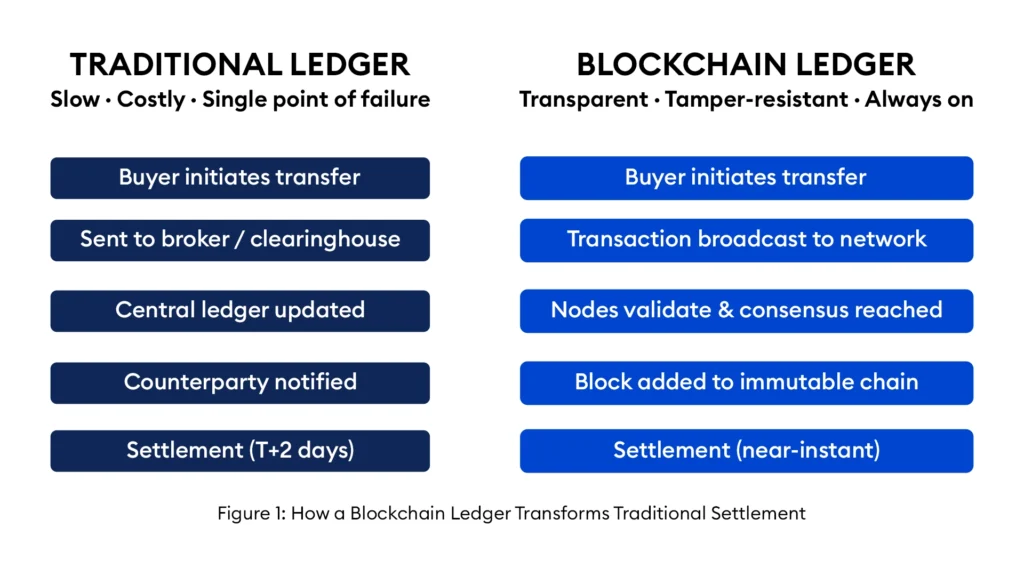
Traditionally, a central authority maintains the official records of ownership.
For instances,
- The Property Register is the authority that keeps records of who owns the property and other information, such as mortgage or lease status.
- For stocks, it ‘s the stock exchange. Further stockbrokers, clearing houses, and banks are involved in the transfer and settlement process.
You trust them, as they are regulated entities. But the entire process is in the hands of several entities that rely on one another.
Now let’s replace one middleman that records ownership (e.g., a property register, a stock exchange, or a central depository). Then blockchain will do it by recording the information. It is a shared record book, which is a ledger distributed across thousands of computers.
All transactions are recorded, and no single entity can control them. Everyone on the network (chain) holds a copy, but no one can change the record because the rest of the network rejects any such attempts.
This could be defined as a unique feature of blockchain that makes blockchain more transparent, tamper-resistant (once recorded, it cannot be changed), and accessible for everyone.
Smart Contracts: Rules That Run Themselves
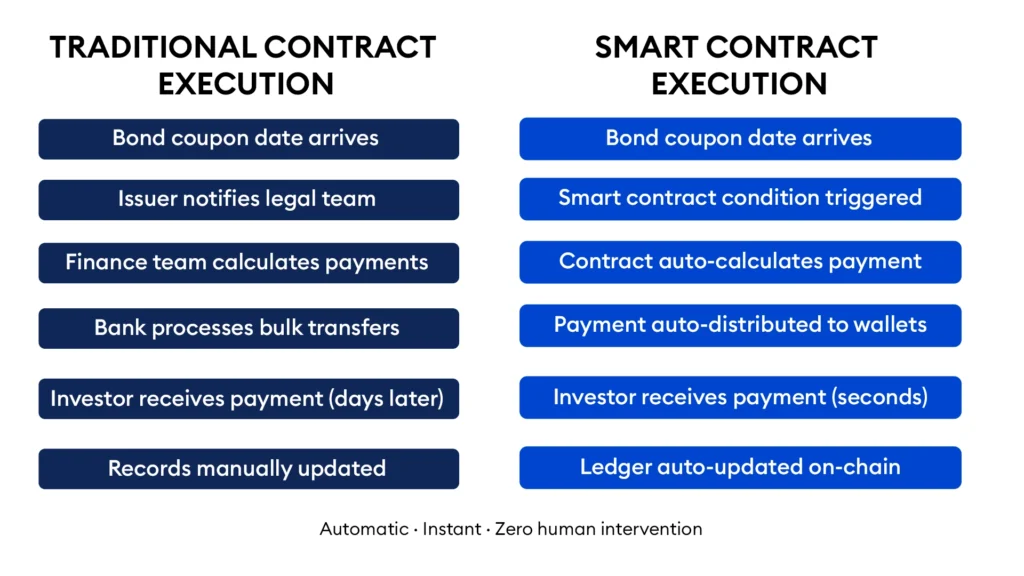
A contract is a legally binding agreement between the parties involved. In traditional finance, executing or enforcing a contract requires the physical involvement of lawyers, banks, and compliance teams, and manual processes take longer to complete.
The term “smart contract” defines itself as a virtual legal binding. A smart contract is a piece of code running on the blockchain that demonstrates autonomy to execute and enforce legal structures.
The code contains certain legal or conditional requirements that must be met to execute the transaction, and smart contracts replace middlemen.
For instance, smart contracts can enforce compliance rules and restrict who holds a token based on jurisdiction. If the regulator requires freezing the asset and deducting taxes upon transfer, these requirements can be programmed.
Imagine a bond that pays quarterly interest. With a smart contract, on the exact scheduled date, the payment checks the conditions and distributes funds directly to every token holder’s wallet. Automatically. Instantly. No one needs to “press a button”.
Digital Wallets and Custody: Who Holds the Keys?
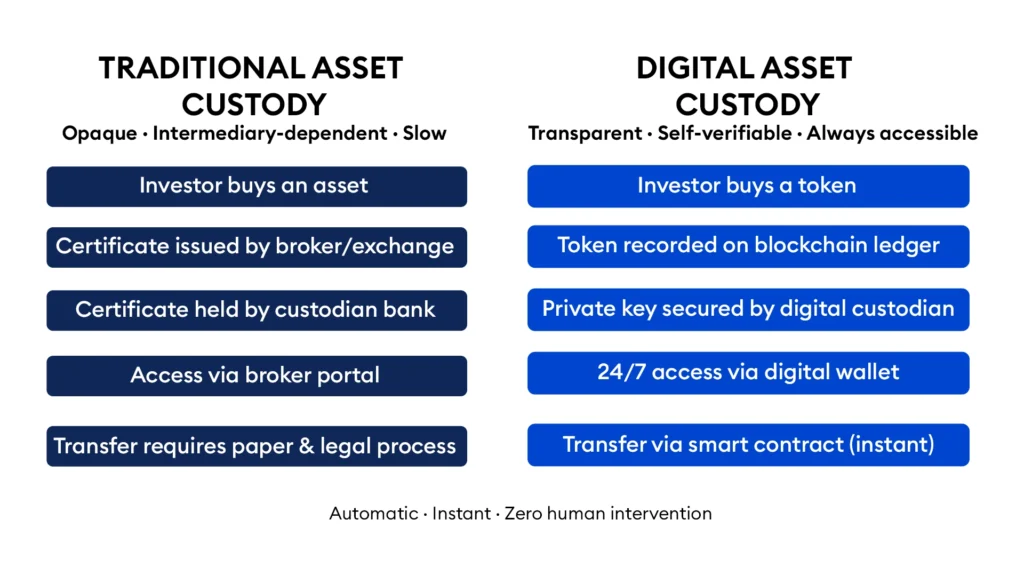
You will have a cryptographic key when you own a tokenised asset. The cryptographic key is a specific digital code that proves your ownership of the tokenised asset on the blockchain.
Now you have a doubt: where are my assets stored?
- Unlike physical wallets, your digital wallet does not store tokens. It stores the cryptographic key (private key) that records your rights to those tokenised assets on the ledger. You have direct access to your tokenized assets through digital wallets
Now I assume this creates another question for you. What will happen if my cryptographic key is lost?
This is a critical point. If you lose the key, there is no “forgot my password.”. You will not be able to access the asset permanently.
That is why awareness is important before investing.
However, custodial wallets are different than digital wallets. In a custodial wallet, a third party holds the key. They can assist you in recovering your account if you lose your key.
There are pros and cons to digital wallets and custodian wallets. But that depends on scenarios.
Simply, digital wallets are ideal for retail investors. But for institutional investors, digital custody is essential to uphold transparency and compliance.
In traditional finance, a custodian bank holds your share certificates in a vault. In tokenised finance, a licensed digital custodian secures your private keys — with institutional-grade security, insurance, and regulatory oversight.
Key Takeaway
Blockchain provides the ledger. Smart contracts provide the rules. Digital custody provides security. Together, these three components form the invisible infrastructure that makes tokenisation possible, not just technically, but trustworthily. Infrastructure enables trust. But governance determines whether that trust scales into widespread adoption.
COMING UP NEXT · Story 5 – The Classification
“Not All Tokens Are Equal: Understanding Asset-Backed, Utility, and Security Tokens”
In Story 5, we will map out every token type clearly, with examples, plain-language definitions, and a simple decision framework to help you identify the type of token you are looking at each time.