
March 31, 2026 – Ripple’s newly bought treasury platform moved $13 trillion in old-school payments last year. None of it touched crypto. CEO Brad Garlinghouse says that gap defines the next big shift.
In Summary
Ripple Treasury processed $13 trillion in payments last year, none of which were via crypto or stablecoins.
The $1 billion GTreasury deal gives Ripple access to 1,000+ clients across 160 countries.
Global stablecoin volume hit $33 trillion in 2025, a 72% yearly surge that outpaced Visa.
Ripple’s RLUSD stablecoin topped $1 billion in market cap within its first year of launch.
Among fintechs surveyed, 89% rank digital asset storage as their top need for tokenised assets.
Ripple CEO Brad Garlinghouse shared a key data point during a talk with Fox Business. According to him, Ripple Treasury, now called GTreasury after a rebrand, moved $13 trillion in payments last year. However, zero percent of that volume flowed through crypto or stablecoins.
In other words, Garlinghouse sees this gap not as a weakness. Instead, he calls it the biggest open door in crypto for firms today.
A $1 Billion Bet on Legacy Finance
Ripple bought GTreasury in October 2025 for $1 billion. Notably, the deal was its third major purchase that year. Before that, Hidden Road, a prime broker, cost $1.25 billion. In addition, stablecoin platform Rail came at $200 million. As a result, Ripple spent nearly $2.5 billion on deals in 2025 alone.
Also, GTreasury serves over 1,000 clients across 160 countries. Its platform handles cash tracking, risk checks, and rule-keeping. As a result, the deal gave Ripple direct access to Fortune 500 CFOs and treasurers.

The logic behind this move is clear. Rather than building crypto use from scratch, Ripple now owns a ready-made path. So, it can add blockchain payments on top of current treasury workflows. After all, finance teams use the platform every day.
Stablecoins: The “ChatGPT Moment” of Finance
Garlinghouse called stablecoins finance’s “ChatGPT moment.” This link is no accident. Just as ChatGPT made AI easy to use, stablecoins now make blockchain handy for daily payments.
The numbers clearly back his claim. Global stablecoin trades hit $33 trillion in 2025, a 72% jump year over year. To put it simply, that volume beat Visa’s $16.7 trillion in yearly output.
In contrast, cross-border payments take 3 to 5 days. They also carry high fees and delays at each step. On the other hand, stablecoin payments clear in under one minute, at any hour. As a result, this speed gain draws strong interest from big firms.
“Ripple Treasury processed $13 trillion in payments last year. 0% through crypto. That gap is the opportunity.”
— Brad Garlinghouse, Ripple CEO
Finance Leaders Favour Digital Assets
In early 2026, Ripple surveyed over 1,000 finance leaders worldwide. The group had banks, asset heads, fintechs, and big firms. Overall, the results showed strong demand for stablecoins and tokenised assets.
Among those looking at tokenised assets, 89% named digital asset storage as a top need. Also, fintechs led in usage rates. For instance, about 31% use stablecoins to collect client payments. Similarly, 29% accept stablecoin payments on the spot.
Clearly, these numbers point to a turning point. Crypto is moving beyond pure trading hype. Instead, treasury teams now treat digital assets as daily tools, not risky bets.
Ripple’s On-Chain Bridge Plan
Ripple’s game plan links old systems to blockchain rails. For example, the firm’s RLUSD stablecoin topped $1 billion in market cap within its first year. Payments sent through RLUSD settle in just three to five seconds.
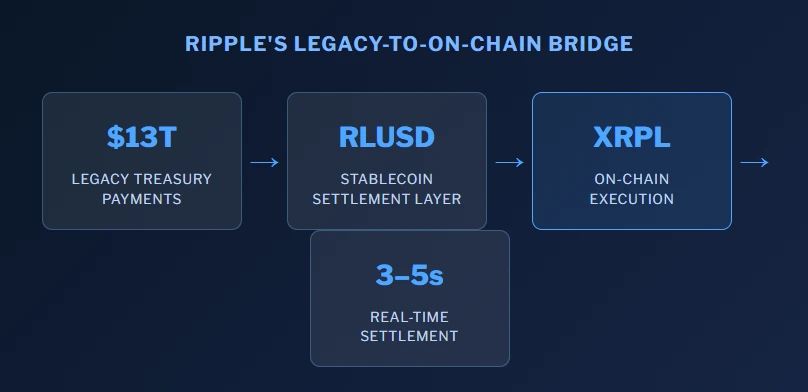
On top of that, the XRP Ledger now supports tokenised real-world assets. Ripple is testing trade finance under Singapore’s central bank BLOOM program. It is also seeking a license in Australia.
Meanwhile, Ripple’s AI-powered safety team has found over 10 bugs in the XRP Ledger’s code. As a result, the next XRPL release will focus only on fixes, not new features. This shows the firm is getting ready for larger clients.
What It Means for Crypto Markets
The $13 trillion figure matters for two key reasons. First, it shows how big the market is. If even 5% of Ripple Treasury’s volume moves on-chain, that would mean $650 billion in new crypto flows each year.
Second, it backs the case for business-led crypto growth. Boards and CFOs are not buying tokens. Instead, they want faster, cheaper payment rails. Stablecoins offer just that.
Looking ahead, Bloomberg projects stablecoin volumes could hit $56 trillion by 2030. Thanks to Ripple’s built-in role in treasury, it could be an early winner in that shift.
At the end of the day, the race is no longer about getting firms to adopt crypto. It is about weaving crypto into systems they use every day.