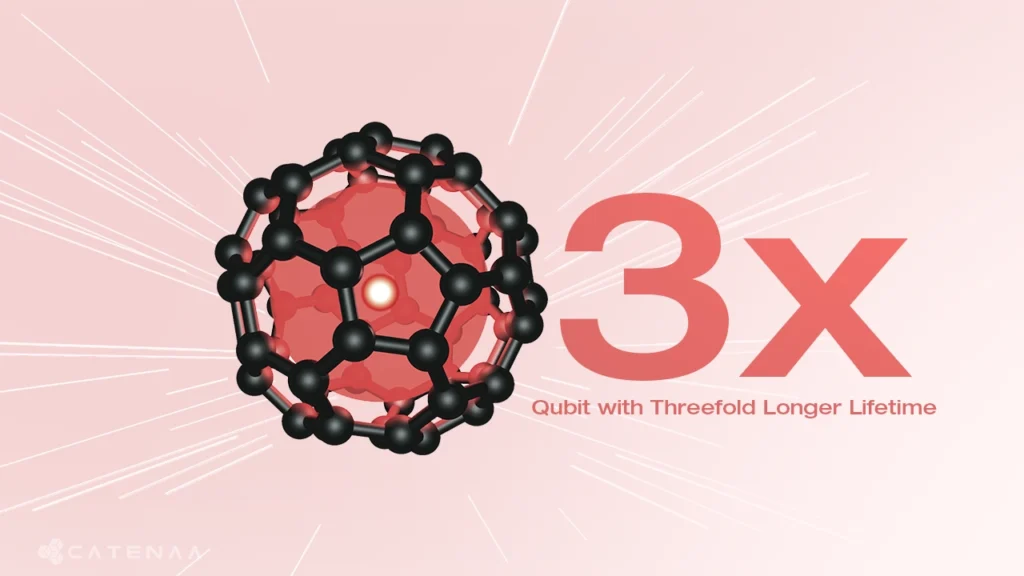


Catenaa, Friday, December 05, 2025- Princeton University researchers have created a superconducting qubit that remains stable for more than one millisecond, over three times longer than previous designs, advancing the potential for practical quantum computing.
The new qubit uses a tantalum-silicon architecture that sharply reduces energy loss, extending coherence times and enabling more reliable quantum operations.
By replacing traditional sapphire substrates with high-quality silicon and using tantalum to improve circuit stability, the team achieved a record lifetime nearly fifteen times that of qubits used in commercial-scale processors.
The design is compatible with existing Google and IBM quantum processors, allowing for integration into current systems.
Researchers note that scaling up with this qubit could improve the performance of a 1,000-qubit system by roughly one billion times compared with current industry-standard devices.
Error correction and large-scale processor stability, historically limited by rapid energy loss in transmon qubits, are expected to benefit from the new design.
Tantalum’s robustness reduces defects that trap energy, while silicon substrates further limit losses, simplifying mass production.
The work combines expertise in quantum device engineering, materials science, and superconducting circuits, and has been partially funded by Google Quantum AI and US Department of Energy programs. The breakthrough, published November 5 in Nature, represents the largest jump in coherence time for superconducting qubits in more than a decade.
Researchers say the advancement could accelerate the development of large, stable quantum processors capable of solving real-world problems and marks a critical step toward making practical quantum computers a reality.