

Catenaa, Sunday, December 14, 2025-Researchers have developed a radically miniaturized brain implant called BISC, offering a high-speed, wireless interface between the brain and external computers for advanced AI decoding.
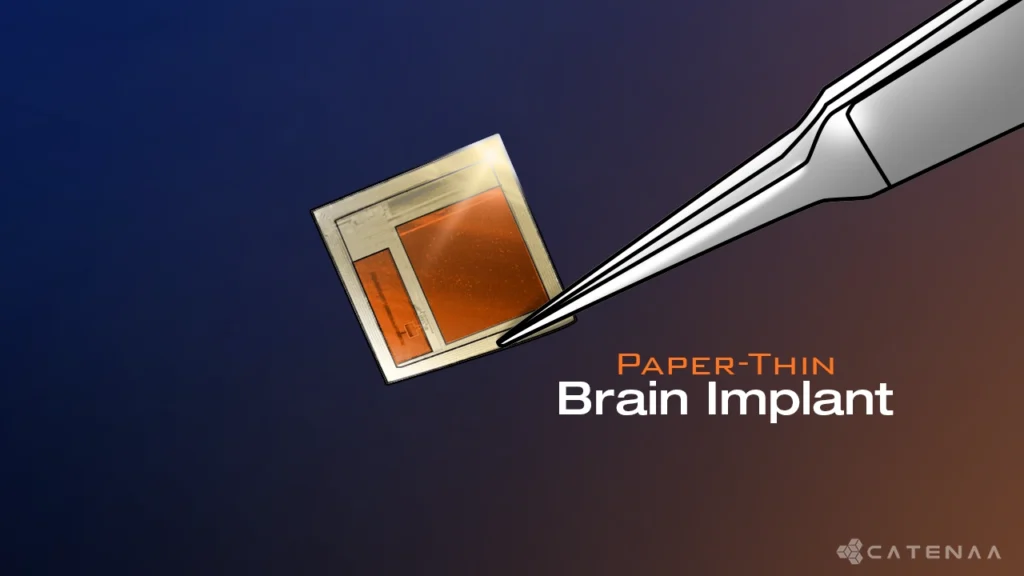
The Biological Interface System to Cortex (BISC) consists of a single 50-micron-thick silicon chip, a wearable relay station, and specialized software.
The device incorporates 65,536 electrodes, 1,024 recording channels, and 16,384 stimulation channels, allowing unprecedented data throughput.
The wireless system transmits brain activity at up to 100 Mbps, at least 100 times faster than existing wireless brain-computer interfaces.
Developed by teams at Columbia University, Stanford, the University of Pennsylvania, and NewYork-Presbyterian Hospital, BISC is designed for minimally invasive implantation between the brain and skull. Early preclinical tests show it can reliably record neural signals over time while minimizing tissue reactivity and signal degradation.
Early human studies are underway, focusing on short-term intraoperative recordings.
The implant is intended to improve treatment for neurological disorders, including epilepsy, ALS, stroke, spinal cord injuries, and blindness, by restoring motor, speech, and visual functions.
Beyond clinical applications, the high-resolution interface could enable direct human-AI interactions, potentially allowing seamless communication between thought and machine learning systems.
BISC represents a shift in brain-computer interface design, integrating all electronics—including radio, power, and data converters—onto a single flexible chip.
Researchers emphasize that its scalability and high data throughput could accelerate neuroprosthetics development and broader applications of AI-assisted brain interfaces.
Commercialization efforts are underway through Kampto Neurotech, a spin-off founded by project engineers to advance preclinical and eventual human use of the technology.