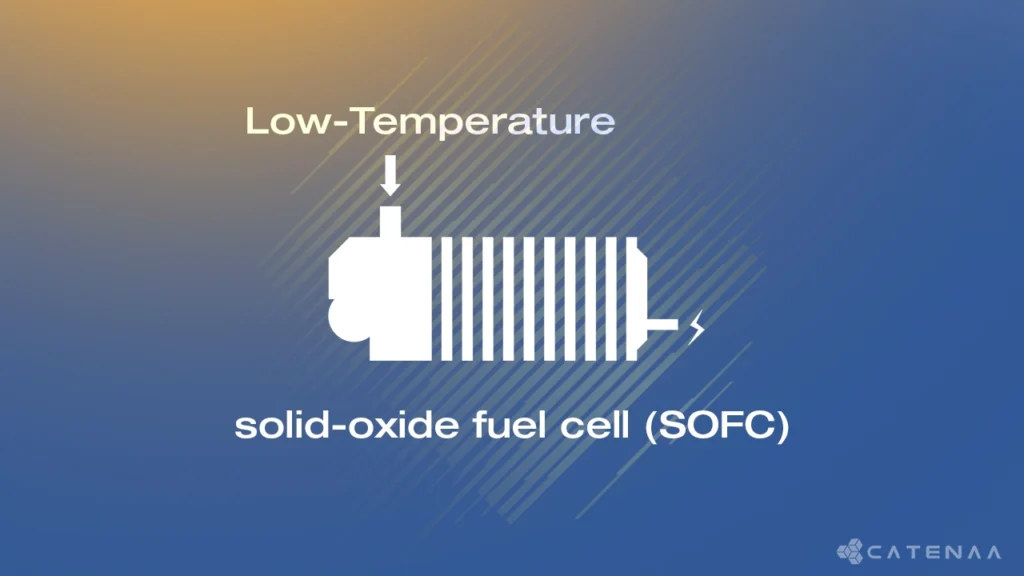


Catenaa, Friday, December 05, 2025- Researchers at Kyushu University have developed a solid oxide fuel cell (SOFC) that operates efficiently at 300°C, far lower than conventional designs, potentially enabling affordable hydrogen power for wider applications.
The breakthrough relies on scandium-doped barium stannate (BaSnO₃) and barium titanate (BaTiO₃), which create high-conductivity pathways for protons, the charged particles responsible for electricity generation in SOFCs.
Molecular simulations show that scandium links surrounding oxygen atoms to form “ScO₆ highways,” allowing protons to move quickly with minimal resistance.
Conventional SOFCs typically require 700-800°C to achieve similar proton conductivity, demanding expensive materials and limiting deployment.
The new design achieves conductivity over 0.01 S/cm at 300°C, comparable to standard high-temperature cells, while lowering material costs and energy requirements.
This low-temperature approach balances the number of mobile protons with unobstructed lattice channels, overcoming the typical trade-off in doped oxide materials that slows proton transport.
The findings could accelerate commercial adoption of SOFCs for electricity generation, hydrogen pumps, CO₂ conversion reactors, and low-temperature electrolysis.
Lead researcher Yoshihiro Yamazaki said the discovery could transform hydrogen technologies from laboratory prototypes to practical systems for everyday use.
The work combines structural analysis and molecular modeling to create scalable, cost-effective solutions for decarbonized energy generation.
The study, published in Nature Materials, demonstrates a pathway to high-efficiency, intermediate-temperature fuel cells that could reduce reliance on fossil fuels while enabling broader applications of hydrogen in energy, industry, and climate-focused technologies.