April 02, 2026 – The MPC network introduces dWallets to Solana’s $9 billion DeFi ecosystem. The pitch: control assets across every chain without bridges or synthetic wrappers.
In Summary
Ika expands to Solana with dWallets, programmable multi-chain accounts that remove bridge dependency.
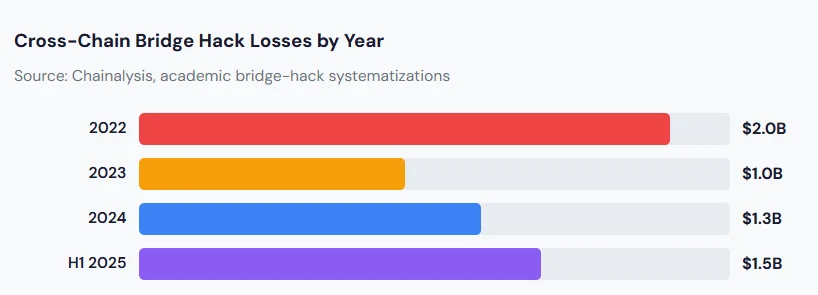
Cross-chain bridge hacks have caused $4.3 billion in losses since 2021, with 40% of all Web3 theft tied to bridges.
Solana’s DeFi TVL hit an all-time high of 80 million SOL (~$9B) in February 2026, drawing major institutional players.
Ika uses 2PC-MPC cryptography for sub-second signing. No single party ever holds a complete private key.
The project has raised over $21 million in funding. Solana devnet launch is planned for early Q2 2026.
Cross-chain bridges remain crypto’s most costly vulnerability. Cumulative bridge hack losses reached $4.3 billion across 49 incidents between June 2021 and September 2024. The trend accelerated in 2025, with over $1.5 billion stolen through bridge exploits by mid-year alone.
Ika, a parallel MPC network, is positioning itself as an alternative. On March 31, the project announced its expansion to Solana. The goal is to enable what it calls “Bridgeless Capital Markets.”
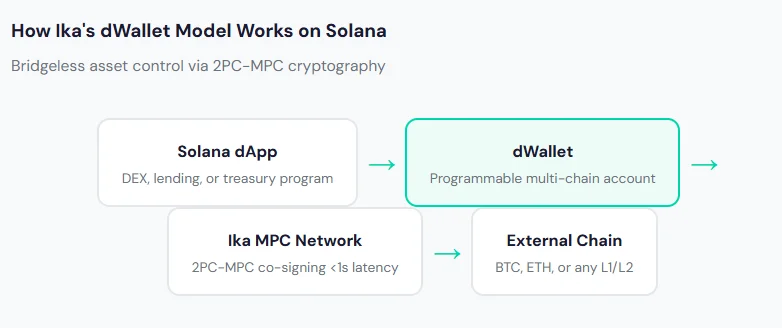
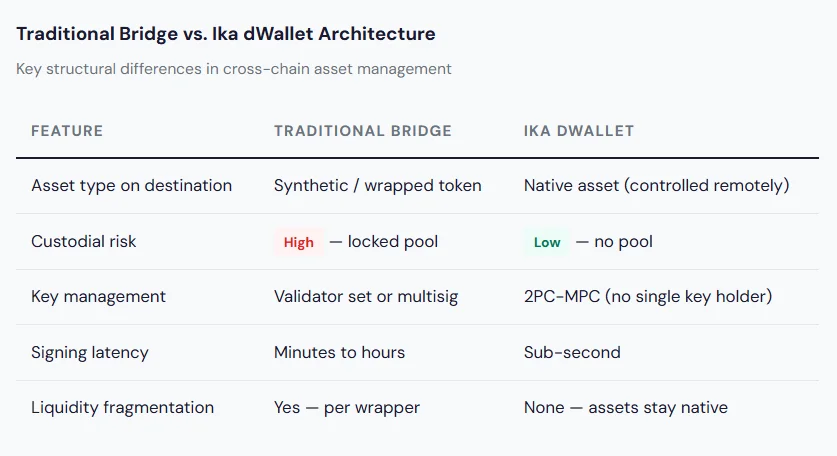
Rather than wrapping tokens through intermediary contracts, Ika uses dWallets. These are programmable multi-chain accounts. They allow Solana users to control native assets on any blockchain. The signing process relies on 2PC-MPC cryptography. No single party holds a full private key.
Solana’s DeFi ecosystem provides the growth context
The timing is notable. Solana’s SOL-denominated DeFi TVL hit an all-time high of 80 million SOL in February 2026. In dollar terms, the ecosystem rebounded to over $9 billion. This represents roughly a 900% year-over-year increase.
Institutional capital is also flowing in fast. Goldman Sachs disclosed $108 million in SOL ETF holdings. BlackRock’s BUIDL fund cleared $550 million on the network. Morgan Stanley filed for spot SOL ETFs in January 2026.
Yet Solana’s cross-chain capabilities still lag behind this growth. Most non-native assets arrive through traditional bridges. These bridges fragment liquidity and introduce security risk.
Bridge vs. bridgeless: the security trade-off
Traditional bridges lock tokens on one chain. Then they mint synthetic versions of another. This creates honeypots. A single smart contract vulnerability can drain hundreds of millions. The Axie Infinity Ronin Bridge lost nearly $600 million in one attack.
Ika’s approach avoids asset locking entirely. Instead, dWallets create signing authority over addresses on external chains. The user and the Ika network jointly co-sign transactions. Neither party ever holds a complete private key.
Funding and ecosystem integration
Ika has raised over $21 million in total funding. The Sui Foundation led its most recent strategic round. The project reached a peak private valuation of $600 million FDV.
Until now, Ika operated exclusively on Sui. The Solana expansion opens a second front. Co-founder David Lachmish said Solana already has the execution speed and builder energy. Ika aims to add the cross-chain primitive the ecosystem currently lacks.
The project plans a Solana devnet launch in early Q2 2026. A mainnet deployment is expected later this year. Ika also frames dWallets as a control layer for AI agents. Solana programs can define agent policies across chains. The agent never holds a private key independently.
Market outlook and open questions
Ika’s bridgeless thesis addresses a real problem. Bridge exploits account for roughly 40% of all Web3 hack losses. The industry clearly needs safer interoperability infrastructure.
The scale of demand is significant. Solana processes over 3.4 billion non-vote transactions per month. Its DEX volume topped $95 million in February 2026. Bringing Bitcoin, stablecoins, and RWAs natively to Solana could unlock substantial new liquidity.
However, the project faces serious competition. LayerZero, Wormhole, and Axelar already serve Solana’s cross-chain needs. Each has an established integration footprint. Ika must prove that MPC-based dWallets offer a meaningful security and UX upgrade.
Adoption by major Solana protocols will be the clearest signal. The project claims sub-second signing at 10,000 TPS scale. These numbers are technically ambitious. Independent benchmarks after devnet launch will be critical to validate.
Solana’s $9 billion DeFi ecosystem and rising institutional capital create a large addressable market. Goldman Sachs, BlackRock, and Morgan Stanley are already deployed. If Ika delivers on zero-trust cross-chain security, bridgeless capital markets could reshape how multi-chain DeFi operates.