
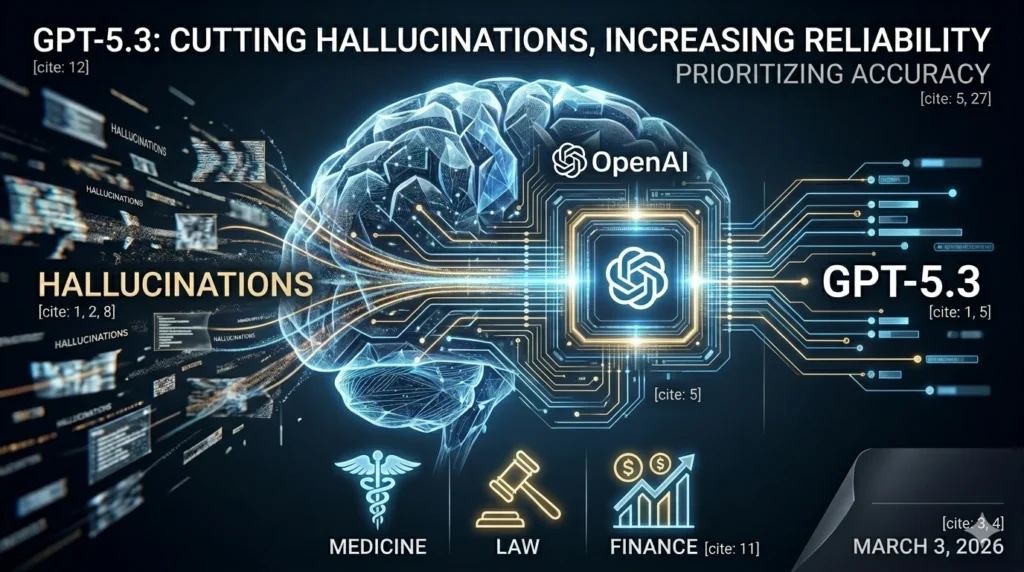
March 03, 2026 – OpenAI rolled out GPT-5.3 Instant on Monday. As a result, ChatGPT’s default model now prioritises reliability over raw capability. This shift matters because enterprise adoption of AI chatbots is accelerating worldwide.
Hallucination Rates Drop Sharply
Most importantly, the update delivers a significant drop in hallucinations. According to OpenAI’s internal testing, errors fell by 26.8% when using web search. Furthermore, the decline still reaches 19.7% without web access in high-stakes fields. As a consequence, medicine, law, and finance stand to benefit the most.
These numbers address a core credibility challenge for AI companies. Until now, hallucinations have slowed enterprise deployment across regulated industries. Therefore, a meaningful reduction could unlock new revenue streams for OpenAI. In addition, it raises the competitive bar for both Google and Anthropic.
A Less “Preachy” ChatGPT
In addition to improving accuracy, OpenAI also addressed a growing user complaint. Previously, the GPT-5.2 model often refused harmless requests. Users described its tone as “preachy” and “overbearing.” In contrast, GPT-5.3 Instant delivers more direct answers. As a result, defensive preambles have been significantly reduced.
Similarly, web search integration received a notable upgrade. Instead of simply summarising links, the model now blends online results with its training knowledge. Consequently, it surfaces the most relevant information upfront.
What This Means for the AI Race
The timing of this release is no coincidence. Currently, OpenAI faces mounting pressure from rivals. For instance, Anthropic recently updated its Claude lineup. Meanwhile, Google’s Gemini continues to gain market share. Because of this, each percentage point of accuracy now carries real business implications.
Developers can already access the model through the API. However, the older GPT-5.2 Instant will be retired on June 3, 2026. Ultimately, this update reinforces a broader industry trend. The race is shifting from building bigger models to building better ones. In regulated industries, after all, accuracy is not a feature. It is a requirement.