Catenaa, Friday, March 13, 2026- Engineers at the University of Illinois Urbana-Champaign have created a magnetic material that behaves mathematically like graphene, opening a new path to study exotic electronic behavior using magnetic waves rather than electric charge.
The research, published in the journal Physical Review X, describes a two-dimensional magnetic system that reproduces the same mathematical rules governing how electrons move through graphene’s atomic lattice.
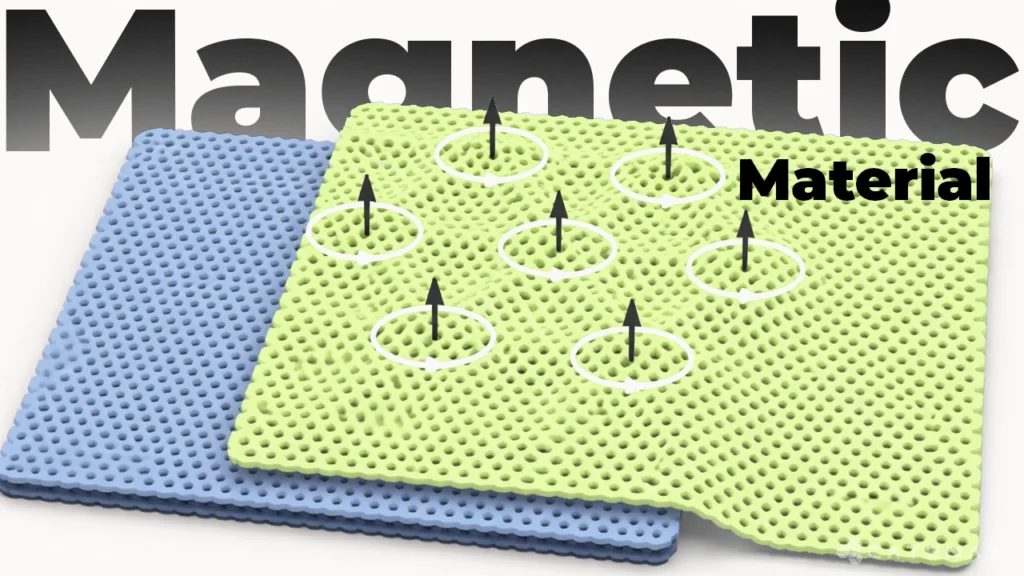
Lead author Bobby Kaman designed a structure known as a magnonic crystal, a patterned magnetic material that guides waves of spin, called magnons. Instead of electrons traveling through carbon atoms as in graphene, the new system allows spin waves to propagate through a carefully engineered pattern of holes arranged in a hexagonal geometry.
The pattern mirrors graphene’s honeycomb lattice, which gives the carbon material many of its unusual electronic properties. When spin waves move through the magnetic structure, researchers found that they follow the same mathematical description used to model graphene’s electrons.
Scientists say this produces excitations that behave like massless Dirac particles, a hallmark of graphene’s physics. In graphene, electrons move through the lattice as if they have no mass, forming characteristic cone-shaped energy structures known as Dirac cones.
By recreating that same energy landscape using magnetic waves, the Illinois researchers demonstrated that magnonic systems can reproduce graphene-like physics in a completely different type of material.
The structure also revealed a complex set of nine energy bands, far more than appear in simple graphene models. Some bands allow waves to move freely, while others trap energy in localized states within the patterned lattice. Researchers also observed signatures of topological effects that influence how waves move along the material’s boundaries.
Such properties are important for emerging fields such as topological physics and spintronics, where scientists seek to manipulate the magnetic properties of electrons rather than their electrical charge.
The team says the results help connect two previously separate areas of physics: electronic behavior in materials like graphene and wave propagation in magnetic systems.
Senior researcher Axel Hoffmann said the work could eventually lead to smaller and more efficient microwave components used in communications systems.
Magnonic devices can guide signals in a single direction, enabling components such as circulators and isolators that prevent interference between transmitting and receiving signals. Conventional microwave circulators can measure several centimeters in size, but magnonic versions could shrink to microscopic dimensions.
That miniaturization could be valuable in telecommunications networks, including 5G infrastructure, where thousands of such components are used to manage radio signals.
The magnetic crystals are created using nanofabrication techniques such as electron-beam lithography, which allows engineers to carve microscopic patterns into thin magnetic films.
Researchers say the geometry of the pattern determines how spin waves move through the structure, meaning the system’s electronic-like behavior can be tuned simply by adjusting its design.
Scientists say the discovery also highlights the broader potential of metamaterials, engineered structures designed to control waves in ways that natural materials cannot.
By designing materials that mimic the mathematical properties of well-known systems like graphene, researchers can explore complex quantum behavior in platforms that are easier to manipulate experimentally.
The Illinois team plans to conduct further experiments to confirm the predicted properties of the magnetic lattice and explore potential applications in next-generation electronics and quantum technologies.