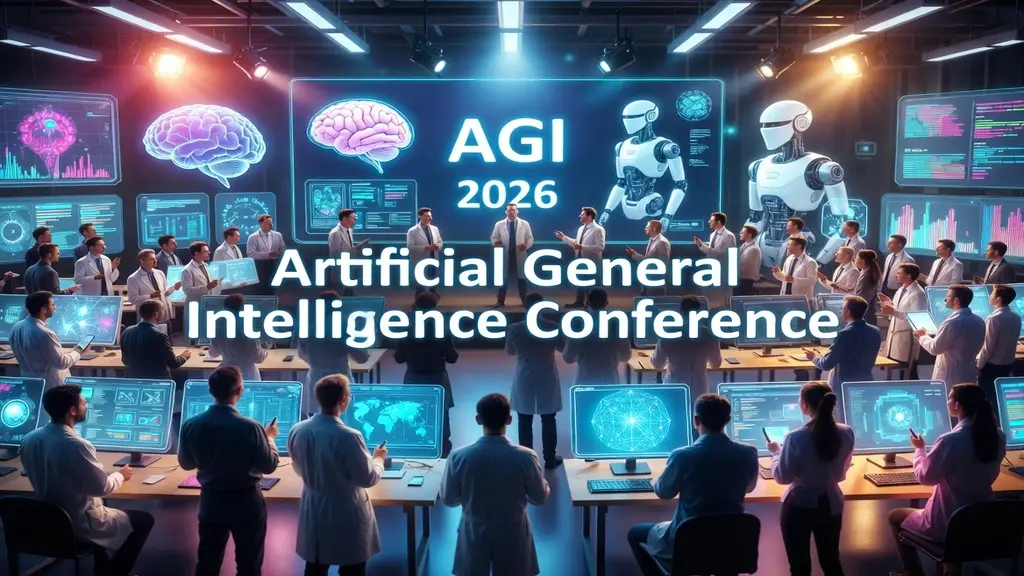
Catenaa, Friday, March 20, 2026- The AGI Society announced plans for its 19th annual Artificial General Intelligence conference, scheduled for July 27-30 in San Francisco, bringing together researchers focused on developing systems with human-level cognitive abilities.
The event, known as AGI-26, will be held in a hybrid format with both in-person and virtual participation. Organizers say it remains one of the few global forums dedicated exclusively to artificial general intelligence, a field that seeks to move beyond specialized AI systems toward broader reasoning and adaptability.
Conference chair Matt Ikle described AGI as a defining scientific pursuit, emphasizing the need for careful development as capabilities expand. The gathering is expected to attract academic researchers, industry engineers and policymakers examining both technical progress and societal implications.
The four-day program will feature peer-reviewed papers, technical workshops and demonstrations covering advances in reasoning systems, machine learning architectures and multi-modal intelligence. Organizers said submissions will emphasize empirical validation and measurable results.
Key themes include scaling current AI models toward more general capabilities, improving system reliability and designing architectures that integrate insights from neuroscience. Researchers will also examine methods for combining symbolic reasoning with data-driven approaches.
The conference will host discussions on how AI systems process language, images and real-world data in unified frameworks, a step considered necessary for broader intelligence.
Submissions for AGI-26 are open through mid-April, with categories including full research papers and shorter technical reports. Awards will recognize contributions in areas such as generalization, safety and computational efficiency.
Past conferences have featured prominent figures in artificial intelligence research, including Yoshua Bengio and Jürgen Schmidhuber, reflecting diverse approaches to building intelligent systems.
Organizers said the event will also include tutorials aimed at early-career researchers, providing guidance on emerging techniques and experimental methods.
The conference comes at a time of rapid progress in artificial intelligence. Recent systems have demonstrated improvements in reasoning, planning and cross-domain learning, prompting renewed discussion about the timeline for achieving general intelligence.
Advances in large-scale models have enabled more complex tasks, including problem-solving and multi-step decision-making. Researchers are increasingly exploring how to extend these capabilities while maintaining accuracy and control.
Despite progress, experts note that current systems still face limitations in generalization and consistency, particularly when operating outside trained scenarios.
A central focus of AGI-26 will be safety and alignment, addressing how AI systems can be designed to act in accordance with human intentions. Workshops will examine potential risks, including unintended behavior and misuse.
Researchers are developing techniques to improve transparency, allowing engineers to better understand how models reach decisions. Other sessions will explore methods for monitoring system outputs and preventing harmful outcomes.
The conference is expected to include discussions on governance frameworks and international cooperation, reflecting growing interest from regulators and policymakers.
Participants will also examine the role of computing infrastructure in advancing AI capabilities. High-performance hardware remains essential for training and deploying large-scale models.
New approaches, including specialized processors and alternative computing methods, aim to improve efficiency while reducing energy consumption. Demonstrations at the conference will highlight developments in both hardware and software optimization.
Experts say continued investment in infrastructure will be necessary to sustain progress in the field.
The final day of the conference will feature an investor-focused program examining funding trends and commercialization pathways. Analysts estimate that global investment in AI technologies has grown rapidly, attracting both private capital and government support.
Sessions will address challenges in translating research breakthroughs into real-world applications, as well as the economic impact of advanced AI systems.
Industry participants are expected to discuss partnerships between academic institutions and technology companies, which play a central role in advancing research.
The development of AGI has implications across multiple sectors, including healthcare, finance and manufacturing. Proponents argue that more capable AI systems could improve productivity and enable new forms of innovation.
At the same time, concerns remain about workforce disruption and ethical considerations. Policymakers are increasingly examining how to balance technological progress with social stability.
Organizers said the conference aims to encourage collaboration across disciplines, bringing together perspectives from computer science, neuroscience and public policy.
While opinions differ on when AGI might be achieved, most researchers agree that significant challenges remain. Progress will depend on advances in algorithms, data efficiency and system design.
AGI-26 is expected to serve as a platform for evaluating competing approaches and identifying areas for further study. The event reflects ongoing efforts to move the field from theoretical exploration toward practical implementation.