
April 01, 2026 – Coins now change hands an average of 6 times per month. USDC drives the surge via TradFi displacement and early AI-agent payments.
In Summary
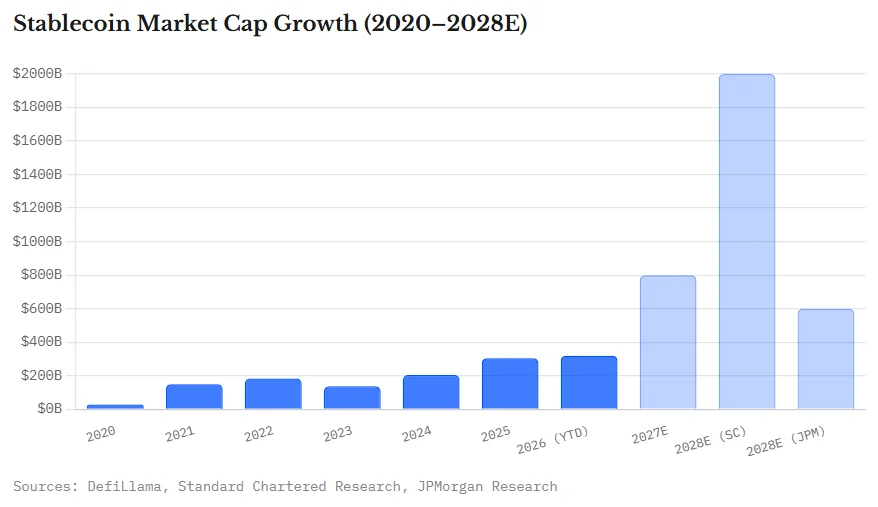
Standard Chartered maintains its $2T stablecoin market cap forecast for end-2028.
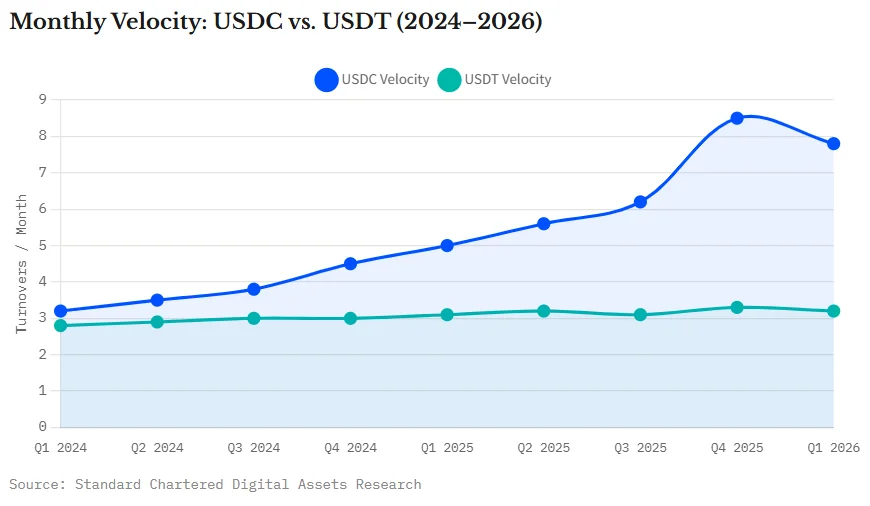
Stablecoin velocity has doubled in two years to six turnovers per month.
USDC drives acceleration via TradFi rails and Coinbase’s x402 AI payment protocol.
JPMorgan offers a more conservative estimate of $500B–$600B by 2028.

The stablecoin sector is growing faster than most Wall Street models predicted. Standard Chartered’s latest research note flags a striking trend. Stablecoin velocity has doubled over the past two years. On average, each coin now changes hands six times per month.
That metric matters. Higher velocity means fewer coins can support the same transaction volume. In theory, this should reduce the total market cap needed. Yet Standard Chartered stands by its bold $2 trillion forecast for end-2028.
Why the Bank Isn’t Backing Down
Geoff Kendrick leads digital assets research at Standard Chartered. He argues the velocity gains reflect entirely new use cases. These are additive to existing demand, not a replacement for it.
The critical insight: new high-velocity use cases have not eroded low-velocity ones. Emerging-market savers still hold stablecoins as dollar proxies. JPMorgan projects a more modest $500B–$600B by 2028. The gap between the two banks highlights genuine disagreement on Wall Street.
USDC vs. USDT: A Growing Divergence
The velocity surge is not evenly distributed. USDC accounts for roughly 25% of the market. Yet it drives most of the velocity acceleration. Circle’s token began diverging from Tether’s USDT in mid-2024.
Two catalysts explain this shift. First, the GENIUS Act created a federal regulatory framework in mid-2025. This gave USDC a compliance advantage for institutional use. Second, Coinbase’s x402 protocol enabled AI-agent payments on Solana and Base.
USDT, by contrast, serves a different market. Its velocity stays relatively flat. Emerging-market users hold it as a savings instrument. They park dollars, not spend them rapidly.
AI Payments: Hype or Real Catalyst?
Starting in October 2025, USDC velocity on Solana and Base surged sharply. Kendrick attributes this to x402. The open-source protocol lets AI agents make autonomous payments. However, x402 volumes reached only $24M over 30 days. That is tiny relative to $46T in annual settlement volume.
Volumes have since pulled back. This suggests the initial surge may have been transient. Still, even small AI payment flows can significantly boost velocity. Machines transact faster than humans.
The Bigger Picture: A $320B Market in Transition
The stablecoin sector’s current market cap sits near $320 billion. That represents a roughly 50% year-over-year increase, according to Macquarie research. Transaction volume reached $11.6 trillion in 2025 alone.
The market is no longer just about crypto trading. B2B payments account for 62.9% of stablecoin payment volume. Cross-border remittances, treasury management and AI applications are expanding the total addressable market.
Banks are responding. Fidelity launched a stablecoin. JPMorgan runs tokenised deposits. Visa and Mastercard now settle in USDC. The competition is no longer crypto versus TradFi. It is about which rails move dollars fastest.
What Investors Should Watch
Kendrick’s parting note is clear. Velocity is now a “key input” for forecasting market size. If high-velocity use cases continue to grow without displacing savings demand, $2 trillion remains plausible.
The bear case is simple. AI payment volumes could stall. Regulatory headwinds could slow TradFi adoption. And JPMorgan’s $600B estimate may prove more realistic.
Either way, the stablecoin sector has moved beyond speculation. It is now core financial infrastructure, measured in trillions.