March 26, 2026 – For the first time, a UK-regulated bank will put retail deposits on a public blockchain. Founder Charles Hoskinson expects billions in TVL.
In Summary
Monument Bank will turn £250M ($335M) in retail deposits into digital tokens.
This is the first time a UK-regulated bank has placed deposits on a public blockchain.
Deposits stay FSCS-protected, earn interest, and can be swapped back to GBP.
Hoskinson expects the deal could bring billions in TVL to the Midnight system.
The global RWA token market has grown by 380% over three years and is now worth $30 billion.
London-based Monument Bank has struck a major deal with the Midnight Foundation. As a result, the bank will turn up to £250 million ($335 million) in retail deposits into digital tokens. In fact, this marks the first time a UK-regulated bank has placed retail deposits on a public blockchain.
Shortly after the news broke, Cardano founder Charles Hoskinson shared his views on X (formerly Twitter). He described it as “one of the largest deals we’ve ever done.” Moreover, Hoskinson said the deal could bring hundreds of millions, or even billions, of dollars in total value locked (TVL) to the Midnight system.
Key Deal Structure: What the Numbers Show
First, it is worth noting that Monument Bank is regulated by the Bank of England. Right now, it holds about £7 billion in deposits. In addition, the bank serves over 100,000 customers, mostly wealthy people. Notably, its target group holds between £50,000 and £5 million in investable assets.
The digital tokens will continue to earn interest and remain fully backed by the bank. Also, they can be swapped back one-for-one into British pounds (GBP) at any time. Above all, deposits keep their shield under the UK’s Financial Services Compensation Scheme (FSCS). As a result, this sets the deal apart from most crypto products on the market today.
| Metric | Detail |
| Phase 1 Target | £250 million ($335M) in tokenized deposits |
| Total Deposits Held | £7 billion |
| Customer Base | 100,000+ (wealthy retail clients) |
| Blockchain Used | Midnight Network (Cardano system) |
| Safety | FSCS-backed; Bank of England watched over |
Three-Phase Rollout: From Deposits to On-Chain Lending
To begin with, the plan follows a clear, three-phase roadmap. In Phase 1, the bank will mirror savings on Midnight’s private blockchain. Next, Phase 2 will add real-world asset (RWA) token products. For instance, these include private equity and commodity funds run by global firms.
Finally, Phase 3 will bring Lombard-style lending to normal customers. In other words, users will borrow cash against their token-based holdings within the Monument app. Before this, such lending was only open to very wealthy private banking clients. Therefore, Monument’s model could open the door to tools that were once out of reach for most people.
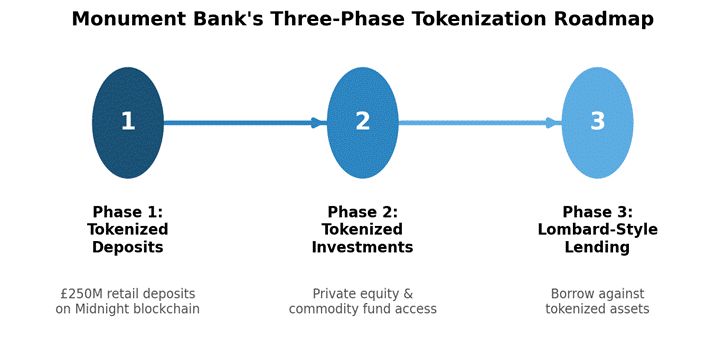
Figure 1: Monument Bank’s phased tokenization roadmap on Midnight.
Why Midnight? Privacy as the Missing Link for Banking
For years, data privacy has been a key barrier to blockchain use in banking. However, Midnight solves this problem with zero-knowledge proofs. As a result, only the bank and its customers can see the data for each deal. In short, the system runs on a public chain but still meets strict privacy rules.
Midnight was built by
Market Context: RWA Token Growth Surges
This deal comes at a time of rapid growth in real-world asset (RWA) tokenization. Indeed, the global RWA market grew by 380% over three years, reaching $30 billion by mid-2025. Furthermore, Boston Consulting Group thinks this sector could reach $16 trillion by 2030. Similarly, Standard Chartered sees an even bigger $30 trillion market by 2034.
Meanwhile, major firms are moving fast in the token space. For example, BlackRock’s BUIDL fund now holds $2.9 billion in token-based assets. On top of that, the SEC gave Nasdaq the green light to support token trading. Likewise, Goldman Sachs and BNY Mellon have rolled out token-based money-market funds.
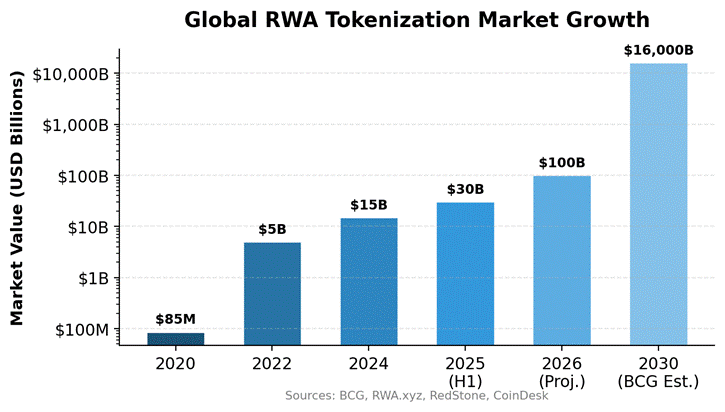
Figure 2: RWA token market growth path, 2020–2030 (log scale).
What This Means for Cardano and ADA
As of late March 2026, ADA trades near $0.27. At the same time, Cardano’s market cap sits at roughly $9.5 billion. Because of this deal, the Cardano system could see a big rise in TVL. This matters most since ADA is down 71% from its September peak.
In addition, Monument Technology plans to offer its token-deposit tools to other banks through a service platform. If other firms adopt this model, it could greatly widen Midnight’s reach. Consequently, the deal places Cardano’s system as a strong player in big-league blockchain finance.
The Bottom Line
Overall, Monument’s move links regulated banking with public blockchain systems. Keeping FSCS cover and Bank of England checks reduces risk for users. Besides that, the three-phase rollout shows this is more than a one-off test. Ultimately, this UK-first step could pave the way for other banks around the world to follow suit.