March 16, 2026 – Ex-Petronas executive builds blockchain-based crude oil token on Arbitrum, joining the $36 billion RWA wave amid surging institutional interest.
| KEY TAKEAWAYS • Each LITRO token represents one litre of audited physical crude oil. • Testnet launches March–May 2026; full debut planned for January 2027. • Each • Built on Ethereum’s Arbitrum L2, compatible with all EVM chains. • The broader RWA tokenisation market has surpassed $36 billion. |
Globally, crude oil trading generates roughly $6 trillion each year. Despite this scale, its infrastructure remains largely paper-based and slow. As a result, a new blockchain venture called LITRO aims to modernise how oil changes hands. Specifically, it plans to tokenise on-chain physical crude oil reserves. In practice, each token will represent exactly one litre of verified crude.
Baron Lamarre, a former head of trading at Malaysian state oil giant Petronas, co-founded this initiative. Currently, he leads the International Digital Exchange (INDEX), which serves as the platform behind LITRO. According to Lamarre, the testnet and product demo will roll out between March and May 2026. Furthermore, an official launch is targeted for January 2027.
How the Tokenization Works
First, oil producers pledge certified reserves to the INDEX platform. Next, independent auditors verify quantity, authenticity, and ownership. Only after this verification are LITRO tokens minted on a strict 1:1 basis. Meanwhile, physical crude stays at the producer’s facility. Instead, legal title transfers digitally to the INDEX system.
Notably, LITRO’s value is indexed to Brent and West Texas Intermediate benchmarks. As a result, token holders can redeem for cash at any time. In addition, physical crude delivery will eventually be available. For this purpose, the platform uses AI-driven logistics, IoT sensors, and vessel tracking.
Technically, the project is built on Arbitrum, an Ethereum Layer 2 scaling solution. Moreover, it maintains compatibility with any EVM-compatible blockchain. Because of this design, 24/7 liquidity is possible, unlike on traditional exchanges. Consequently, settlement occurs in minutes rather than days.
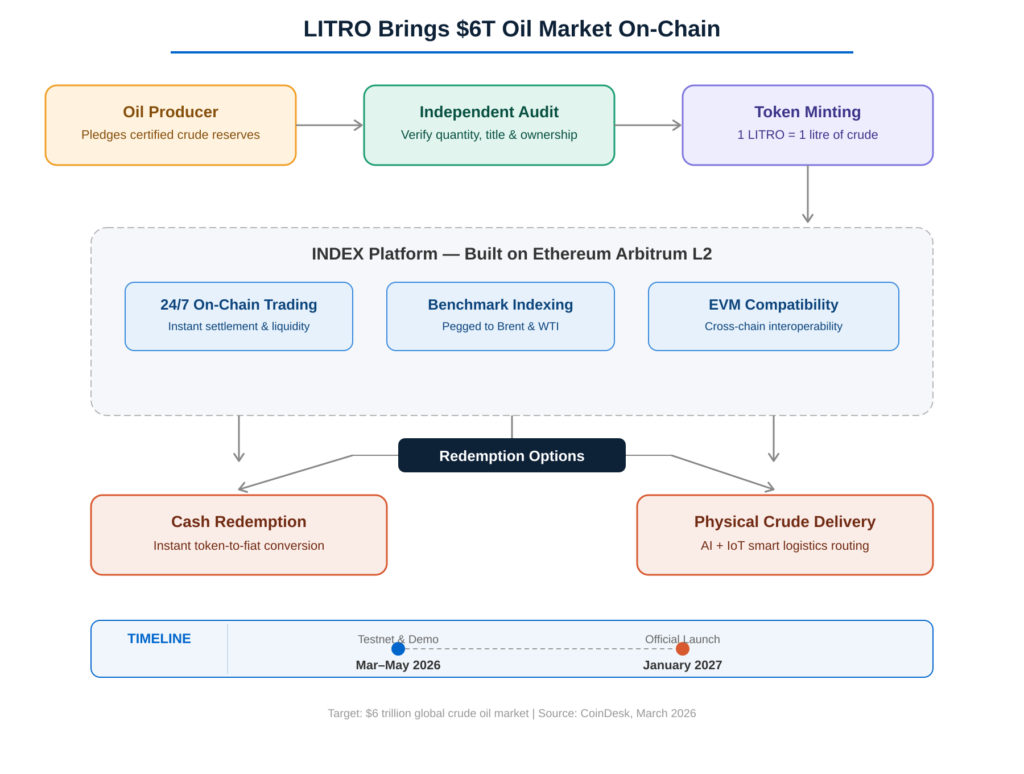
Figure 1: LITRO tokenisation process from crude reserves to on-chain trading and redemption.
Riding the RWA Wave
With this approach, LITRO enters a fast-growing market. According to research from Canton Network, the tokenised real-world asset (RWA) sector exceeded $36 billion by late 2025. That figure marks over 2,200% growth since 2020. Similarly, Ripple and Boston Consulting Group project the market will reach $18.9 trillion by 2033.
However, most RWA activity is concentrated in financial instruments. For example, tokenised U.S. Treasuries alone account for roughly $8.7 billion. Additionally, private credit dominates at nearly $17 billion. In contrast, physical commodities like oil remain largely untapped on-chain. This gap is precisely what LITRO targets.
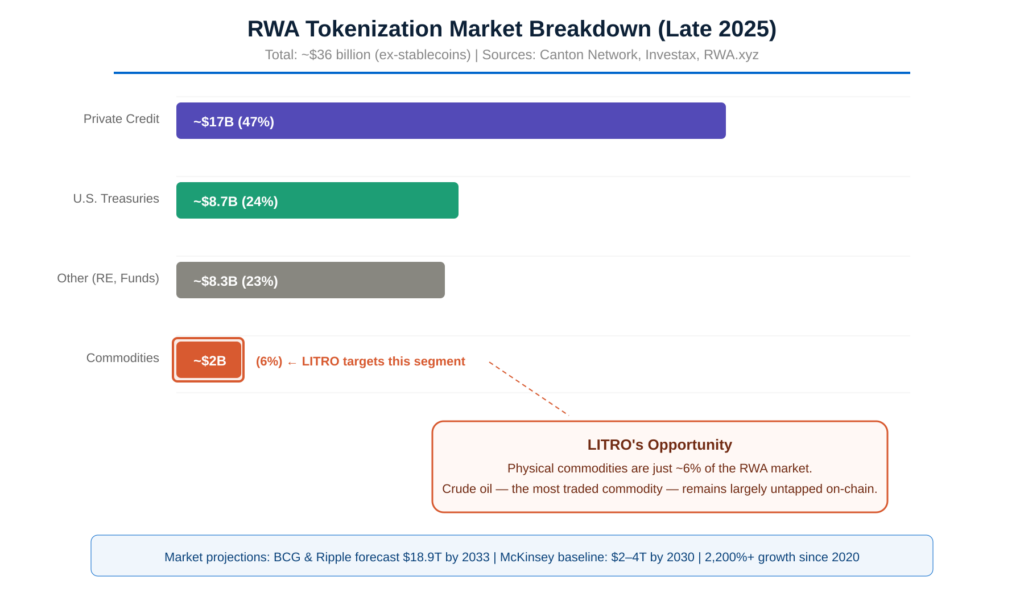
Figure 2: RWA market composition, commodities remain the smallest segment, presenting LITRO’s opportunity.
RWA Market Data Summary (Late 2025)
| Asset Class | Market Size | Share |
| Private Credit | ~$17B | ~47% |
| U.S. Treasuries | ~$8.7B | ~24% |
| Commodities (Gold, etc.) | ~$2B | ~6% |
| Other (Real Estate, Funds) | ~$8.3B | ~23% |
Sources: Canton Network, Investax Q3 2025 RWA Report, RWA.xyz
Challenges Ahead
Of course, tokenising physical oil carries unique risks. For instance, custody verification is far more complex than with bonds. Likewise, cross-chain interoperability gaps could limit liquidity. On top of that, regulatory frameworks for tokenised commodities remain fragmented globally. Furthermore, academic research warns that most RWA tokens suffer from low secondary-market trading volumes.
Nevertheless, institutional momentum is strong. Notably, BlackRock, Goldman Sachs, and BNY Mellon are all exploring tokenised products. At the same time, war-driven oil price spikes above $100 per barrel have renewed interest in alternative trading venues. Therefore, LITRO could benefit from this convergence of commodity volatility and blockchain innovation.
The Bottom Line
Ultimately, LITRO represents a bold experiment at the crossroads of energy and crypto. If its January 2027 launch succeeds, it would become one of the first tokenised crude oil products with physical redemption capability. Without a doubt, the $6 trillion oil market is watching closely.
SOURCES & REFERENCES
• CoinDesk- “Meet LITRO: The Tokenized Crude Project to Start Pilot Testing Soon for 2027 Debut” (March 12, 2026)
• Canton Network-“State of RWA Tokenization 2026” (December 2025)
• Investax-“Q3 2025 Real World Asset Tokenization Market Report” (September 2025)
• RWA.xyz- On-chain RWA dashboard (accessed March 2026)
• Ripple & BCG-Tokenized asset market projection of $18.9T by 2033
• KuCoin Research – “RWA Crypto Growth 2026” (January 2026)
• FINTECH.TV – “Tokenized Crude Oil Startup LITRO Eyes 2027 Launch” (March 2026)