
March 18, 2026 – Fortis and Emera lead a sector rotation as investors flee volatility in favor of stable dividends and AI-driven growth.
KEY TAKEAWAYS
• The S&P 500 Utilities sector rose 10% in February 2026, outpacing all other sectors.
• Fortis (TSX: FTS) holds a 53-year consecutive dividend streak, yielding 3.2%.
• Emera (TSX: EMA) posted 23% trailing 12-month returns with a $20B capital plan.
• AI-driven data center demand could triple the electricity consumption share by 2028.
Utilities Stage a Comeback
Utility stocks are no longer the sleepy corner of the market. Instead, they have become the go-to defensive play in 2026. Notably, the S&P 500 Utilities sector surged 10% in February alone. As a result, it became the top-performing sector for the month. Meanwhile, Technology, Financials, and Consumer Discretionary all fell 4%.
This reversal is particularly striking. In 2023, utilities were the weakest S&P 500 sector. Earnings declined 15% that year, according to S&P Dow Jones Indices. However, the sector rebounded sharply in 2024, with a 23.4% return. Furthermore, year-to-date 2025 gains of 20.25% outpaced the broader index by 493 basis points. Analysts at State Street Global Advisors consequently called it a shift from “defensive to dynamic.”
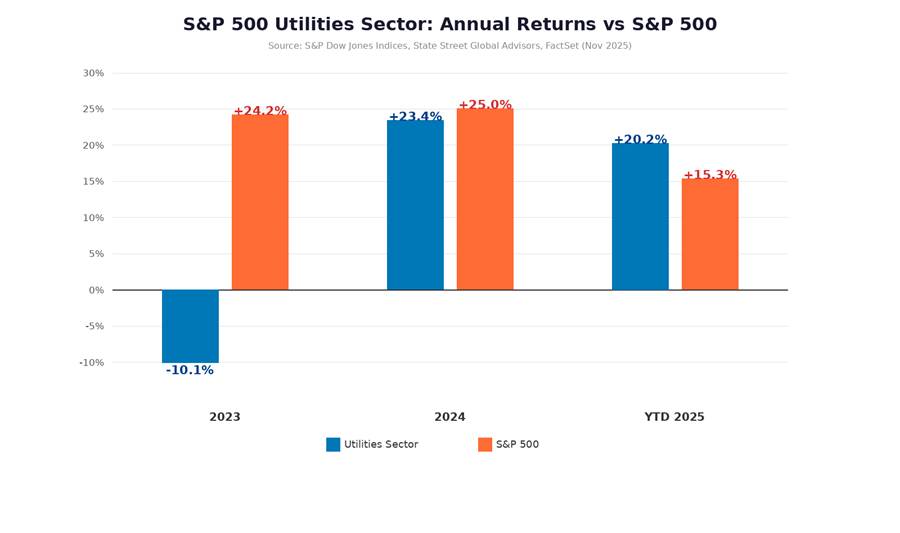
Figure 1: S&P 500 Utilities sector performance vs broader index (2023–2025). Source: FactSet, S&P Dow Jones Indices.
What Is Driving the Utility Sector Rally?
Three forces are converging to boost utility stocks. First, interest rate stabilization is reducing borrowing costs. Specifically, the Federal Reserve held rates at 4.25–4.50% in early 2026. In addition, markets expect at least two 25-basis-point cuts this year. Because of this, capital-intensive utilities stand to benefit directly.
Second, AI-driven electricity demand is surging rapidly. For instance, the EIA raised its 2025 U.S. power demand forecast by about 1%. Moreover, commercial electricity use could rise 5% in 2026. Data centers’ share of total consumption may consequently triple by 2028. That shift alone could require over 50 GW of new capacity. Similarly, Gabelli Research estimates roughly 50 GW of data center demand by 2030.
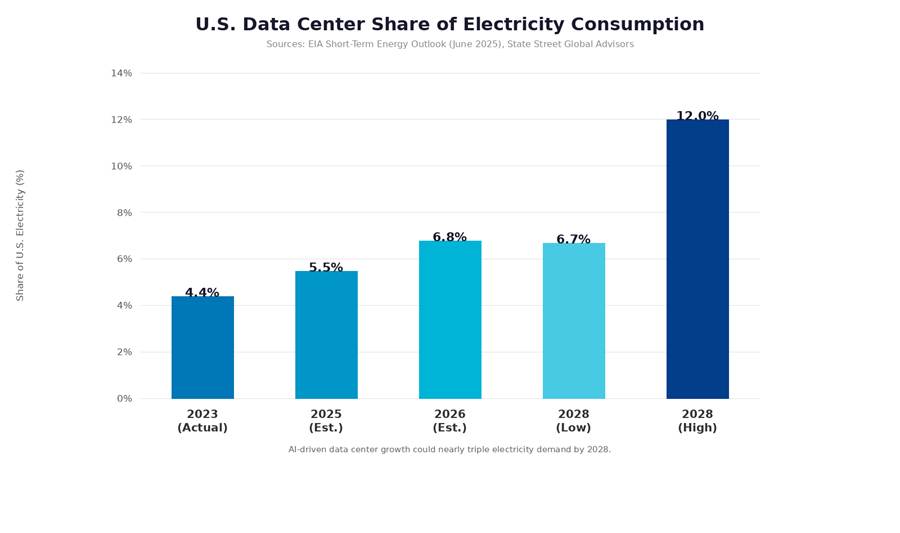
Figure 2: Data centers’ growing share of U.S. electricity consumption. Source: EIA, State Street Global Advisors.
Third, rising market volatility is pushing investors toward safety. Commodity prices, for example, have swung sharply amid geopolitical tensions. In contrast, utilities offer regulated revenue streams and predictable cash flows. Therefore, the sector’s low beta makes it a natural hedge against uncertainty.
Two Canadian Utilities Leading the Charge
Fortis (TSX: FTS) is North America’s most consistent utility. Specifically, it operates 10 regulated utilities across Canada, the U.S., and the Caribbean. With a dividend streak spanning 53 consecutive years, Fortis qualifies as a Dividend King. Currently, the yield sits at approximately 3.2%. In addition, Fortis has earmarked over C$28 billion for infrastructure modernization.
Emera (TSX: EMA) offers a higher-growth profile by comparison. In November 2025, the company unveiled a C$20 billion capital plan. Approximately 80% of that spending targets Florida operations. As a result, the plan supports a 7–8% rate base growth through 2030. Additionally, Emera’s Q3 2025 adjusted earnings per share rose 9%. Over the trailing 12 months, its stock return reached approximately 23%.
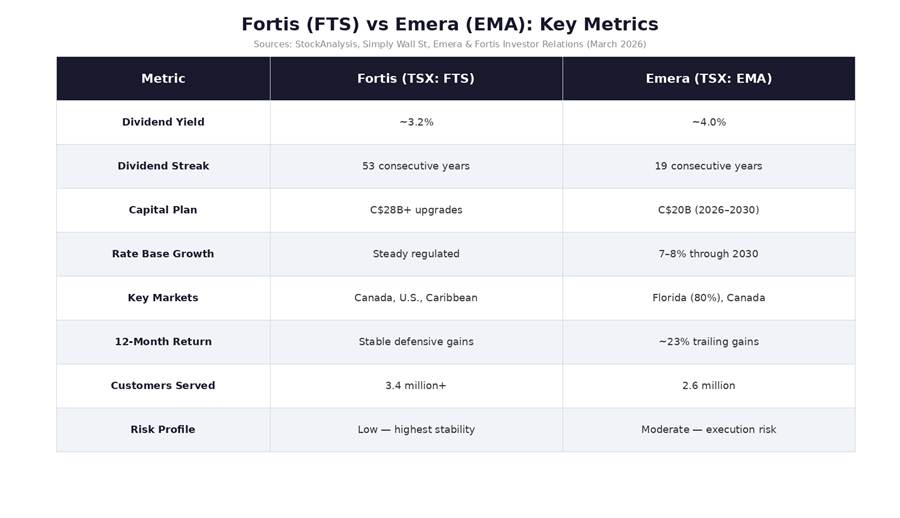
Figure 3: Key metrics comparison of Fortis vs Emera. Source: StockAnalysis, Simply Wall St, company filings.
Valuation and Risks
Currently, the S&P 500 Utilities sector trades at a forward P/E of 21.2x. Although this sits above the 10-year average of 18.9x, it remains below the broader S&P 500’s 21.7x multiple. Furthermore, consensus estimates project median sector EPS growth above 7% annually through 2027. Accordingly, S&P Global projects utility capital expenditures will reach $227.8 billion in 2026–2027.
However, risks remain significant. For instance, Bank of America downgraded Emera in January 2026 on valuation concerns. Execution risk around large capital plans could also pressure returns. In addition, wildfire liability, as seen in California, adds regulatory uncertainty. Affordability concerns over rising utility bills likewise pose political risk.
The Bottom Line
Overall, the utility sector is experiencing a structural transformation. AI demand, rate stabilization, and defensive rotation are all driving renewed interest. Consequently, Fortis and Emera represent two distinct approaches to the same opportunity. For investors seeking income and resilience, this once-boring sector therefore deserves serious attention.
SOURCES & REFERENCES
1. S&P Dow Jones Indices – U.S. Sector Dashboard (Feb 2026)
2. State Street Global Advisors – “From Defensive to Dynamic: Utilities Enter a New Era” (Nov 2025)
3. Emera Inc. Investor Relations – Q3 2025 Earnings & $20B Capital Plan (Nov 2025)
4. Fortis Inc. Investor Relations – Annual Reports & Dividend History
5. EIA Short-Term Energy Outlook (June 2025)
6. Gabelli Research – “Utilities U.S.: Powering the Future” (Jan 2026)
7. Simply Wall St – Fortis (FTS) Dividend Analysis (Feb 2026)
8. StockAnalysis.com – FTS and EMA Dividend Data (March 2026)
9. Seeking Alpha – “Emera: Decent Returns, But The Risk For 2026 Is Now Higher” (Feb 2026)
10. The Motley Fool Canada – “Why Boring Utility Stocks Are Suddenly Looking Very Attractive” (Mar 2026)