
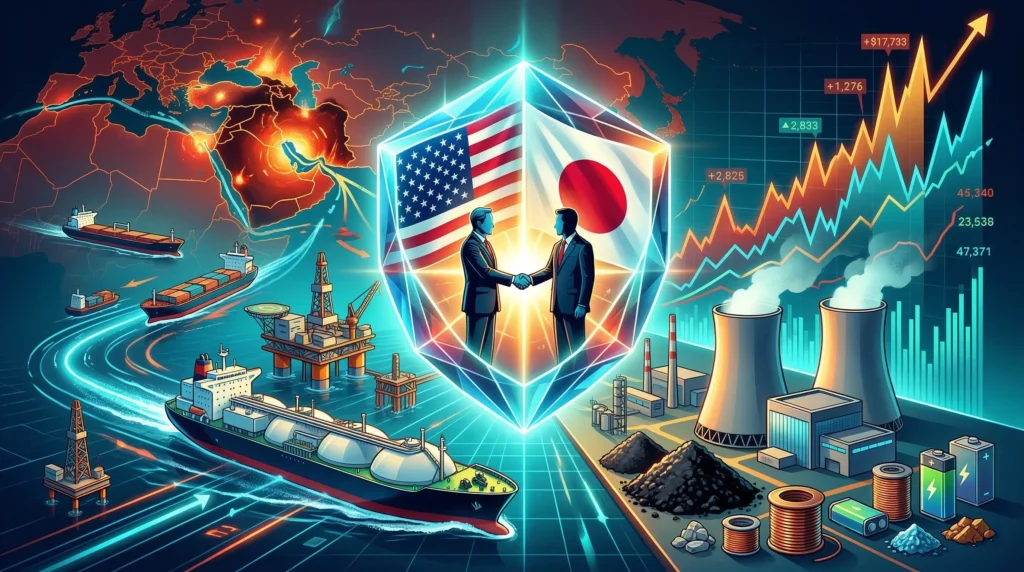
March 15, 2026 – Tokyo forum unveils roughly 20 agreements spanning LNG, coal, nuclear, and critical minerals amid Qatar supply disruption
The United States and Japan unveiled at least $30 billion in energy agreements this weekend. The deals emerged from the inaugural Indo-Pacific Energy Security Ministerial in Tokyo. Roughly 20 transactions cover LNG, coal, nuclear power, critical minerals, and batteries, according to a White House official.
The forum was co-hosted by Japan’s Ministry of Economy, Trade, and Industry and the U.S. National Energy Dominance Council. U.S. Interior Secretary Doug Burgum and Energy Secretary Chris Wright joined ministers from over a dozen nations. The event sets the stage for Prime Minister Takaichi’s White House visit on March 19.
Gulf Crisis Drives Urgency
Qatar’s LNG production shutdown on March 2 looms over the negotiations. Iranian drone strikes forced QatarEnergy to halt operations at Ras Laffan, the world’s largest LNG export facility. The suspension removed roughly 20% of global LNG supply overnight. European benchmark gas prices surged by more than 50% within hours. Asian spot LNG prices jumped nearly 39%.
Morgan Stanley warns that disruptions lasting beyond one month could erase the projected 6-million-ton LNG surplus for 2026. The global LNG market handles approximately 420 million tons annually. Goldman Sachs estimates prolonged Qatari outages could push European gas prices up by 130%.
Inside the $550 Billion Framework
This weekend’s agreements build on a broader $550 billion trade framework signed in mid-2025. Japan has already committed $36 billion in first-tranche investments. The centerpiece is a $33 billion natural gas power plant in Ohio. Operated by SoftBank subsidiary SB Energy, the facility will generate 9.2 gigawatts. A $2.1 billion deepwater crude oil terminal in Texas and a $600 million synthetic diamond plant in Georgia complete the initial slate.
Nuclear power could follow. Reuters reported Westinghouse is in discussions to build reactors under the bilateral framework. Pressurized water reactors and small modular reactors valued at up to $100 billion are under consideration. A proposed copper smelting facility may also be finalized during the Washington visit.
Strategic Implications for LNG Markets
The United States is already the world’s largest LNG exporter. U.S. exports rose 17% last month, per LSEG data. Venture Global’s contract to supply 1.5 million tons annually to Hanwha was among the deals discussed. The agreements position American producers to capture market share during the Qatari disruption.
Japan’s trade minister Ryosei Akazawa noted that only 1–2% of the $550 billion involves direct cash. The rest is structured through loans and guarantees. The Nomura Research Institute has called the arrangement “unequal,” questioning whether the projects serve Japan’s economic security interests.
Still, both governments see the partnership as critical. The Strait of Hormuz remains closed to commercial LNG traffic. Asian buyers face potential supply shortfalls. Diversifying away from vulnerable suppliers has become urgent across the Indo-Pacific.