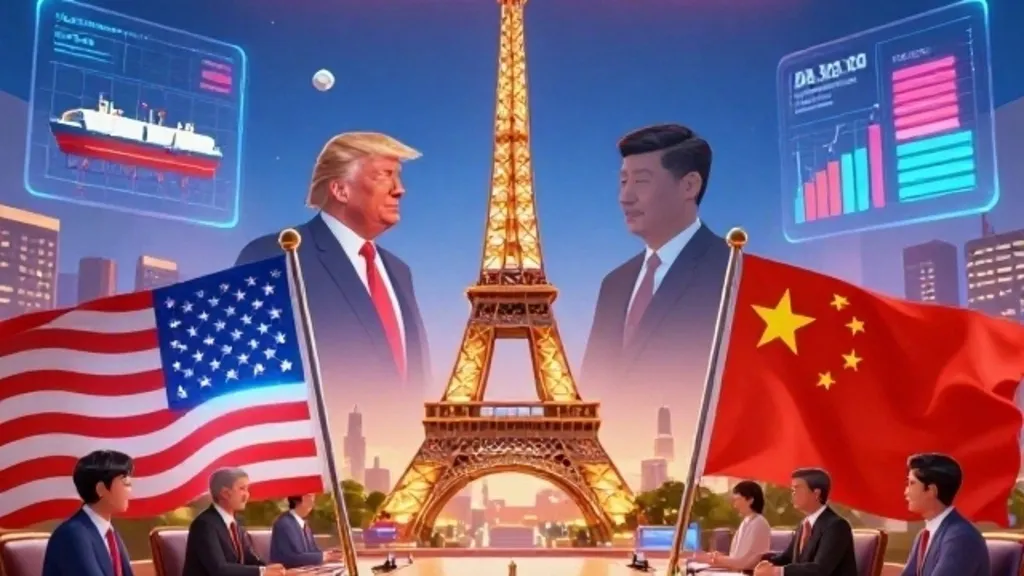
Catenaa, Sunday, March15,2026- Senior US and Chinese economic officials opened two days of trade talks in Paris on Sunday, seeking progress before a planned summit between Donald Trump and Xi Jinping later this month in Beijing.
US Treasury Secretary Scott Bessent met Chinese Vice Premier He Lifeng at the headquarters of the Organisation for Economic Co-operation and Development. US Trade Representative Jamieson Greer joined the meetings, which focus on tariffs, export controls, rare earth supplies and agricultural trade.
Officials also reviewed commitments made under the Busan trade truce reached in October 2025. The deal paused a tariff escalation after duties on bilateral goods rose sharply earlier that year.
China met its initial soybean purchase target of about 12 million metric tons for the 2025 marketing year. Officials also signaled plans to import roughly 25 million tons in 2026.
Trade flows between the two largest economies reached about $690 billion annually before tensions rose in recent years. Washington recorded a goods trade deficit of about $279 billion with Beijing in 2025.
Rare earth supply chains remain a central issue in the Paris discussions. Chinese exports of several minerals resumed after the Busan truce, yet shortages persist for US aerospace and semiconductor manufacturers.
US industry groups say imports of yttrium oxide dropped more than 60 percent since early 2025. The material is used in heat resistant coatings for jet engines and military aircraft including the F-35 Lightning II.
Neodymium magnet supply also tightened, disrupting production lines for electric vehicle motors and advanced electronics. China controls about 87 percent of global processing capacity for those materials.
US officials are also pressing Beijing to expand purchases of energy products. A framework under discussion targets annual imports of roughly 15 million tons of US liquefied natural gas.
Agriculture remains a central bargaining area. American soybean shipments to China climbed to about 28 million tons last year after a slump during earlier tariff disputes.
Trade tensions escalated again this month after the United States launched new investigations into Chinese industrial capacity. The probe began under Section 301 trade law and includes reviews with about 15 partner economies.
The investigation could lead to tariffs ranging from 25 percent to 60 percent within a year. Chinese officials warned that countermeasures remain possible if new duties are imposed.
Energy security and the conflict involving Iran also loom over the Paris meetings. Disruption risks around the Strait of Hormuz threaten major oil shipments heading toward Asia.
China imports about 12 million barrels of oil per day, with roughly 45 percent moving through the narrow waterway. Oil prices have climbed sharply since US strikes on Iran’s Kharg Island earlier this month.
The Trump administration granted a temporary waiver on sanctions involving some Russian oil shipments to stabilize tanker traffic. Analysts say the step eased pressure on global energy markets.
Washington also asked allies to increase patrols along shipping lanes that carry about one fifth of global crude supplies.
Market reactions remain cautious while officials negotiate. Soybean futures held steady in early trading, while rare earth oxide prices climbed about 12 percent during the past week.
Shares of Boeing gained modestly on expectations that aircraft orders could appear in future trade arrangements with China.
Policy analysts expect limited results from the Paris talks because of the tight schedule before the Trump-Xi summit.
Research groups including the Center for Strategic and International Studies say negotiators may focus on avoiding new tariff clashes rather than reaching major agreements.
Experts at the Hudson Institute and Fudan University describe the meeting as groundwork for later negotiations.
Future venues could include the Asia-Pacific Economic Cooperation summit in Peru and the Group of Twenty meeting in Washington later this year.
The Busan truce expires in October 2026 unless both sides extend it. Officials say the next several months will determine whether trade tensions ease or return.