
March 16, 2026 – The International Energy Agency (IEA) confirmed on Sunday that emergency oil reserves will flow to Asia and Oceania immediately. The move responds to the largest supply disruption in global oil market history. Buyers across Asia are racing to replace barrels lost to the Middle East conflict.
Record 400 Million Barrel Release
IEA member countries agreed on March 11 to release 400 million barrels from emergency reserves. This marks the largest stockpile drawdown in the agency’s 52-year history. Of this total, 271.7 million barrels come from government-managed stocks.
The U.S. is leading with 172 million barrels from its Strategic Petroleum Reserve. That accounts for 43% of the IEA total. Japan, Germany, and Austria have also confirmed participation. Europe and the Americas will receive barrels from the end of March.

Figure 1: IEA stockpile release composition. Source: IEA, CNBC
Why Asia Gets Priority
Asia’s heavy reliance on Middle Eastern crude makes it the most exposed region. The Strait of Hormuz carries roughly 20% of the global oil supply. Since the conflict began on February 28, export volumes through the strait have crashed to below 10% of pre-war levels. Gulf producers have already cut output by at least 10 million barrels per day.
Oil Prices Remain Above $100
Despite the historic release, oil markets show little relief. Brent crude closed at $103.14 per barrel on Friday. Prices have surged by more than 17% since the March 11 announcement. Before the war, Brent traded below $70.
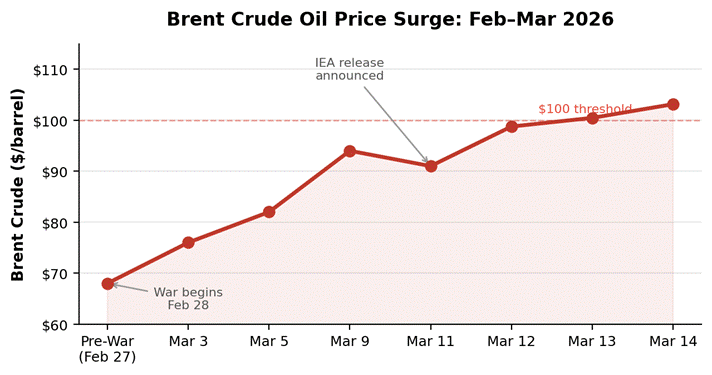
Figure 2: Brent crude price surge since the outbreak of conflict. Source: IEA, Fortune, CNBC
Bernstein analysts noted the U.S. daily release rate covers only 15% of the lost supply. Rystad Energy forecasts Brent could hit $135 per barrel by June if the war lasts four months. The IEA’s March Oil Market Report projects global supply will drop 8 million barrels per day this month.
Stockpile Depletion Risks
The 400 million barrels equal 33% of the 1.2 billion held in IEA member reserves. The U.S. portion alone accounts for 41% of the Strategic Petroleum Reserve. Energy Secretary Chris Wright pledged to replace the released volumes within a year.
Tobin Marcus of Wolfe Research warned that stockpiles alone will not resolve the crisis. Reopening the Strait of Hormuz remains essential. This is the sixth emergency collective action in IEA history, following interventions in 1991, 2005, 2011, and twice in 2022.
Sources
1. IEA, “Update on IEA Collective Action Decision of 11 March 2026,” iea.org, March 15, 2026.
2. IEA, “IEA Member Countries to Carry Out Largest Ever Oil Stock Release,” iea.org, March 11, 2026.
3. IEA, “Oil Market Report – March 2026,” iea.org, March 12, 2026.
4. CNBC, “The Biggest Release of Emergency Oil Stockpiles in History,” cnbc.com, March 14, 2026.
5. CNBC, “Oil Closes Above $100 for Second Day,” cnbc.com, March 13, 2026.
6. U.S. Energy Information Administration, “Short-Term Energy Outlook,” eia.gov, March 2026.