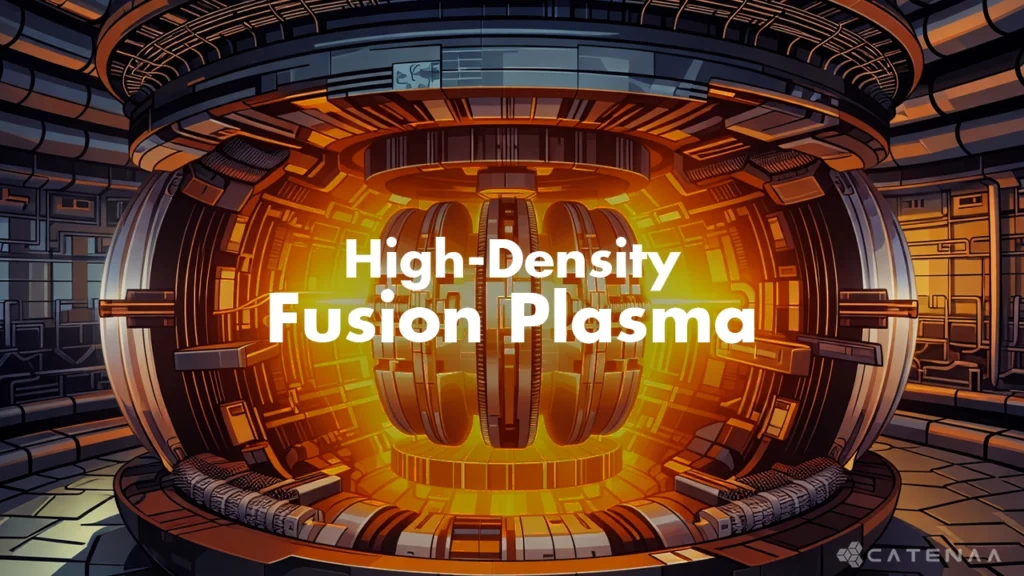
Catenaa, Wednesday, January 07, 2026- China’s EAST tokamak has reached a “density-free regime,” sustaining stable fusion plasma at densities far above traditional limits, moving closer to ignition.
The achievement, published in Science Advances, confirms a theoretical approach known as plasma-wall self-organization (PWSO), which predicts stable operation when plasma and reactor walls balance interactions.
Researchers from Huazhong University of Science and Technology and the Hefei Institutes of Physical Science applied a high-density operating strategy, controlling initial fuel pressure and electron cyclotron resonance heating during startup.
This careful early-stage control reduced impurities and energy losses, enabling plasma density to rise steadily without triggering disruptive instabilities that usually limit tokamak performance.
Fusion output depends on plasma density, increasing with the square of density at 13 keV (150 million kelvin), making high-density operation critical for achieving practical energy yields.
EAST’s results mark the first experimental confirmation of the PWSO theory, demonstrating that tokamaks can exceed long-standing empirical density barriers while maintaining stability.
Prof. Ping Zhu noted that this method offers a practical pathway to extend density limits in current and next-generation fusion reactors.
Associate Prof. Ning Yan said the team plans to apply the technique during high-confinement operations to push the density-free regime under even higher performance plasma conditions.
The breakthrough suggests a scalable approach to increasing fusion power output safely and efficiently, addressing a persistent obstacle in the pursuit of clean, reliable energy from nuclear fusion.
Analysts say the results could accelerate the timeline for practical fusion energy and inform designs for future burning plasma devices.