
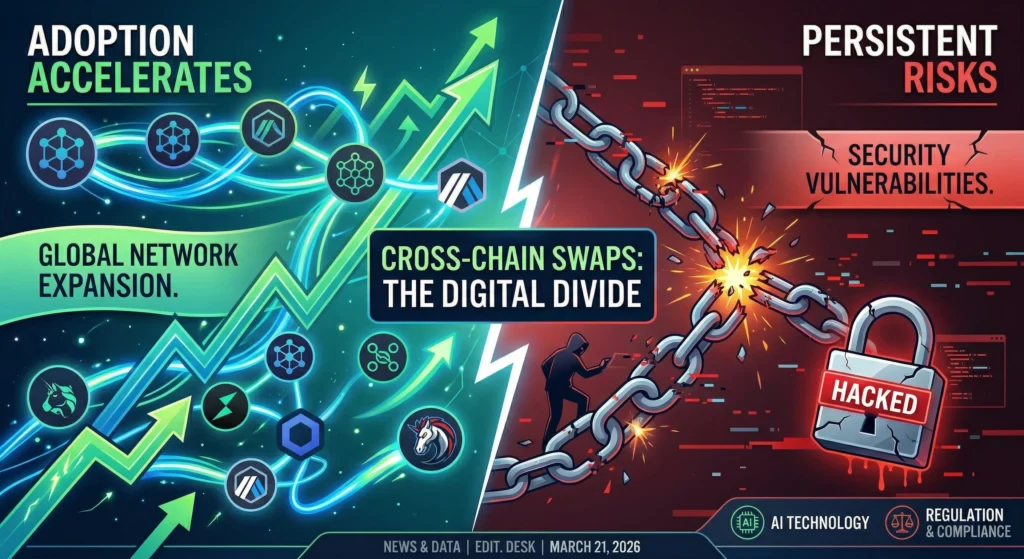
March 23, 2026 – Bridge hacks have cost $2.8 billion since 2022, yet adoption continues to accelerate. Here’s what the data reveals about the sector’s rapid growth and persistent security risks.
In Summary
Cross-chain transaction volume reached $56.1 billion in July 2025, with TVL growing 35.5% in Q2.
Bridge-related hacks have cost more than $2.8 billion since 2022, accounting for 40% of all Web3 exploits.
Coinbase chose Chainlink CCIP as its sole bridge for $7 billion in wrapped tokens.
Symbiosis processed $7 billion in volume across 60+ networks and 780,000 wallets.
EU MiCA regulation will require full bridge operator licensing by July 2026.
Cross-chain swap platforms are reshaping decentralised finance. Transaction volumes hit $56.1 billion in July 2025, according to CoinGape. Total value locked grew 35.5% in Q2 2025. This surge reflects a broader shift toward multi-chain DeFi ecosystems. Ethereum L2 expansion and institutional adoption are key growth drivers.
DEX volume jumped 25.3% in Q2 2025 alone. Yet this rapid adoption carries real trade-offs. Choosing the right platform now demands careful evaluation of security, fees, and compliance posture.
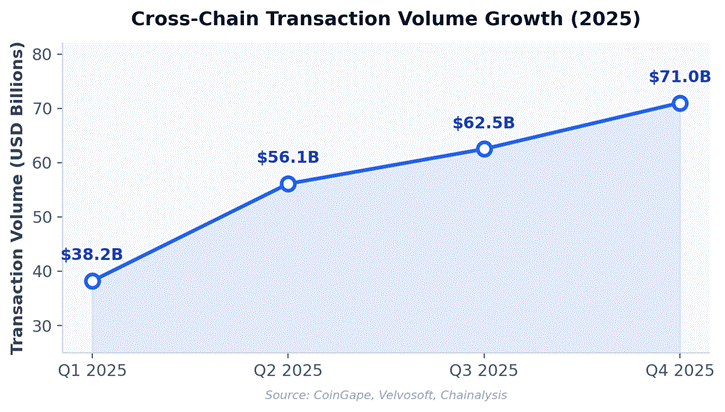
Figure 1: Cross-chain transaction volume surged throughout 2025.
Security Risks Remain a Critical Challenge
The sector faces serious security threats. Cross-chain bridge hacks have exceeded $2.8 billion since 2022, per Chainlink and DefiLlama. That figure represents nearly 40% of all Web3 hacks. Smart contract bugs and private key compromises remain the top attack vectors.
The trend worsened in 2025. Chainalysis reported $3.4 billion stolen across the crypto sector for the full year. The ByBit breach alone accounted for $1.5 billion. Private key compromises drove 88% of stolen funds in Q1 2025. These incidents highlight a widening gap between adoption speed and security readiness.
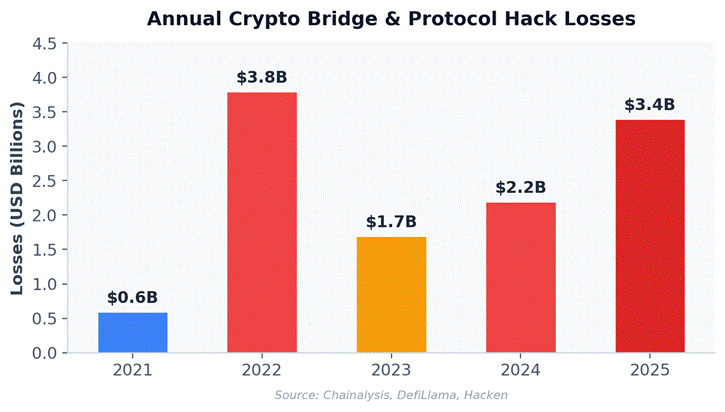
Figure 2: Crypto hack losses rebounded sharply in 2024–2025 after a brief dip.
Platform-by-Platform Analysis
Uniswap: Deep Liquidity Across 17 Networks
Uniswap remains the dominant decentralised exchange by volume. V3 introduced concentrated liquidity, improving capital efficiency for providers. V4 reduced gas costs by up to 99% using singleton contracts. The protocol supports 17 networks, including Ethereum, Solana, and BNB Chain. Strong L2 routing makes it especially effective for high-frequency DeFi users.
THORChain: Native Swaps Without Wrapped Tokens
THORChain enables true native-asset swaps across blockchains. Users can exchange BTC, ETH, and BNB directly without wrapping. Its continuous liquidity pool model eliminates reliance on centralised bridges. The protocol requires no KYC and is fully non-custodial. This makes it a preferred tool for traders who prioritise sovereignty and certainty in cross-chain settlement.
Symbiosis: Own Execution Chain Across 60+ Networks
Symbiosis takes a hybrid approach by combining swap aggregation with its own blockchain. The SIS Chain handles cross-chain liquidity routing natively. The platform processed $7 billion in volume across 780,000 wallets. It supports 60+ networks, including non-EVM chains like Bitcoin. Its MPC-based relayer network addresses the centralisation risks that caused 69% of bridge thefts.
Chainlink CCIP: Institutional-Grade Interoperability
Coinbase selected Chainlink CCIP as its sole bridge for $7 billion in wrapped tokens, CoinDesk reported. CCIP routes messages through decentralised node sets. This replaces single- and multisig designs that have been repeatedly exploited. Chainlink already powers over 70% of DeFi applications. Its protocol is positioned as a standard for institutional-grade cross-chain transfers.
1inch: Smart Order Routing for Best Execution
1inch aggregates liquidity across fragmented pools for optimal execution. Its Fusion mode uses intent-based solvers to compete on price. The platform supports 12+ networks and is widely used across L2 ecosystems such as Arbitrum and Optimism. For traders executing large orders, 1inch reduces slippage by optimizing paths across multiple DEXs.
Quick Comparison: Leading Platforms
| Platform | Networks | Volume | KYC | Key Feature |
| Uniswap | 17+ | $1.8T+ | No | Concentrated liquidity |
| THORChain | 10+ | $80B+ | No | Native cross-chain |
| Symbiosis | 60+ | $7B+ | No | Own execution chain |
| Chainlink CCIP | 20+ | $7B* | Varies | Institutional-grade |
| 1inch | 12+ | N/A | No | Smart order routing |
*Coinbase wrapped token value secured via CCIP. Data from public sources as of March 2026.
What’s Next: AI Routing and Regulation
AI-powered routing and intent-based solvers will reshape trade execution in 2026. The EU’s MiCA regulation requires full bridge operator licensing by July 2026. In the U.S., the GENIUS Act mandates one-to-one reserves for bridge-connected stablecoins. These regulatory shifts could consolidate the market around compliant platforms.
The cross-chain sector sits at a critical inflection point. Adoption data points to sustained momentum. Yet security lapses remind the industry that speed without safety carries real cost. The platforms that balance both will define the next era of DeFi.