
March 21, 2026 – Europe’s biggest asset manager bets on blockchain rails for cash management. As a result, tokenised funds are now shifting from test projects to real-world tools.
KEY TAKEAWAYS
- Amundi, which manages €2.3 trillion, launched the SAFO tokenised fund with $100M in assets.
- Moreover, the fund runs on both Ethereum and Stellar, with Chainlink posting NAV data on-chain.
- Meanwhile, the wider tokenised RWA market has grown from $5B in 2022 to roughly $52B in Q1 2026.
- In addition, Spiko, the fund’s token platform partner, recently passed $1 billion in AUM.
The Deal
Amundi, Europe’s biggest asset manager, has made a bold move into tokenised funds. More to the point, the Paris-based firm launched the Spiko Amundi Overnight Swap Fund (SAFO) this week. As a result, the product now holds $100 million in pledged assets.
Notably, SAFO is Amundi’s second blockchain fund launch in just five months. Before this, the firm placed a money market fund share class on Ethereum in late 2025. However, this latest product focuses only on corporate cash and collateral needs.
Furthermore, the fund is managed by SPIKO SICAV, which is governed by French law. It uses fully backed total return swaps with top-tier banks. Because of this, the fund pays yields above the risk-free rate while maintaining overnight cash access.
How SAFO Works
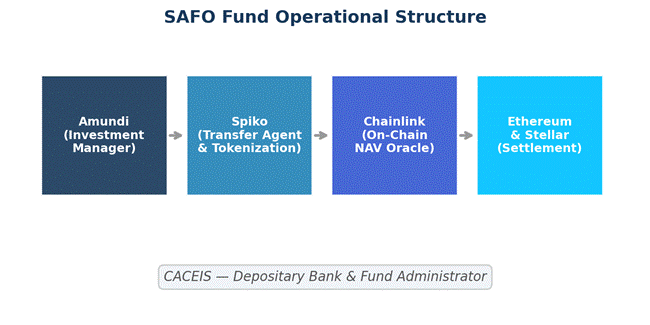
Fig 1: SAFO fund setup from investment management to blockchain settlement.
First, Amundi serves as SAFO’s lead investment manager. In addition, CACEIS, a unit of Crédit Agricole, acts as the fund’s bank and admin. Meanwhile, Spiko handles the transfer agent role, the token layer, and trades.
On top of that, the share register lives on both Ethereum and Stellar. Similarly, Chainlink provides the data feed to record SAFO’s Net Asset Value on-chain. As a result, this dual-chain setup blends Ethereum’s smart contract tools with Stellar’s low-cost, high-speed network.
Also, investors can buy in using EUR, USD, GBP, or CHF. The minimum entry is just one unit of each. Therefore, the fund offers near-instant settlement, live tracking, and round-the-clock global transfers.
Market Context: The RWA Boom
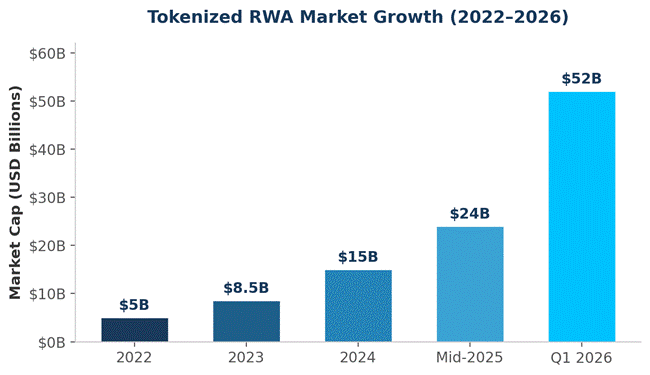
Fig 2: Tokenised real-world assets market cap, 2022–2026. Sources: RWA.xyz, The Block, RWA.io.
Clearly, the timing of SAFO’s launch matters a great deal. Tokenised real-world assets have seen rapid growth in recent months. For instance, the market rose from $15.2 billion at the start of 2025 to nearly $52 billion by mid-March 2026, based on The Block’s data.
Looking ahead, a BCG–Ripple report says the market could reach $18.9 trillion by 2033. Likewise, Standard Chartered expects it to hit $30 trillion by 2034. Together, these numbers show how strong the belief in this trend has become.
At the same time, new rules are speeding up the shift. For example, the U.S. passed the GENIUS Act in 2025. Similarly, Europe’s MiCA rules provide firms with greater legal clarity. As a result, big players now feel safe enough to move on-chain at scale.
Who’s Leading the Race
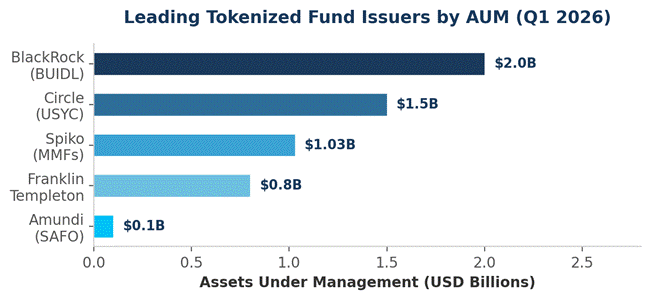
Fig 3: Top tokenised fund issuers ranked by assets under management, Q1 2026.
Currently, Amundi enters a space led mostly by U.S. firms. For instance, BlackRock’s BUIDL fund leads with over $2 billion in on-chain AUM. In the same way, Circle’s USYC and Franklin Templeton’s BENJI also hold big market shares.
Meanwhile, Spiko itself recently crossed $1.03 billion in AUM across its token products. The platform serves over 3,300 active clients. Notably, 92% of its assets come from business users. At that time, only BlackRock and Circle were larger.
However, SAFO stands out because of its treasury focus. Unlike simple money market tokens, it targets active collateral workflows. As a result, the fund’s API and smart contract access make it ready for modern digital finance.
What This Means for Markets
Above all, Amundi’s entry carries weight beyond its $100 million pledge. After all, the firm manages over €2.3 trillion in total assets. Therefore, when Europe’s biggest asset manager builds on public blockchains, it backs the whole industry.
Indeed, the wider market trend is now clear. Tokenised funds are growing from trials into real working tools. For example, features such as 24/7 settlement and cross-border transfers solve real-world daily problems for firms.
On the other hand, risks still exist. For instance, blockchain systems bring new tech and run risks. Besides, rules for tokenised assets are still being shaped across regions. Also, linking Ethereum and Stellar adds more moving parts.
In short, for big investors, SAFO offers a safe, regulated way into on-chain finance. Equally, for the token industry, it proves that Europe’s top firms are now past the test phase and into full-scale use.