

June 09, 2026 – A surprisingly strong May jobs report has reset Wall Street expectations. Goldman now sees the Fed holding firm through all of 2026.
In Summary
Goldman Sachs no longer expects any Federal Reserve rate cut during 2026.
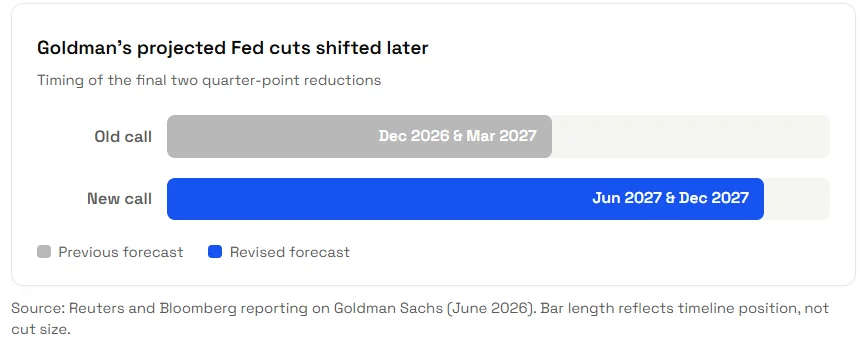
The bank now pencils its final two cuts for June and December 2027.
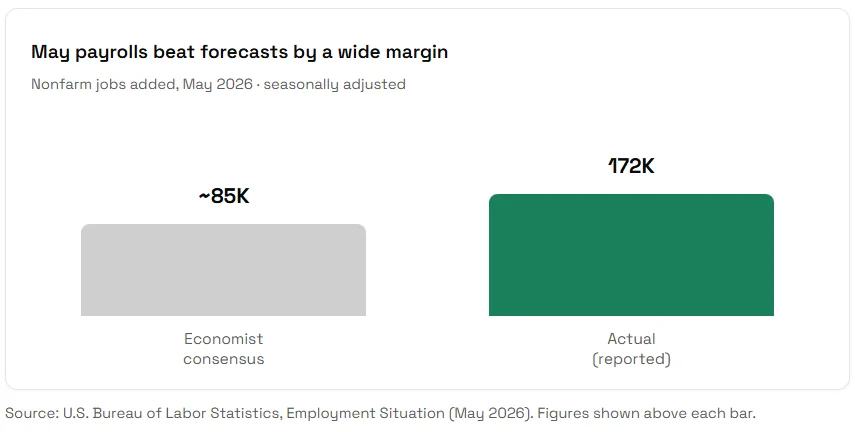
May payrolls jumped 172,000, roughly double the 85,000 consensus.
Goldman doubled its rate-hike odds to 20%, yet a hike stays off-base.
The Fed’s benchmark has held at 3.50% to 3.75% since late 2025.
Goldman Sachs has scrapped its forecast for a Federal Reserve rate cut in 2026. The Wall Street bank now expects the central bank to stay on hold all year. Moreover, it has pushed its final two projected cuts deep into 2027.
The revised call landed on Friday, according to Reuters. Previously, Goldman had penciled in quarter-point reductions for December 2026 and March 2027. Those moves now shift to June and December 2027 instead.
Why Goldman Changed Its Mind
The trigger was a far stronger labor market than economists had modeled. Chief U.S. economist David Mericle cited resilient hiring in a client note, Bloomberg reported. Consequently, the urgency for near-term easing largely evaporated.
The May employment data did most of the work. The U.S. economy added 172,000 nonfarm jobs that month, the Bureau of Labor Statistics confirmed. That figure crushed the consensus estimate of roughly 80,000 to 85,000. Furthermore, the unemployment rate held steady at 4.3% for a third straight month.
A Higher Bar for Cuts and Hikes
Strong data cuts in two directions, however. Goldman doubled its estimated odds of a modest rate hike to 20%, up from 10%. Even so, the bank stopped short of treating a hike as its base case.
The resilient activity and employment data also lower the bar for a rate hike.
-Goldman Sachs research note, via Reuters
The logic is subtle but important. A stronger economy does not signal overheating, the bank argued. Instead, a firmer starting point reduces the risk that a hike later looks like a costly error.
What Has to Happen First
Goldman set clear conditions before any easing begins. Rate cuts should wait until several pressures fade, the bank told clients. These include tariff disruptions, oil prices linked to the conflict in Iran, and what Goldman calls inflated AI demand.
In addition, core inflation must cool further. The bank wants year-over-year core PCE to approach 2% before the Fed moves. Notably, Goldman expects that gauge to stay above 3% through 2026, per Investing.com.
Conviction inside the baseline also slipped. Goldman now assigns just 30% odds to its two-cut scenario for 2027. Earlier, that probability sat at 40%, as CNBC noted in its jobs coverage.

Goldman Is Not Alone
Other forecasters have reached a similar verdict. Nomura predicted last month that the Fed would hold through all of 2026. Therefore, Goldman now joins a growing camp expecting a prolonged pause.
The Fed has kept its benchmark in the 3.50% to 3.75% range since late 2025. Back then, policymakers trimmed borrowing costs by three-quarters of a point. For now, the data gives the central bank ample room to wait.
What It Means for Markets
Higher-for-longer rates carry mixed effects. Savers and bondholders may enjoy supportive yields. Borrowers, by contrast, could face elevated costs well into next year. Markets will watch every jobs and inflation print closely.




